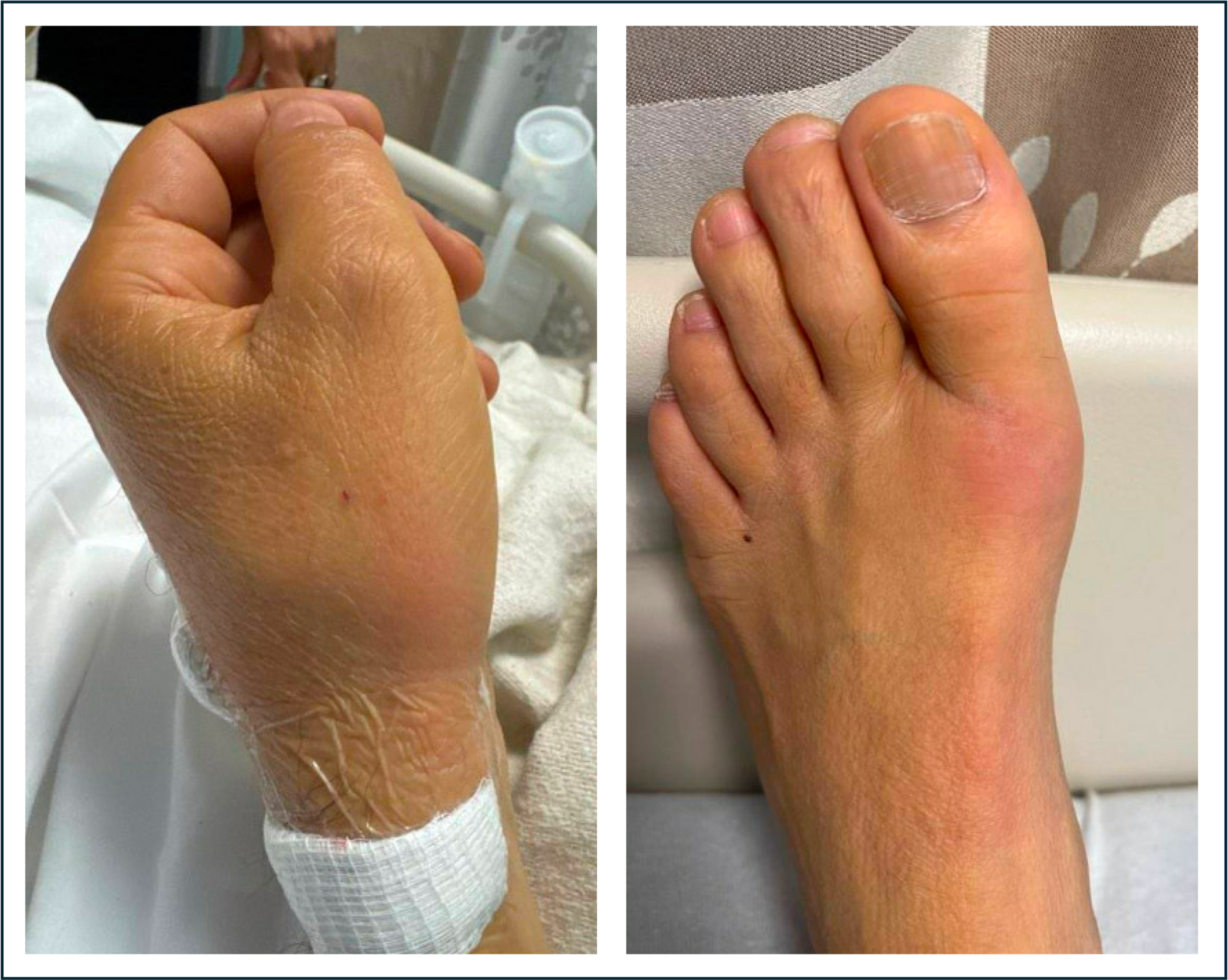
Case Presentation: A 59-year-old man with well-controlled HIV and treated hepatitis C presented with polyarthralgia and rash. He noticed that his right arm, left wrist, first toe and knee were painful and erythematous. He reported one day of nausea and vomiting but had no respiratory, urinary, or visual symptoms. He denied recent infections, travel, or exposures.On presentation, he was hemodynamically stable, afebrile, and on room air. He showed erythematous macules over the left knee, hallux, and wrist with painful range of motion (picture 1), suggestive of enthesitis. The right arm was swollen, tender, and erythematous (picture 2), compatible with cellulitis. Mucous membranes were normal. Laboratory testing demonstrated leukocytosis (15.5 K/uL, 85% neutrophils), anemia (Hb 12.6 g/dL, no evidence of hemolysis), ESR 37 mm/hr, CRP 229 mg/L, normal CPK, and negative HLA-B27. Blood cultures grew Hemophilus influenzae, and an echocardiogram showed no vegetations. Synovial fluid from the left knee showed slightly cloudy fluid with 1,150/uL cells (neutrophils 82%, macrophages 9%), without crystals, and negative Gram stain and culture. There was no evidence of sexually transmitted infection, collection, or deep venous thrombosis in the right arm.A diagnosis of H. influenzae bacteremia and cellulitis with reactive arthritis was made. He received treatment with ceftriaxone, doxycycline, and indomethacin with improvement of infection and arthralgias, and was discharged with ciprofloxacin (for a total of 14 days), NSAIDs, and follow up with Rheumatology.
Discussion: Reactive arthritis is an oligoarticular sterile arthritis from the spectrum of spondyloarthritis, that can present with sacroiliitis, enthesitis, dactylitis, and eye and skin disease [1]. It is often linked to a urogenital or gastrointestinal infection, often happening one to six weeks prior. Typical pathogens include Yersinia, Salmonella, Campylobacter, Shigella and Chlamydia. H. influenzae is not classically recognized as a cause of reactive arthritis and there are only a few case reports in the literature, especially in children or young adults, not in the age group of our patient [2,3].Our patient had leukocytosis with bacteremia and cellulitis, making septic arthritis the primary diagnosis until proven otherwise. An arthrocentesis with a washout procedure was performed to determine the etiology of the arthritis while administering systemic antibiotics and anti-inflammatory medications. In this case, the patient benefited from interdisciplinary management with Infectious Diseases, Rheumatology, and Hospital Medicine to adjust the treatment based on the dynamic presentation and results. This approach can only be done in the inpatient setting. Interestingly, reactive arthritis often presents after the infection has resolved. In our case, the patient had concomitant bacteremia, making the diagnosis challenging. Despite reporting one episode of vomiting, there was no further evidence of gastrointestinal or genitourinary infection, which suggests that the H. influenzae infection was the trigger for the reactive arthritis.
Conclusions: H. influenzae is an infrequent cause of reactive arthritis and must be recognized as an etiology. The diagnosis of reactive arthritis can be challenging when there is concern for septic arthritis, which needs to be ruled out to safely treat with anti-inflammatory medications.