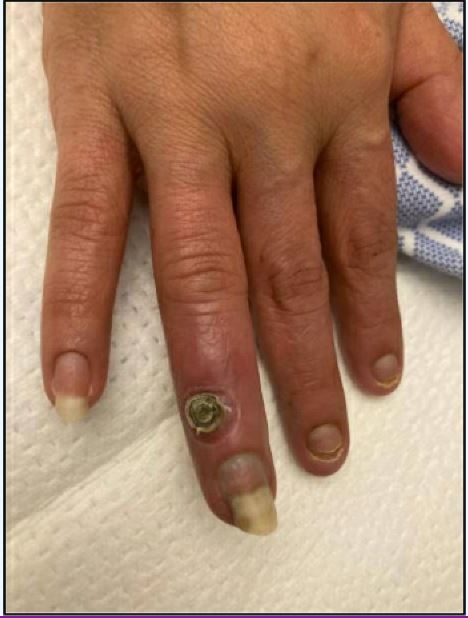
Case Presentation: A 57-year-old female with end-stage renal disease (ESRD) on hemodialysis and a history of calciphylaxis presented with a non-healing wound on her right hand. Two months prior, she developed a wound on the dorsal surface of her right fourth finger without antecedent trauma. The lesion became painful and discolored, resistant to multiple courses of oral antibiotics. Examination revealed a dry papulonodular lesion with a central keratin plug.Her AV fistula was well-functioning, and laboratory tests were within her baseline range. MRI ruled out osteomyelitis, while biopsy showed epidermal ulceration and dermal fibrosis, raising concerns about ischemia. The patient noted worsening symptoms during dialysis. An AV fistula duplex ultrasound revealed poor distal brachial artery blood flow. Manual compression of the AV fistula restored distal waveforms, confirming dialysis-associated steal syndrome (DASS). She underwent fistula plication and proximalization to enhance distal blood flow.
Discussion: DASS is a rare complication of AV fistulas, occurring in less than 2% of cases. DASS occurs when the low-resistance AV fistula diverts blood flow from the high-resistance systemic circulation, causing reduced perfusion to the extremity distal to the anastomosis. Patients present with severe pain out of proportion to exam findings and decreased warmth in the affected limb. Pain worsens with dialysis, as high blood flow rates during dialysis further shunt blood away from distal tissues. Acute DASS presents similarly to acute limb ischemia with coolness, pallor, pain, tingling and numbness in the affected extremity. Chronic DASS, as in the case of our patient, presents with ulcer, muscle/tissue atrophy, nail changes, and diminished or absent distal pulses. In severe cases, patients can develop tissue necrosis. Notably, ulceration and wounds do not follow the typical distribution of other vascular ulcers.Diagnosis is primarily clinical, based on a history of symptoms worsening with dialysis and physical examination findings showing wounds or ulcers distal to the fistula site. Doppler ultrasound of the affected extremity with and without fistula compression can help confirm the diagnosis. Relief of symptoms on fistula compression is highly suggestive of DASS, because occluding fistula flow improves distal perfusion. Other diagnostic findings include: brachial artery digit index of 0.6 or less, digital pressures below 50mmHg or a non-recordable doppler waveform. The differential also includes necrotizing infection, calciphylaxis, vascular dissection or embolism, which can be differentiated through labs and imaging. In particular, calciphylaxis can be distinguished histologically on biopsy, but generally tends to present in adipose tissues rather than distal to a fistula. Treatment typically involves surgical revision via angioplasty or ligation to restore arterial perfusion.
Conclusions: Hospitalists often care for patients on hemodialysis who present with cutaneous ulcers. The differential is broad and includes infection, calciphylaxis, inflammatory conditions, peripheral vascular disease, and trauma. DASS is an uncommon complication arising after AV fistula creation that can present as a non-healing cutaneous ulcer with associated pain that worsens during dialysis. Having a high index of suspicion and early referral to surgery can help mitigate further injury and definitively address rare vascular complications, such as DASS.