Background: Graduate Medical Education (GME) aims to provide quality education and patient care while adapting to changing healthcare systems, learner needs, and national policies. The traditional model of experiential learning is challenged by an increasing awareness of its effect on patient safety and resident fatigue. Simulation has emerged as a tool to provide deliberate practice and immediate feedback without placing patients or learners at risk. Simulation has been widely used for procedure and algorithm-based training. However, its use in internal medicine training has been limited by several issues. A body of data supports its educational utility, but there is a paucity of literature surrounding the use of simulation in internal medicine residencies, for medical decision making outside algorithms based protocols, and the impact of simulation on patient care.
Purpose: We aimed to create and study a curriculum that focuses on training residents to understand both the medical and systems knowledge required to care for patients during acute floor events.
Description: Incoming, first year, and second year residents were surveyed regarding their confidence in independent management of various scenarios. A group of clinicians reviewed the survey data and built a longitudinal curriculum of simulation cases focusing on management of urgent and emergent inpatient scenarios. Attention was paid to developing scenarios often encountered by residents, but for which they may not have adequate time for debriefing. Cases were designed with progressive levels of difficulty appropriate for level of training. A modified Delphi approach was used to develop a checklist of critical actions to be performed by residents and with which to debrief residents during each scenario. Resident confidence for various clinical scenarios as well as satisfaction with the simulation program was assessed over the course of the program.
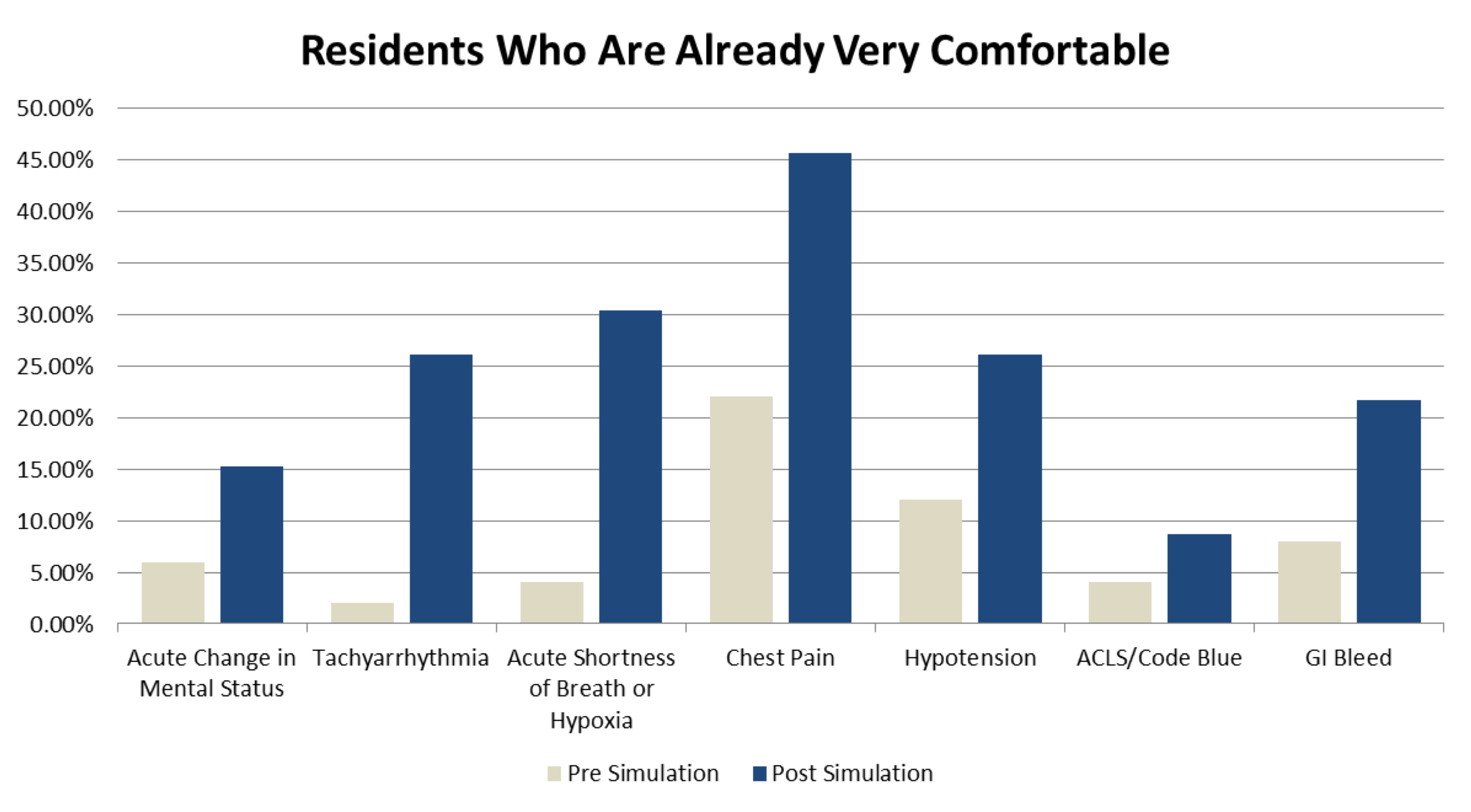
Conclusions: Prior to the start of the course, 58 residents reported that simulation was their preferred method of education. After a single simulation session, 32 residents were asked to review the course itself. 75% reported simulation helped them feel more comfortable when facing a similar situation, 84% would take the course again, and 81% would recommend it to peers. Resident confidence increased for all scenarios taught. One year into the curriculum, residents were surveyed again to determine if simulation remained their preferred method of education. The portion of current residents reporting they would like more simulation based education in their curriculum rose to over 97% of current residents. These preliminary data show that a single simulation session can improve resident confidence in critical patient care scenarios. As health systems become increasingly complex, simulation can be used as a tool to augment resident education and provide feedback. Furthermore, our data highlights residents’ perceived value of simulation based education. Based on this data, our residency program has continued to grow its simulation program, which is now in its fourth year.