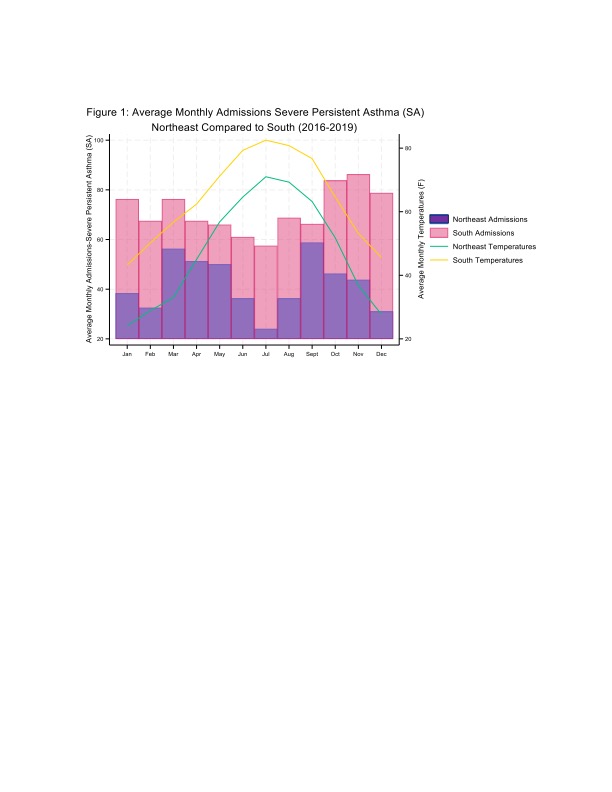
Background: Patients with acute severe asthma exacerbations that are unresponsive to standard therapy are said to be in status asthmaticus (SA). Patients with SA need hospitalization and are at risk of considerable morbidity and mortality along with high healthcare costs. Understanding regional differences in clinical outcomes and healthcare utilization among patients hospitalized with SA may provide insight into best practices in caring for this sick patient population.
Methods: Using the National Inpatient Sample database from 2016 to 2019, we compared adults hospitalized in the U.S. with SA in the Northeast with those in the South regions. We used multivariable regression analyses to determine in-hospital outcomes, focusing on mortality, length of stay, total hospital charges, and post-discharge disposition. By coupling ambient average temperature data for these regions that are contrasting in hotness, from the National Centers for Environmental Information database to hospital admissions for SA in the NIS, we explored associations and variations between the Northeast and the South.
Results: From 2016 to 2019, 5,485 patients were admitted with SA in these two regions; 2,050 (37.4%) were in the Northeast, and 3,435 (62.6%) were in the South. More admissions occurred in the coldest months. In both regions, fewer admissions occurred during the warmer months between May and September. Patients from both regions had similar age, gender distribution, and comorbidity burden (all p values >0.05). There was not a significant difference in adjusted odds of in-hospital mortality (aOR: 0.65 [0.2 to 2.1]; p = 0.48]) or length of stay (adjusted mean difference [aMD]=0.82 days; 95% CI, -0.0 to +1.6; p =0.05). However, patients from the Northeast had higher hospital charges (aMD=$20,986; 95% CI, 6,743 – 35,228; p =0.04) and lower odds of being discharged to home following their hospitalization (aOR: 0.65 [0.44 to 0.97]; p = 0.03]). Throughout all months across the four-year study period, average monthly temperatures were lower in the Northeast compared to the South.
Conclusions: This study highlights significant disparities in outcomes for patients admitted with SA between the Northeast and South from 2016 to 2019. One striking difference between these regions is ambient temperatures, which are known to influence many factors associated with breathing—both patient and environmental variables. These results should remind clinicians and health systems to be poised to offer even more diligent and attentive care to patients hospitalized with SA during colder periods.