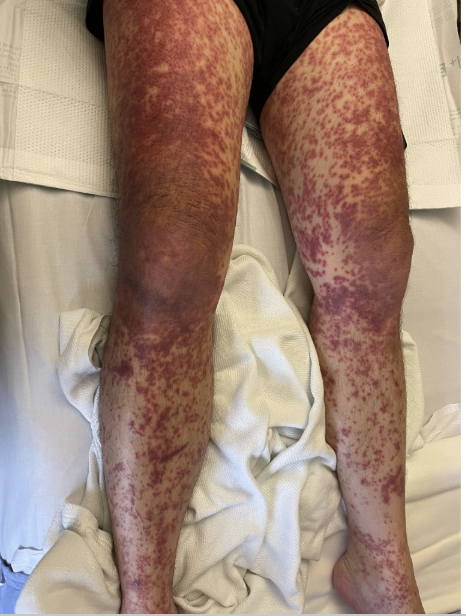
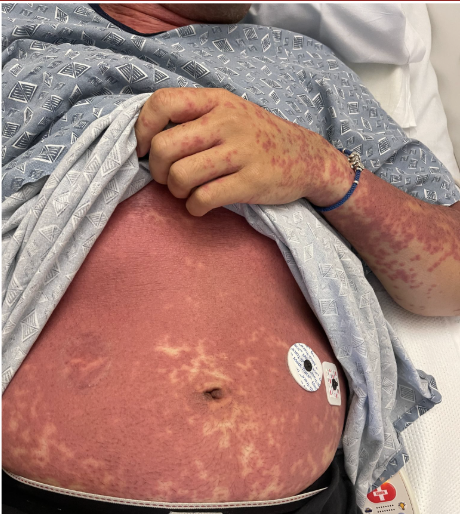
Case Presentation: A 37-year-old Thai male with a history of gout presented with a progressively worsening rash. The rash began 10 days earlier following a work trip to Utah, initially appearing on the back of his hands and gradually spreading to his arms, trunk, and legs, accompanied by pruritus. Four days prior to admission, the rash spread to his palms, soles, and face. The patient reported subjective fevers, chills, and facial swelling. Despite using over-the-counter antihistamines, his symptoms did not improve. Notably, the patient had been prescribed allopurinol for gout six weeks prior. On admission, the patient’s vital signs were stable. Physical examination revealed dusky red papules with an erythematous base across the upper and lower extremities, including the trunk, face, and palms/soles. The facial rash exhibited crusted, scaling erythematous papules, particularly in the periorbital regions and eyelids, with no mucosal involvement. Labs were notable for a creatinine of 1.35 and ALT of 77. Infectious disease was consulted who suggested a low likelihood of an infectious process, leading to the discontinuation of empiric antibiotics. Dermatology was consulted, who had lower concern for DRESS (drug reaction with eosinophilia and systemic symptoms) and recommended topical steroids and a short course of prednisone. Despite treatment, the patient’s liver enzymes and creatinine continued to rise. Hence, dermatology recommended transitioning to methylprednisolone 500 mg daily for 3 days, which resulted in improvement in his clinical presentation. Following discharge, HLA-B*5801 testing was positive, supporting the diagnosis of allopurinol-induced DRESS.
Discussion: DRESS syndrome should be considered in patients who present with a diffuse rash, eosinophilia, and involvement of multiple organ systems, especially following the initiation of a new medication such as allopurinol. The RegiSCAR score can help assess the likelihood of DRESS, based on timing of rash onset, eosinophilia, and multiorgan involvement. Allopurinol, a common medication for gout, is a known trigger for DRESS, particularly in Thai, Korean and Han Chinese patients who may have the HLA-B*5801 allele. In this case, the patient’s clinical presentation raised a broad differential diagnosis. After consideration of the timing of symptom onset following allopurinol initiation, along with the development of systemic organ involvement, a diagnosis of DRESS syndrome emerged as the most likely diagnosis. Although the patient initially did not meet all of the criteria, the progression of organ involvement warranted a shift in management and eventual improvement.
Conclusions: DRESS is an under-recognized, life-threatening condition that requires prompt recognition and intervention. It is important to consider DRESS in the differential for patients who present with a diffuse, erythematous rash and systemic symptoms, particularly with a recent history of drug initiation, such as allopurinol. This case is particularly relevant to hospital medicine, for it highlights the importance of thorough medication history-taking and a high index of suspicion when faced with complex rashes and multisystem involvement. Early recognition and timely management of DRESS are crucial in preventing severe complications and improving patient outcomes.