Background: Our Queens, NY community hospital serves an aging, diverse population with substantial socioeconomic barriers to care transitions. These factors create obstacles to discharge planning and disposition, contributing to prolonged hospitalization. A structured, proactive process that identifies discharge challenges early and coordinates multidisciplinary actions is essential to reduce excess days.
Purpose: To implement twice-weekly multidisciplinary meetings designed to identify and resolve discharge barriers for patients with prolonged or complex hospitalizations. Goals included improving care transitions, reducing excess days, and maintaining quality metrics.
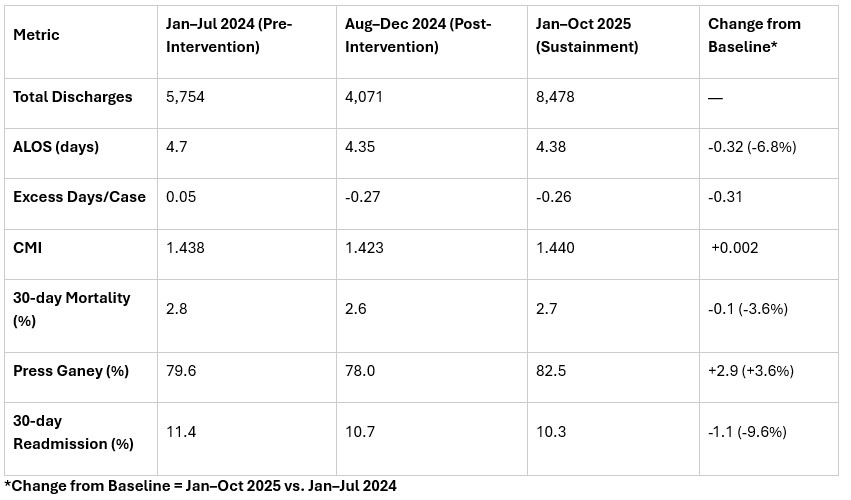
Description: We launched twice-weekly virtual meetings via MS Teams in August 2024:1. Monday Length of Stay (LOS) meeting (30 mins):• Strategic timing aligned with hospitalists’ end-of-week patient familiarity (7-on, 7-off model) and the start of the business week to facilitate completion of pending action items (e.g., rehab/SNF placement, procedures).• Led by physician advisor; participants included faculty hospitalists, Director of Hospital Medicine, Director of Nurse Practitioners, Surgery supervisor, and senior CM/SW leaders.• All inpatients with LOS ≥7 days reviewed. Faculty hospitalists provided clinical summaries and pending items; physician advisor and NP Director reported for voluntary patients; CM/SW leaders gave real-time discharge updates.• MS Teams captured estimated discharge dates, targeted dispositions, and action items, enabling transparent tracking and ownership.2. Wednesday Complex Care meeting (30 mins):• Mid-week checkpoint to maintain momentum, address escalating complexity, and reinforce accountability.• Review of all patients with LOS ≥10 days plus any patient deemed medically or socially complex regardless of LOS.• Same multidisciplinary team ensured continuity; MS Teams chat enabled real-time communication and escalation outside meetings.Analysis included patients with LOS< 15 days; LOS≥15 days were excluded due to extreme, nonstandard barriers.Post-implementation (Aug-Dec 2024) showed early reductions in Average LOS (ALOS) and excess days/case, helping build clinician and leadership buy-in (Table 1). By 2025, reductions in ALOS (-0.32, -6.8%), and excess days/case (-0.31) were sustained further. CMI remained stable, indicating no meaningful change in patient acuity. Importantly, 30-day mortality remained unchanged, Press Ganey satisfaction improved 3.6% over baseline, and 30-day readmissions decreased 9.6%.
Conclusions: A twice-weekly multidisciplinary meeting structure was associated with substantial, sustained reductions in excess days and improvements in ALOS. Critically, these improvements occurred without compromising mortality, while simultaneously improving patient satisfaction and reducing readmissions. Hospitalist engagement was instrumental: frontline clinical insights enabled Case Management, Social Work, and leadership to rapidly identify and address discharge barriers. The intervention required minimal resources while creating predictable accountability and coordinated action across disciplines. Our approach is adaptable: meet twice weekly, review patients above LOS thresholds, assign clear owners with time-bound actions, and use collaborative tools to track discharge targets. Future work includes integrating real-time dashboards and refining complex case criteria to identify barriers earlier and sustain gains.