Background: The optimal length of hospitalist clinical blocks (e.g. the number of consecutive days worked) is unclear. Some studies have shown that greater continuity is associated with better patient outcomes. However, longer clinical blocks may lead to clinician burnout and fatigue. We conducted a pragmatic trial comparing two different block lengths, one being a standard 7-day duration and the other comprising 3 or 4 day blocks.
Methods: This study was conducted on an attending-only direct care hospital medicine service at a 600-bed academic hospital staffed by ~125 hospitalists. Starting July, 2025, 5 direct care teams were assigned to work 7-day block lengths and 3 direct care teams assigned to shorter lengths (a mix of 4 days and 3 days). When developing the schedule, hospitalists could indicate individual preference for longer or shorter blocks, although hospitalists could work both block lengths. Each direct care hospitalist managed up to 10 hospitalized patients, including patients admitted from the previous evening that were randomly distributed to the teams each morning. We compared outcomes (length of stay, discharge by noon, in-hospital mortality, and 7 and 30-day readmission) of patients cared for on 7-day blocks to patients managed on shorter block lengths, adjusting for patient characteristics.
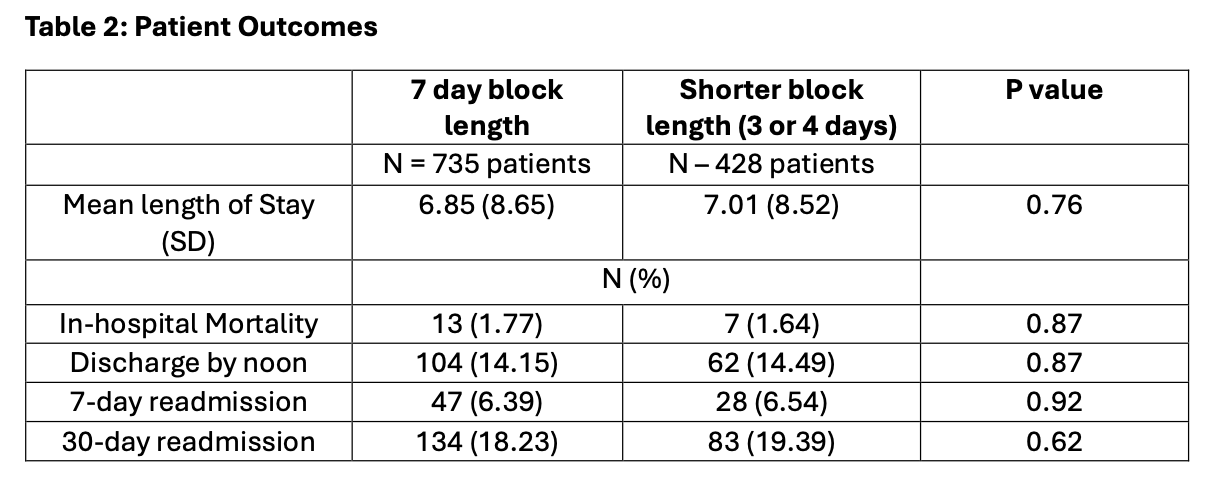
Results: From July 1 to November 13, 2025, 735 patients were managed by hospitalists working 7-day blocks and 428 patients on shorter blocks. Baseline patient characteristics were similar between the 2 groups (Table 1). Compared to 7-day block lengths, shorter rotations of 3 or 4 days were not associated with significantly different in-patient length of stay, % discharge by noon, in-hospital mortality, or 30-day readmissions (Table 2).
Conclusions: Although 7-day block lengths are common in hospital medicine, some hospitalists may prefer shorter rotations. In our study, we did not find differences in patient-level outcomes between 7 day and shorter block lengths, suggesting that offering hospitalists greater flexibility in scheduling may be feasible without compromising patient care.
.png)