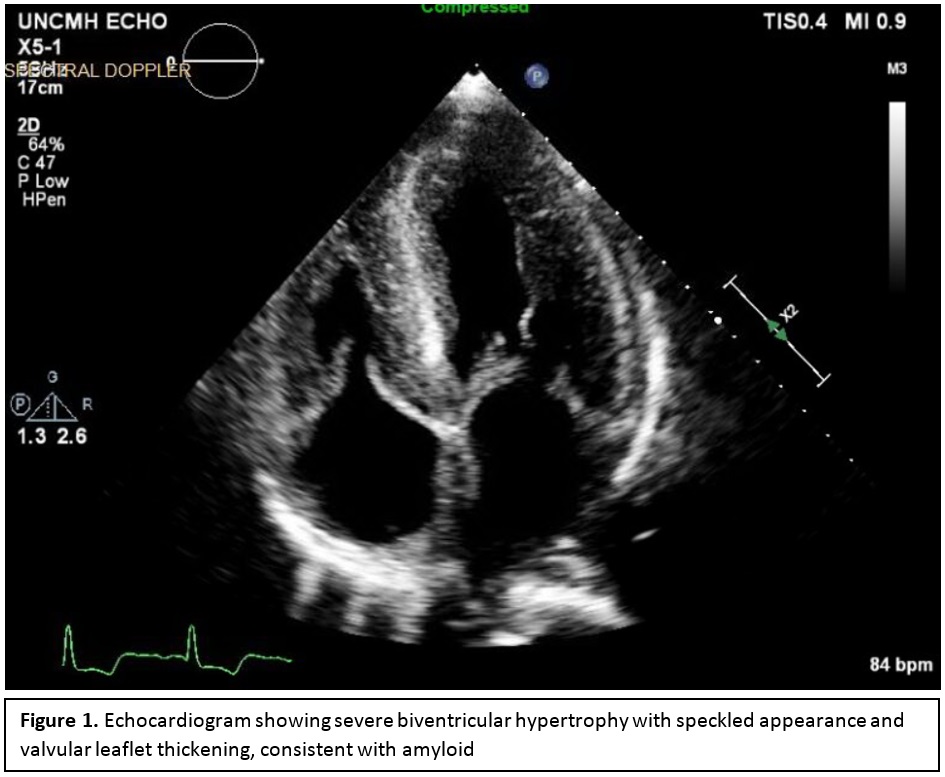
Case Presentation: A 44-year-old Caucasian man presented with rectal bleeding following an episode of constipation. He reported a two-year history of cachexia, peripheral neuropathy generalized weakness, urinary retention, and chronic constipation. His father had similar issues including chronic constipation and bilateral carpal tunnel syndrome. The patient was consistently hypotensive with orthostasis. A soft cardiac murmur was heard on exam, and a transthoracic echocardiogram showed an ejection fraction of 50%, severe biventricular hypertrophy and a speckled appearance of the myocardium. The patient had severe axonal sensorimotor polyneuropathy with active denervation in distal leg muscles on electromyography. Colonoscopy was performed with colonic biopsy revealing diffuse infiltration of mucosa and submucosa by homogeneous eosinophilic and Congo red-positive material. Bone marrow biopsy was negative for plasma cell dyscrasia, but focal perivascular amyloid deposition with positive Congo red stain was present. The patient was diagnosed with systemic amyloidosis, but other myeloma evaluation was negative, as was evaluation for chronic inflammatory conditions. On mass-spectroscopy, colonic biopsy showed wild-type transthyretin (TTR), but peripheral TTR gene sequencing showed the Thr69Ser mutation. This confirmed a diagnosis of hereditary TTR-mediated amyloidosis. He was started on diflunisal and referred for a compassionate use program for patisiran, an anti-TTR small interfering RNA (siRNA).
Discussion: Systemic amyloidosis can cause clinical manifestations involving many organ systems including cardiomyopathy, peripheral neuropathy, nephropathy, hepatomegaly, and gastrointestinal motility issues. AL amyloidosis (related to light-chain deposition) and AA amyloidosis (secondary to amyloid A fragment deposition from chronic inflammation) are the most common types of amyloidosis. Heritable amyloidosis is rarer and caused by mutations in amyloid precursor proteins, including mutations of transthyretin. Familial amyloidosis was a strong consideration in this patient given his father’s similar symptoms and a negative evaluation for AL and AA amyloidosis. Early in the disease course, liver transplantation may be considered if the liver is the source of the precursor protein. Investigational therapies include diflunisal (an NSAID) and tafamidis (a selective TTR-binder), both of which can stabilize TTR, as well as siRNAs that reduce gene expression of TTR.
Conclusions: In patients with a clinical syndrome consistent with amyloidosis, a family history of similar symptoms and a negative evaluation for plasma cell dyscrasias or chronic inflammation, consider familial amyloidosis as a possible etiology.