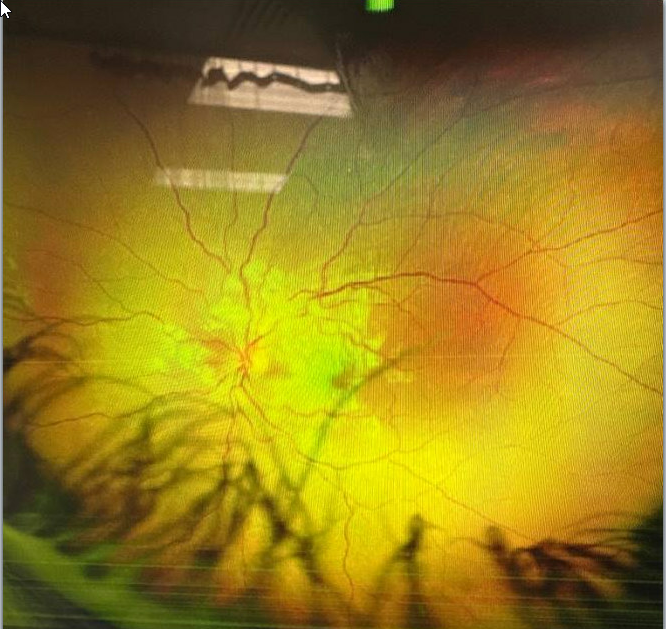
Case Presentation: A 23-year-old man with a history of alcohol use disorder was admitted for alcohol-induced interstitial edematous pancreatitis. Initial laboratory testing revealed elevated lipase and lactic acidosis; CT scan showed steatohepatitis and acute pancreatitis without necrosis.Bilateral vision loss developed 24 hours after initial presentation, described as “blurred” and “darkened” vision. Visual acuity was reduced to counting fingers in the right eye and 20/400 in the left eye, with severe right and full left visual field restriction. A relative afferent pupillary defect was noted on the right. Fundoscopy revealed diffuse macular whitening in both eyes by Purtscher flecken, which were found superior, inferior and nasal to the disc in a peripapillary distribution. A single punctate retinal hemorrhage was noted near the inferior arcade of the right eye. Six weeks later, the patient reported no improvement in his vision.
Discussion: Purtscher retinopathy is characterized by vision loss following head trauma and is typically accompanied by fundoscopic findings of Purtscher flecken, cotton-wool spots and intraretinal hemorrhage (1). When these signs accompany non-traumatic conditions, such as acute pancreatitis, it is referred to as Purtscher-like retinopathy. Vision loss in the context of acute pancreatitis should always raise suspicion for this retinopathy. There is currently no proven treatment (1).These vision changes are thought to occur due to emboli in precapillary arterioles, which causes retinal infarction (2). Embolic occlusion can be caused by fat, fibrin and leukocyte aggregates. Leukocyte aggregates are of particular interest regarding Purtscher-like retinopathy, as they can form due to complement activation in patients with acute pancreatitis (2).One prospective study showed that retinopathy following pancreatitis was associated with both multiple organ failure and poor prognosis (3). Given the potential prognostic value of Purtscher-like retinopathy in patients with pancreatitis, it is important to monitor vision changes in these patients. Loss of visual acuity is the most important symptom to recognize, especially bilateral vision loss. Fundoscopy is also revealing, with cotton-wool spots, intraretinal hemorrhages and Purtscher flecken being the most common fundoscopic signs (1).
Conclusions: Purtscher-like retinopathy is a rare but potentially serious cause of painless vision loss in patients with acute pancreatitis.
.png)