Background: Hospital Medicine has seen rapid growth since its emergence as an independent field. While internal medicine residency provides robust training for the clinical aspects of inpatient medicine, residents are not always given adequate education and insight into the non-clinical aspects of a hospitalist career. Specialized hospitalist tracks have been developed in residency programs across the country, but there has been little published about the outcomes from these training programs.
Purpose: The Internal Medicine Residency Program Hospitalist Track was developed to provide education and mentorship to residents with an interest in hospital medicine. There are relatively clear pathways for residents applying for fellowship; however, many residents are unaware of the wide variety of career paths for a hospitalist, including medical education, informatics, and quality improvement. This track was designed to give the enrolled residents exposure to these career paths as well as face time with established hospitalists in these roles.
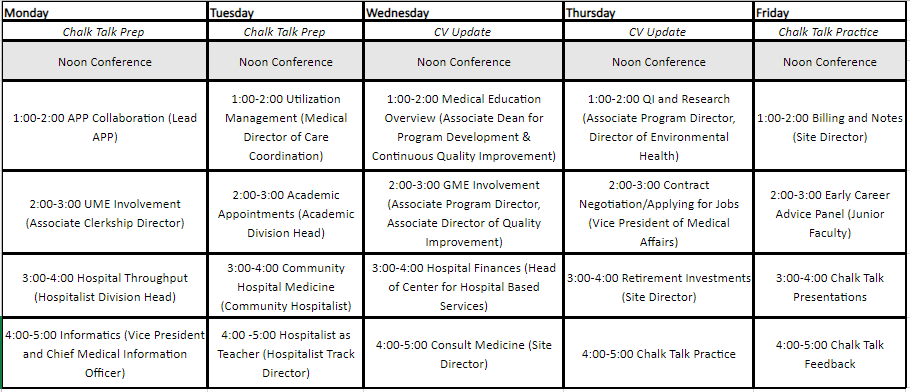
Description: Enrollment in the track requires a statement of commitment and a discussion with the track director about career interests and goals. During PGY-2 and PGY-3 years, residents are expected to rotate on addiction medicine, palliative care, neurology, and medical education. In addition, each resident is required to complete 3 weeks on the Junior Hospitalist Elective, which involves working one-on-one with a junior faculty member on a direct care team. In this elective, the resident is given increased autonomy as compared to a regular teaching service and has the opportunity to discuss the application process and career paths with the attending. During the PGY-3 year, the resident completes a Junior Hospitalist Elective week participating in a “mega-team” in the Observation Unit; this gives the resident increased exposure to observation care and the ability to work closely with an advanced practice provider (APP). There is a mandatory week of didactic lectures (outlined below) which the residents must attend at least once. This lecture series involves hour-long lectures from institutional leaders, all of whom are hospitalists. These small group lectures (usually 3-8 residents) give the residents an opportunity to have intimate discussions with leaders that they otherwise might not have. Residents in the track are given access to a shared drive with numerous CVs and cover letters as well as a repository of questions to consider asking in interviews.
Conclusions: Since the track was formalized in 2021, 6 residents have completed the track; 5 practice hospital medicine, 3 which remain at our institution. There are currently 13 residents enrolled in the track from the PGY-2 and PGY-3 classes (a quarter of the residents from those two classes). There has been overwhelmingly positive feedback regarding the education provided by the track as well as the relationships developed during the experience.