Background: Patients with limited English proficiency (LEP) have a primary language other than English. During the hospital discharge process, patients with LEP may experience challenges communicating with members of the healthcare team and in our division, they have increased readmission rates and reported increased difficulty understanding discharge instructions compared to English proficient patients.
Purpose: To increase the percentage of patients with LEP who receive professionally translated, language-concordant discharge instructions through a health systems and equity-focused QI project.
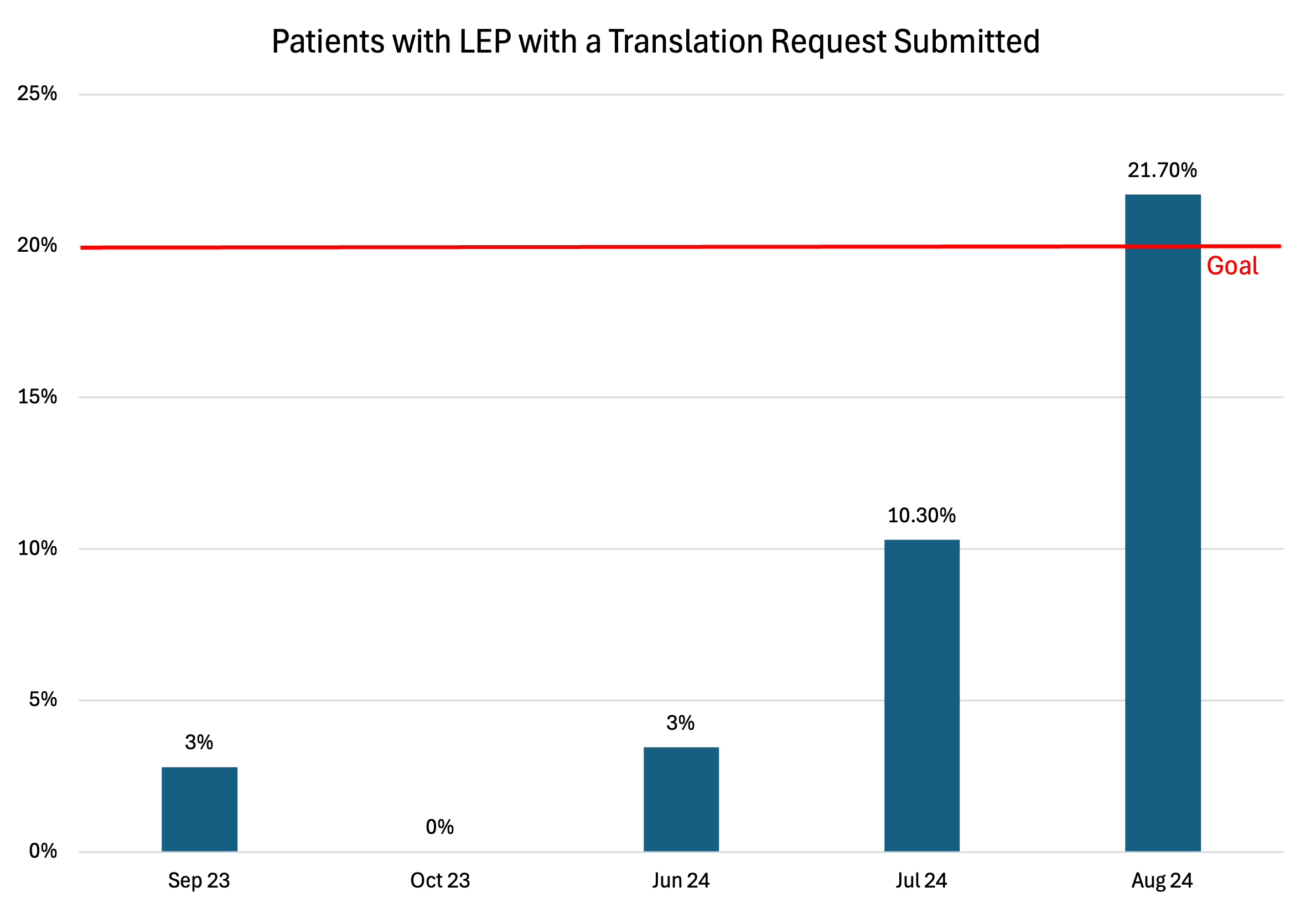
Description: An A3 problem-solving method was applied to the identified problem of low rates of translated discharge instructions. At a 600-bed academic tertiary care center, data was collected on the number of translated discharge instructions for patients with LEP admitted to the adult hospital medicine service beginning October 2023 in collaboration with the institution’s Interpreter Services (IS) department. Patient interviews identified a strong preference for translation of their discharge instructions and hospitalist surveys identified low awareness of the institution’s document translation services and concerns about time constraints. To address this, a two-pronged intervention was used. First, an educational campaign was launched to educate hospitalists on the disparate outcomes faced by patients with LEP in the discharge process and on the workflow on professional translation offered by the institution’s IS department. Second, we collaborated with the division’s clinical assistant and trained them to take on the multi-step workflow for professional translation of documents. Additionally, they proactively identified patients with LEP discharging within 48 hours and directly messaged hospitalists to prepare discharge instructions ahead of time, which the assistant would submit in time for professional translation. Collaboration with an IS liaison allowed for hospitalists’ requests to be expedited whenever possible, and direct lines of communication between IS and the clinical assistant were established. Routine check-ins with IS and the clinical assistant revealed no major concerns. A retrospective pre- and post-intervention analysis of the use of hospital-provided document translation services was used to investigate the success of the intervention. Pre-intervention data from September-October 2023, and May-June 2024, revealed the percentage of discharged patients with LEP that received professionally translated discharge instructions was 0-3%. Our intervention launched on July 15, 2024 where an increase to 10.3% of patients with LEP that received professionally translated discharge instructions was immediately apparent in July 2024. In August, 21.7% of patients with LEP received professionally translated discharge instructions from the institution’s IS department.
Conclusions: A two-pronged QI intervention of education and an innovative collaboration with IS and a clinical assistant tasked with the translation submission increased the usage of professional translation services, representing meaningful increases in the in patients with LEP who were discharged with language-concordant instructions. Hospitalist and patient feedback on the intervention has been positive. This success promotes equitable care, highlights ongoing provider education, and engaging an interdisciplinary team with IS and clinical assistants in implementing new protocols.