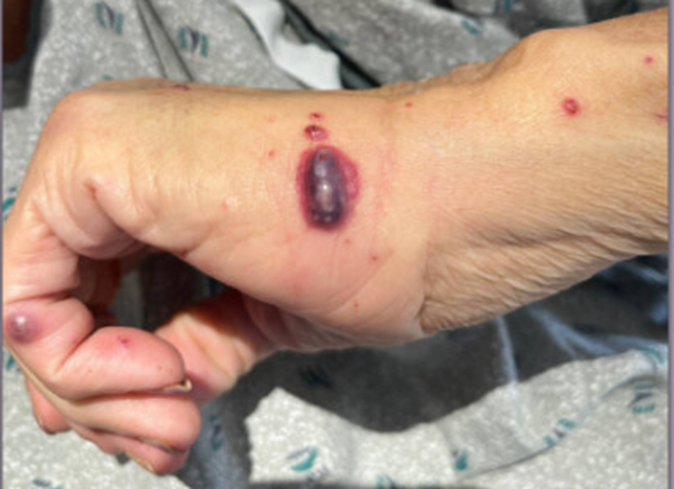
Case Presentation: We present the case of a 61-year-old female with past medical history of cirrhosis and heart failure status post ICD placement who presented with acute kidney injury and intermittent fevers. She denied recent history of cat bite/scratch, but she had been exposed to a cat with fleas. During her admission, her creatinine peaked at 6.6 from a baseline of 1.8 obtained one month prior. Kidney biopsy showed rapidly progressive glomerulonephritis with C3 deposits. She developed a rash consisting of flesh-colored papules and violaceous nodules on her hands, arms, face, and thorax. Biopsy of the lesions showed intraepidermal vesicular dermatitis with underlying dense neutrophilic inflammation. Warthin-Starry silver stain was not available. An echocardiogram was performed and showed a 1.6 x 1.0cm vegetation on the right ventricular lead of her ICD. Infectious workup was positive for B. henselae serologies with an IgG of 1:32,768 and IgM >1:20. Blood cultures remained negative. Her B. henselae infection was treated with doxycycline 100mg q12h for a planned 12 weeks and rifampin 300mg q12h for a planned 6 weeks. Her glomerulonephritis was treated with prednisone starting at 40mg daily and tapering by 10mg weekly. Her skin lesions significantly improved and her creatinine downtrended to 2.98 after one month of treatment. She then underwent successful removal of the infected ICD.
Discussion: Bartonella henselae infection commonly presents with cutaneous manifestations and lymphatic involvement; however, bartonella can also notoriously cause “culture negative” endocarditis1. Bartonella infectious endocarditis often presents with an immune-complex mediated glomerulonephritis2. Early treatment of rapidly progressive glomerulonephritis is imperative, as significant crescents and fibrosis may become irreversible3.
Conclusions: This case report highlights the importance of prompt recognition of B. henselae infection as a possible cause of rapidly progressive glomerulonephritis. This allows for appropriate antibiotic treatment to be initiated at the same time as potential immunosuppressive therapy for the best outcomes in treating both infection and kidney disease.
.png)