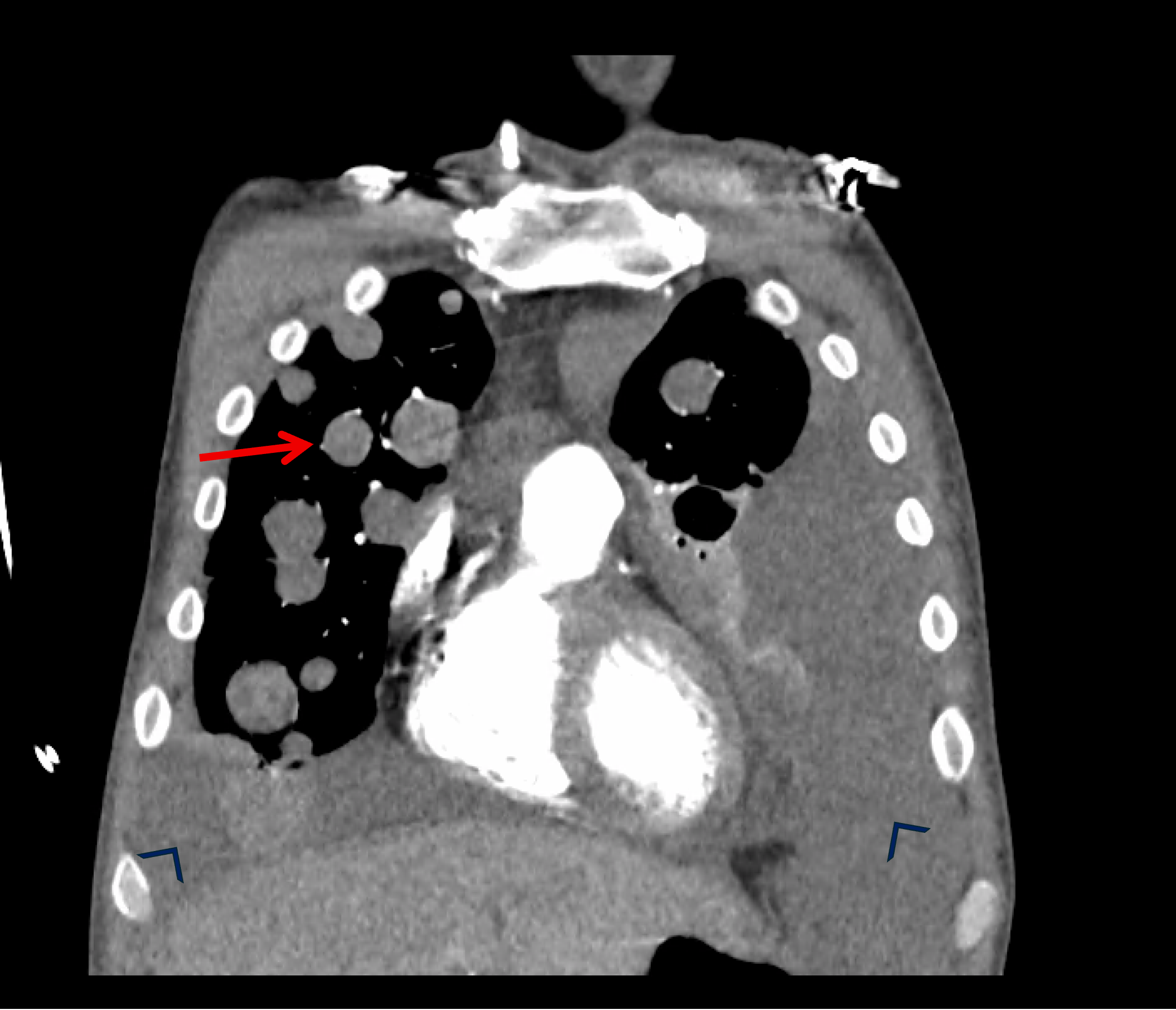
Case Presentation: A 45-year-old male presents with a 2 week history of right knee pain, with inability to bear weight. He denied any fevers, chills, night sweats, weight loss, nor anorexia. Objectively, his vital signs were stable. Physical exam was notable for right knee edema with no evidence of tenderness to palpation. A right knee MRI reveals a large intramedullary mass within the distal femoral diaphysis/metaphysis with cortical breakthrough. This was followed by a CT chest, abdomen, and pelvis which demonstrated multiple bilateral non-calcified pulmonary nodules ranging between 1.5 to 3 cm in size. A right knee CT guided needle biopsy was performed. Histopathological evaluation was positive for biphasic synovial sarcoma. Genetic analysis via fluorescent in-situ hybridization (FISH) confirms t(X;18) translocation. He was scheduled for close follow up with oncology department in outpatient setting. Two weeks later, he presented with a 2 day history of progressively worsening dyspnea at rest. Upon arrival, significant respiratory distress was noted. ABG demonstrated acute hypercapnic respiratory failure with pH 7.1 and pCO2 of 74 mmHg. He was briefly placed on bi-level positive airway pressure (BIPAP). However, the patient’s mental status significantly declined and was subsequently intubated and placed on invasive mechanical ventilation for airway protection. A CT chest reveals bilateral large pleural effusions with bilateral pulmonary nodular masses measuring up to 3.5 cm. A diagnostic left thoracentesis was performed resulting in the drainage of 1.5L of hemorrhagic exudative pleural effusion. Two days later, his oxygen requirements and mental alertness have improved. An initial trial of chemotherapy comprised of doxorubicin, ifosfamide, and mesna (AIM) was initiated. However, after completing a 3-day course, there was a notable decline in the patient’s mental status. After further discussion with the family, a decision was made to proceed with comfort care measures. The patient was palliatively extubated and was discharged in a hemodynamically stable condition to an inpatient hospice facility.
Discussion: Synovial sarcoma is a rare mesenchymal neoplasm, with an incidence of 1-3 cases per million per year in the general population. The ‘synovial’ reference is a misnomer as it has no predilection for specific tissues, and was historically named secondary to its microscopic resemblance to synovial cells. It most commonly arises in younger adults and is characterized by t(X;18) translocation involving the fusion of SS18 gene with the X-chromosome resulting in uncoordinated SSX transcription. The majority of metastatic synovial sarcomas are chemotherapy sensitive with anthracycline-based regimen represents a first line modality. The decision to initiate treatment in our case as part of non-curative intent was based on his young age and improving clinical markers. However, despite initiating the ‘AIM’ regimen, there was a notable progression of his encephalopathy that warranted cessation of further treatment and proceeding with comfort focused care.
Conclusions: Synovial sarcomas represent a rare entity of malignant sarcomas known for their aggressive natural course. Its propensity for early systemic spread calls the need for novel effective systemic treatments to improve overall survival. Early involvement of a multidisciplinary team is imperative to minimize diagnostic delays and improve clinical outcomes.