Background: Although popular belief often suggests a link between lunar cycles and human behavior, particularly in psychiatric contexts, scientific evidence supporting this association remains limited. This study explores the potential association between lunar phases and antipsychotic medication administration in psychiatric patient encounters at select hospital units from July 2018 to August 2023.
Methods: Data were extracted from patient records for encounters from July 2018 to August 2023 within the Integrated Medicine and University of Missouri Psychiatric Center Adult and Youth units. Included patients received at least one antipsychotic medication Intravenously or Intramuscularly: olanzapine, haloperidol, aripiprazole, or risperidone. Encounters coinciding with any of the eight lunar phases (new moon, waxing crescent, first quarter, waxing gibbous, full moon, waning gibbous, last quarter, and waning crescent) were classified accordingly. Statistical analyses, including correlation coefficients, r-squared values, and p-values, were used to determine whether lunar phases significantly influence antipsychotic administration.
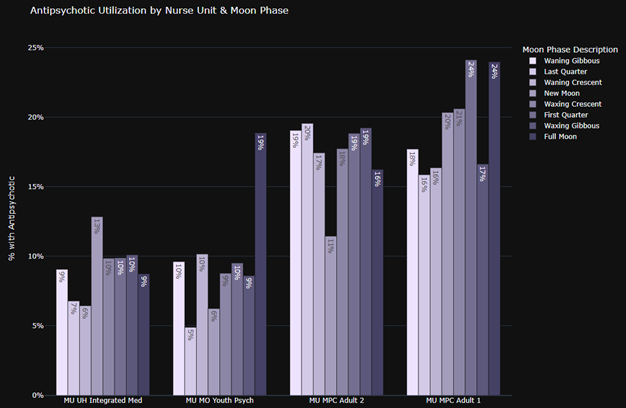
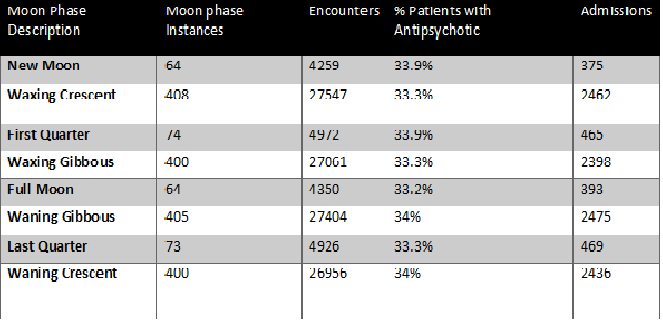
Results: Statistical analysis revealed an absent relationship between the phases of the moon and whether a patient was given an antipsychotic medication (Correlation coefficient: -0.0017, p-value:0.533, and R2: 3.056). There is a notable exception observed in the Youth unit, where a statistically significant indicated higher antipsychotic utilization on the day of admission during the full moon phase (Correlation coefficient: 0.061, p-value: 0.0016, and R2: 0.0037).
Conclusions: This retrospective study does not support a relationship between lunar phases and the utilization of antipsychotic medications in psychiatric nurse units. While popular myths suggest a lunar impact on psychiatric behavior, our findings align with scientific evidence to the contrary. This study underscores the importance of empirical evidence in guiding psychiatric care and refutes lunar effects as a basis for treatment variation in mental health settings.