Background: Continuity of care is a cornerstone of high quality, patient-centered care. In high-volume hospitals, rapid bed placement and minimizing Emergency Department wait times often take precedence, making consistent team-patient alignment difficult, particularly in geographically based unit models. This reduces continuity and limits residents’ experience of longitudinal care and team ownership. At our tertiary academic center, residents admit patients who are then assigned beds across multiple inpatient units, creating frequent misalignment between the admitting team and inpatient location. While most continuity initiatives target ambulatory settings, inpatient continuity for residents remains understudied. This project aimed to improve patient continuity by optimizing the admission process and geographic placement of patients to resident-specific units.
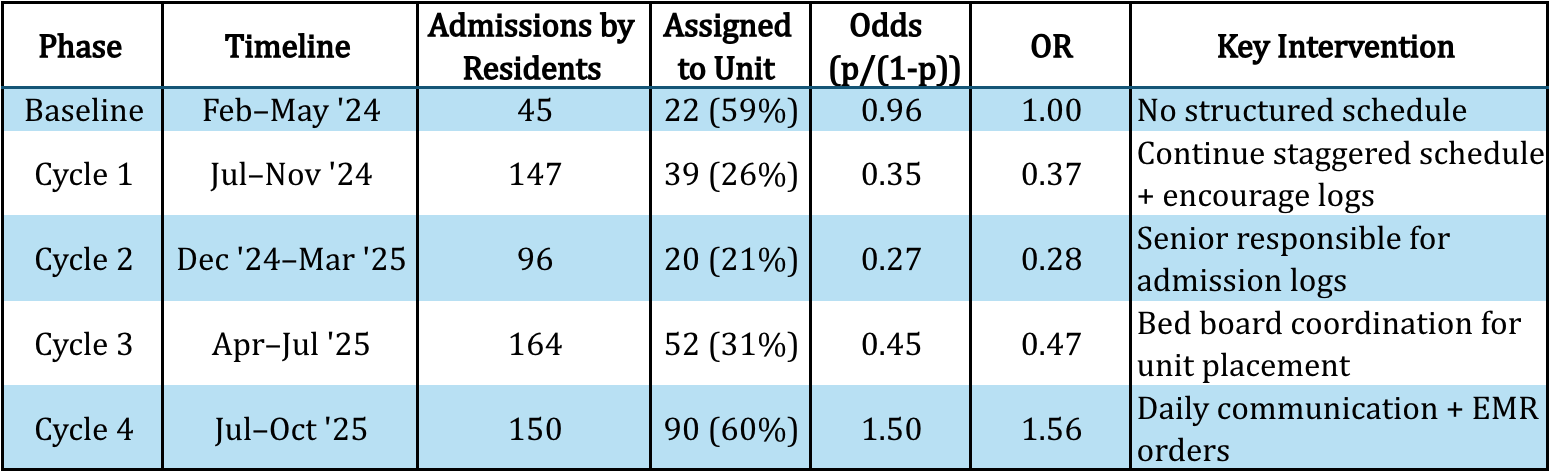
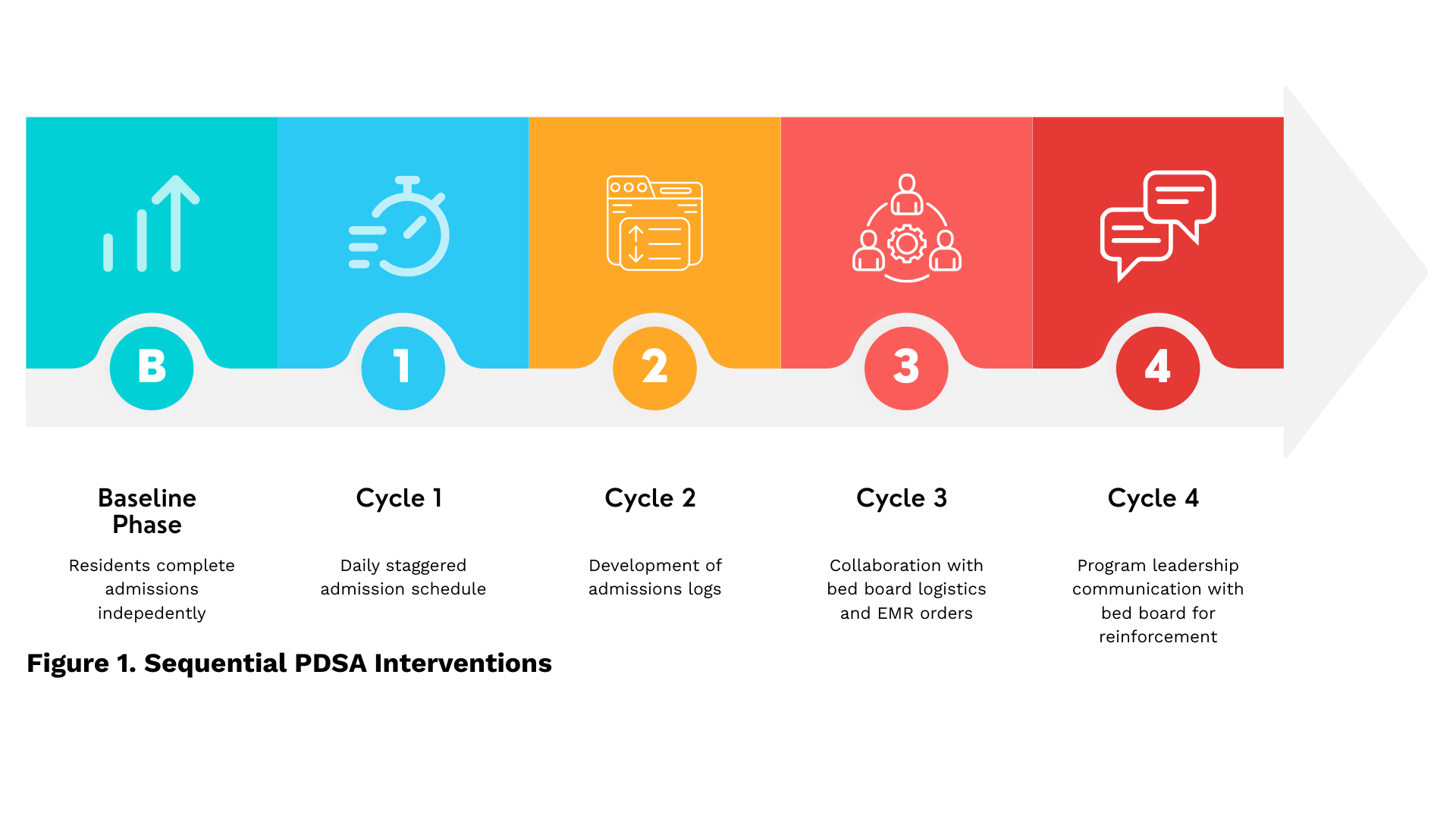
Methods: At a single tertiary care academic center with an ACGME-accredited Internal Medicine Residency Program, 18 residents participated. A multi-cycle Plan-Do-Study-Act (PDSA) model was implemented from July 2024 to October 2025. The model included a baseline phase, during which raw data was collected without a structured process, followed by four sequential cycles introducing targeted interventions. During the baseline phase, residents sought admissions independently. In cycle one, a daily staggered admission schedule was introduced. In cycle two, residents were responsible for maintaining an admissions log. In cycle three, residents collaborated with bed board logistics and placed orders in the electronic medical record to indicate bed preference. In cycle four, program administration communicated with bed board logistics to reinforce appropriate assignment. Monthly data on total resident admissions and correct geographic placement were collected. Aggregated quarterly data were analyzed using binomial logistic regression, with the baseline phase as the reference, to estimate odds ratio (ORs) and 95% confidence intervals (CIs) for successful resident-patient continuity.
Results: A total of 502 resident admissions were analyzed across five phases. Baseline continuity was 49% (22 of 45 admissions). No admission log was maintained; rather, admissions were self-reported and manually confirmed. The staggered admission scheduling intervention increased admission volume (147 admissions). This was followed by a decline in both admissions and continuity, and analysis demonstrated a lack of log maintenance. With structured scheduling and logging, continuity improved (31%), reflecting more accurate performance capture. Subsequent coordination among residents, faculty, and bed board, including EMR bed preference orders and structured daily communication, improved continuity to 60%. Logistic regression showed a 56% increase in odds of patient-resident continuity compared with baseline (OR 1.56; 95% CI 1.05-2.31; p = 0.03).
Conclusions: A structured, multi-level PDSA approach substantially improved inpatient continuity for residents. Interventions emphasizing accountability, transparent communication, and interdepartmental collaboration effectively aligned workflow with educational and patient-care goals. This project demonstrates that meaningful inpatient continuity is achievable within existing systems through incremental process design and sustained engagement with hospital operations.