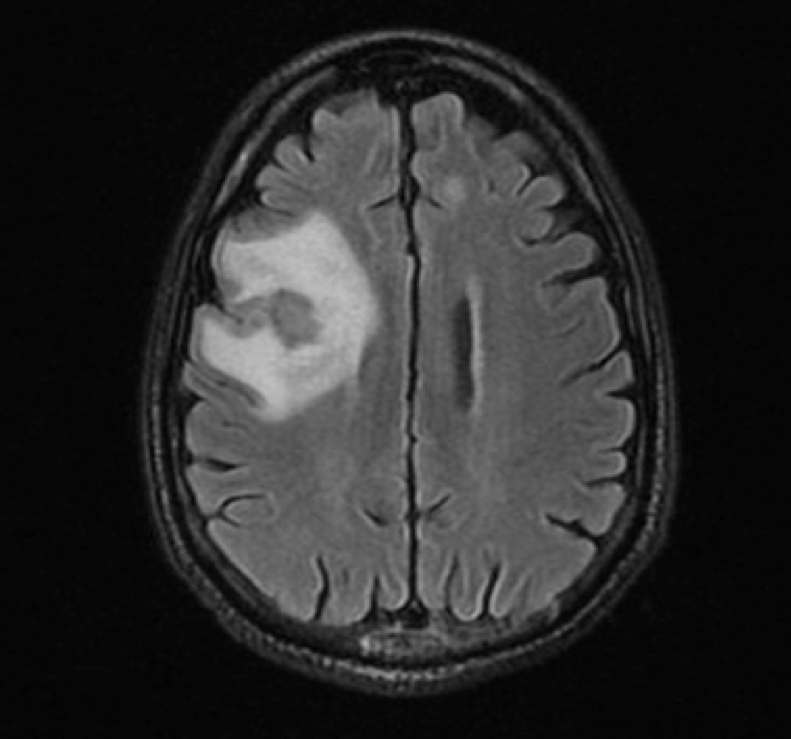
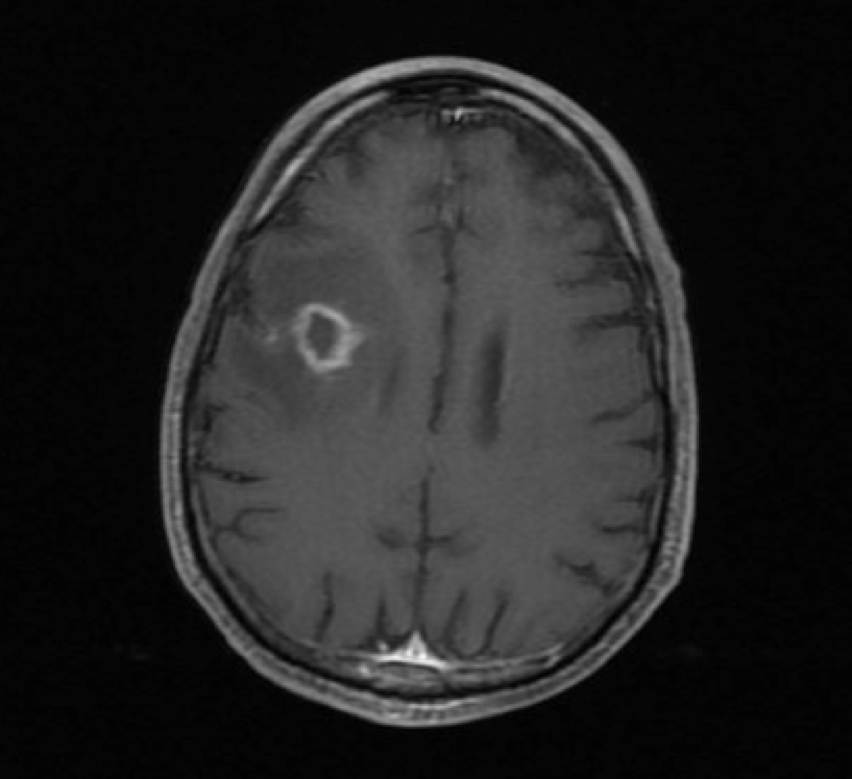
Case Presentation: A 62 year-old man presented with altered mental status. Twelve days prior to presentation, he developed a headache, dizziness, decrease in appetite, and general malaise. He reported an associated right-sided facial droop and weakness. He endorsed significant right eye pain and headache. He also had a 20-30 lb weight loss over the last year. He noted no prior medical history but had not sought medical care in the past several years.
He was afebrile and his vitals were BP 178/100, HR 110, and RR 18. On exam, he was cachectic and chronically ill appearing. He had right eye ptosis, nystagmus, and delay in EOM in comparison to left. He had right sided facial droop. He was pancytopenic with WBC 3.4, Hgb 8.9, and Plt 36. His toxicology screen and ethanol levels were negative.
His CT head showed a large area of subcortical vasogenic edema in the right frontal lobe, and a hypo-attenuating focus in the medial left frontal lobe. Due to concern for acute stroke, neurology was consulted and recommended MRI. MRI demonstrated multifocal enhancing parenchymal lesions, including a large lesion in the right frontal lobe with surrounding vasogenic edema.
His ESR was 104. HIV infection was strongly suspected and laboratory data confirmed an AIDS diagnosis. Toxoplasmosis testing was negative. EBV PCR was positive, but further workup was not pursued.
His hospital course was complicated by steadily declining mental status despite multiple treatments including steroids and broad-spectrum antibiotics. He became non-verbal and at that time, the family decided to pursue hospice care.
Discussion: In 2006, the CDC recommended universal HIV screening for individuals aged 18-65. Both primary care and acute care settings are recommended to conduct HIV screenings. With the advent of antiretroviral therapy, opportunistic infections seen in uncontrolled HIV have become less common. Due to advances in ART, HIV-infected patients adherent to treatment are able to extend their life expectancy.
However, this case exemplifies a patient without access or interactions to the medical system resulting in a delayed HIV diagnosis. His presenting symptoms of in weight loss, fatigue, and reduced appetite are all likely representative of chronic HIV infection. Additional symptoms could include night sweats, swollen lymph nodes, and other B symptoms. These non-specific symptoms can also be indicative of opportunistic infections. In a patient with ring-enhancing lesions of the brain and uncontrolled HIV, the differential remains broad and requires a thorough infectious and non-infectious evaluation. Empiric treatment for a wide variety of CNS infections include toxoplasmosis is needed, as the morbidity and mortality of these lesions are high.
Conclusions: Hospitalists often interact with patients who have been out of the medical system. Without adequate screening for HIV, these patients may present with advanced HIV and life-threatening opportunistic infections.