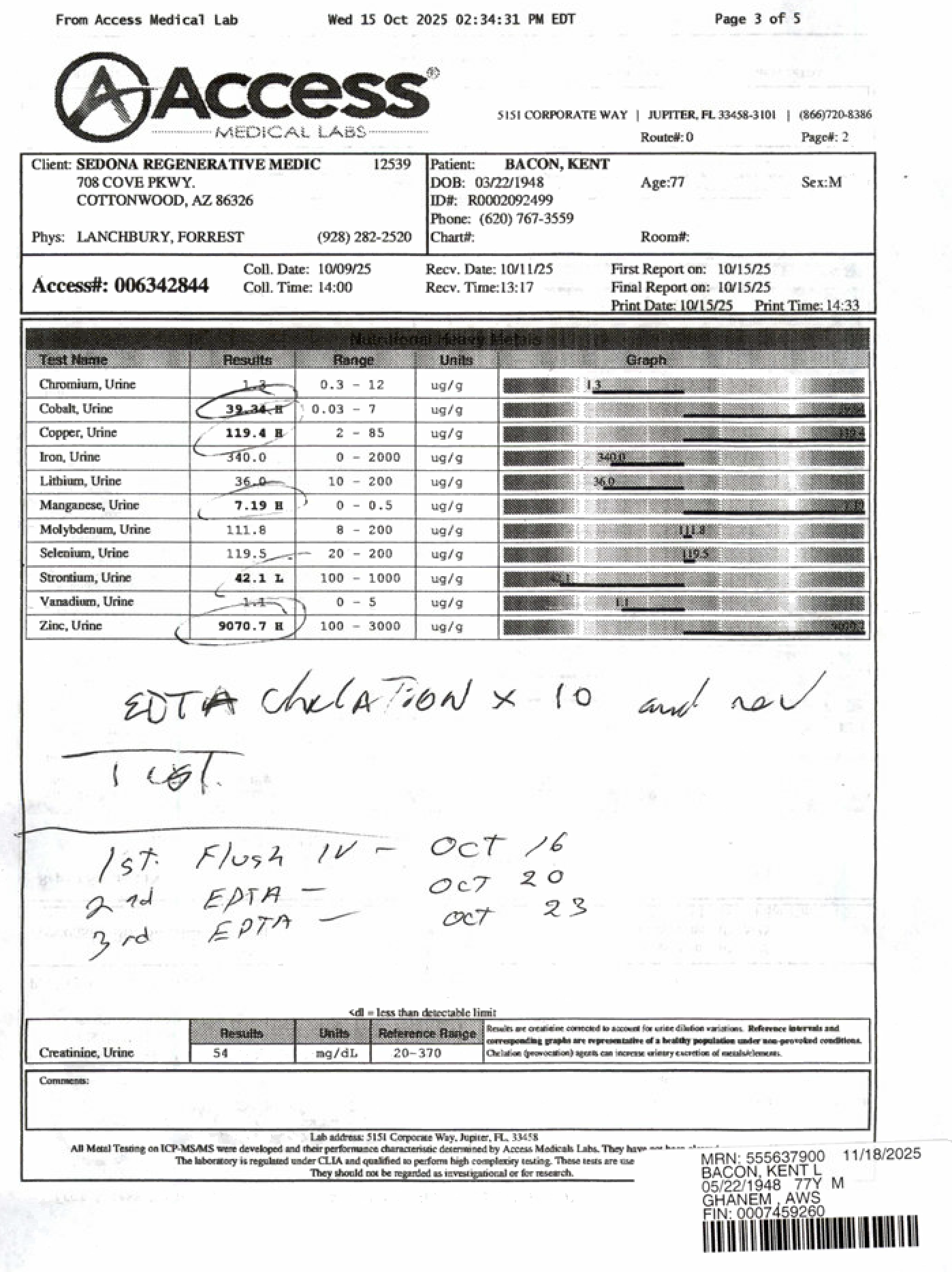
Case Presentation: A 77-year-old male with CKD stage IIIb, hypertension, and treated hepatitis C, with long-term welding exposure, underwent heavy-metal testing revealing elevated copper, cobalt, manganese, strontium, and zinc. He began EDTA chelation therapy and developed progressive generalized swelling within 48 hours of his third dose on 10/23/2025, which he reported was infused over only 15 minutes.Three weeks later, he presented with severe anasarca and blood pressure of 199/100 mmHg. Labs showed creatinine 2.3 mg/dL, BUN 42 mg/dL, eGFR 29 mL/min/1.73m², albumin 2.5 g/dL, cholesterol 185 mg/dL, and nephrotic-range proteinuria with a UPCR of 9.7 mg/mg. Imaging revealed cardiomegaly with pulmonary edema, a small pleural and pericardial effusion, and diffuse soft-tissue edema. Renal ultrasound demonstrated increased echogenicity consistent with chronic parenchymal disease. He received IV furosemide and hydralazine and was admitted for anasarca and AKI on CKD.He achieved a net diuresis of 8.9 L with 13 kg weight loss. Workup for nephrotic and nephritic etiologies was negative except for elevated β₂-microglobulin (7.63 mcg/mL). Renal function initially worsened but improved after high-dose steroids. Renal biopsy demonstrated amyloid deposits with Congo-red positivity and apple-green birefringence on immunofluorescence; light microscopy was negative and electron microscopy pending.
Discussion: EDTA is FDA-approved for lead toxicity but can chelate multiple metals including copper, zinc, cadmium, iron, and mercury. Because of poor GI absorption, it is administered intravenously or intramuscularly [1]. Documented toxicities include acute tubular necrosis, renal failure, proteinuria, and BUN elevation, historically affecting >25% of exposed patients [2]. Early reports described marked proteinuria after EDTA administration and fatal tubular injury following rapid high-dose infusions [3,4]. These cases, however, date back several decades, and no modern reports describe EDTA precipitating full nephrotic syndrome.Nephrotic syndrome is defined by proteinuria >3–3.5 g/day (or UPCR >300–350 mg/mmol), serum albumin < 25 g/L, edema, and often severe hyperlipidemia [5]. While EDTA-associated proteinuria has been documented, progression to nephrotic syndrome has not. In this patient, rapid-onset nephrotic-range proteinuria temporally followed EDTA administration, but biopsy ultimately revealed renal amyloidosis, likely the underlying driver of CKD and proteinuria. The rapid infusion may have exacerbated tubular injury, unmasking or accelerating heavy proteinuric manifestations in a kidney already compromised by amyloid deposition.
Conclusions: This case represents a unique presentation of nephrotoxicity temporally associated with EDTA infusion in a patient newly diagnosed with renal amyloidosis. Although causality cannot be established, the clinical course highlights the possibility that rapid EDTA administration may trigger or amplify nephrotic-range injury in susceptible individuals. This warrants further study to explore whether EDTA may pose specific risks in patients with unrecognized infiltrative kidney disease.