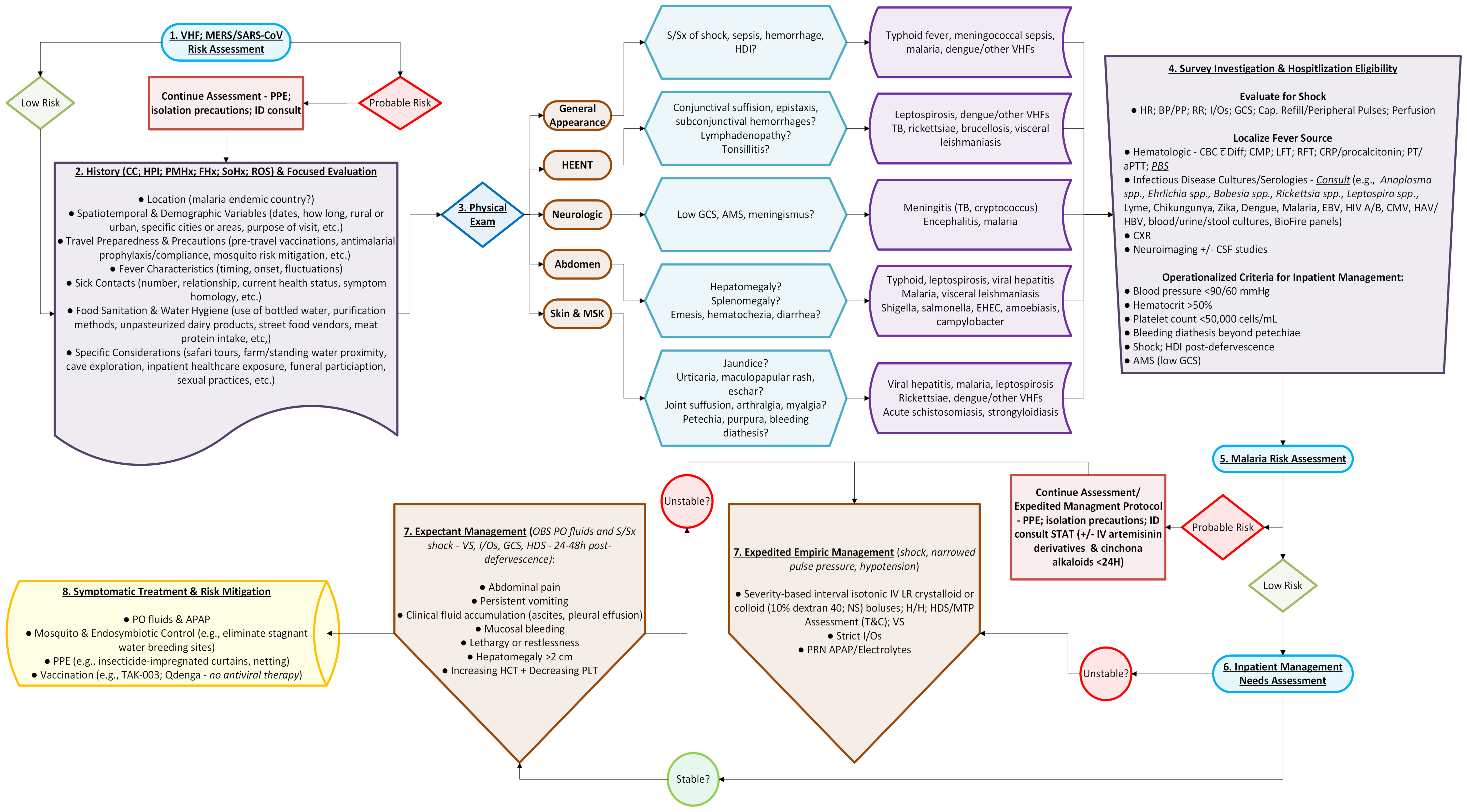
Case Presentation: A 58-year-old male presented to the emergency department with a 48-hour history of nausea, diarrhea, headache, and fever roughly 24 hours after returning from a 14-day trip to the Philippines. Additional symptoms included a retroorbital headache and erythematous rash across his chest (initially felt to be sunburn). He described staying in a small village 3 hours north of Manila as well as a nearby beach resort. He noted eating at street markets and petting stray dogs who would enter the resort. He denied using mosquito precautions like insect repellent or netting. Several of his family members began experiencing similar, generalized symptoms during their trip that were reportedly self-limited. Upon arrival his workup revealed neutropenia (ANC < 500 K/uL) and thrombocytopenia (95 K/uL) but otherwise normal complete metabolic panel. Infectious disease was consulted and recommended additional studies including Anaplasma spp., Ehrlichia spp., Babesia spp., Lyme, Chikungunya, Malaria, Leptospira spp. and Dengue Fever panel, in addition to blood cultures, urinalysis and cultures, and EBV, HIV A/B, CMV, Hepatitis A and B, as well as gastrointestinal and respiratory BioFire panels. He received supportive care with intravenous fluids and acetaminophen. He was started on broad spectrum antibiotics, including doxycycline. His hospital course was uneventful, and his symptoms improved. He was discharged on a 10-day course of doxycycline. One week after discharge, his workup revealed a positive Dengue Fever serum IgM Antibody of 5.37 K/uL (N 1.65), representing a recent infection consistent with his exposure history, clinical presentation, and laboratory abnormalities.
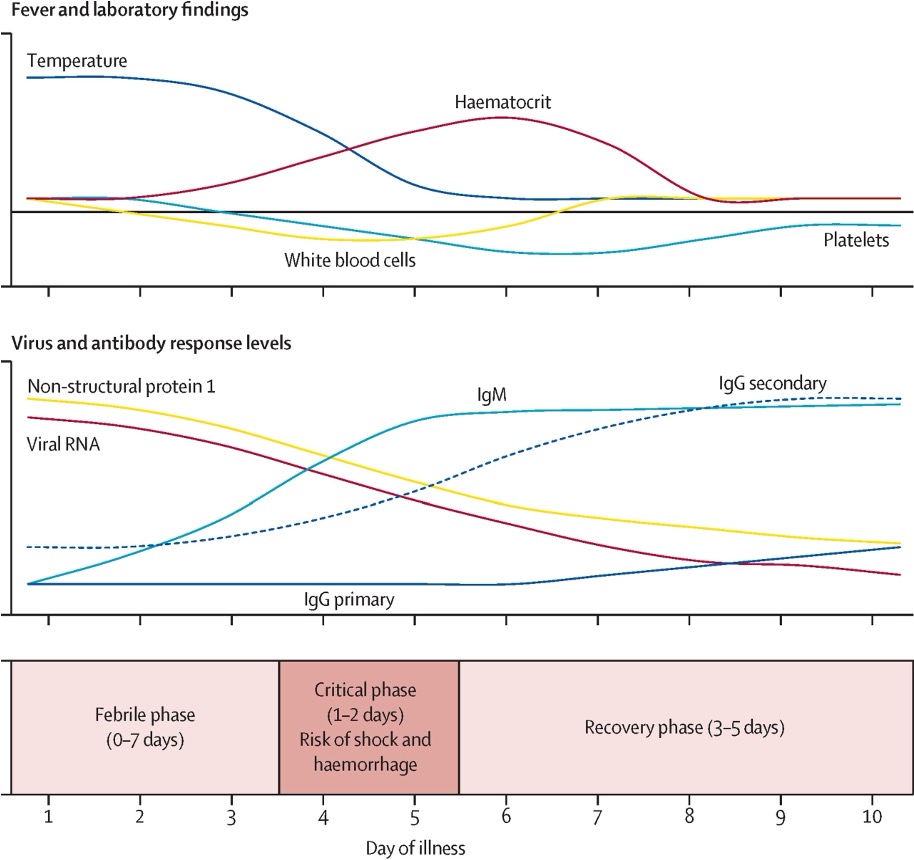
Discussion: An approach to fever in a returning traveler begins with appropriate risk stratification to rule-out severe etiologies. The differential diagnosis for fever in the returning traveler can be reduced substantially by identifying exposures, attending to incubation periods and regional endemicity, and correlating evidence to the clinical presentation and laboratory findings. For Dengue fever, the timing and character of clinical manifestations are essential for diagnosis and expediated management. Our patient met the 2009 WHO Criteria for Dengue without warning signs given his exposure history, accompanied by fever, nausea/vomiting, maculopapular rash, retroorbital pain, myalgia, arthralgia, and leukopenia occurring after a 3-day incubation and lasting 10 days through febrile and recovery phases. Confirmatory testing includes serology or PCR. Management is ultimately supportive, given no antiviral therapy exists. However, prevention is critical and includes mosquito control and vaccination (e.g., CYD-TDV and TAK-003).
Conclusions: Fever in the returning traveler is a clinically significant presentation, often serving as the sole harbinger of a potentially life-threatening infection or epidemiological crisis. The emergence of novel pathogens expanding endemic regions underscores the need for clinicians to remain alert to emerging infectious diseases, and the quality and efficiency of their diagnostic reasoning is irreplicable if scaffolded by a thorough history and physical exam.