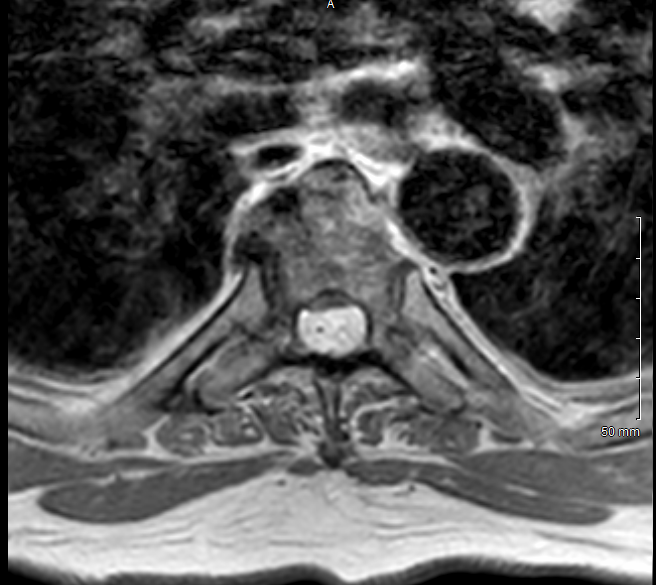
Case Presentation: A 69-year-old male with a past medical history of hyperlipidemia presented with sudden onset severe bilateral lower extremity (LE) weakness ascending to his bilateral upper extremities (UE) and neck following a tooth extraction the day prior. Symptom onset was the night after the tooth extraction. The patient reported being immobilized on the bathroom floor for 12 hours prior to contacting EMS. He denied bowel or bladder incontinence. On initial presentation, his vital signs were stable except for mild tachycardia at 92 bpm. Physical examination revealed ⅗ strength in bilateral UE and LE, absent deep tendon reflexes in the LE, 2+ reflexes in the UE, and a T2 sensory level loss. A firm, tender, non-erythematous mass was noted in the right mandibular region, suspected to be a dental abscess. His straight leg raise was negative. No rashes, wounds, or abnormalities were noted. Initial laboratory evaluation revealed mild leukocytosis with a WBC of 15.6 × 10⁹/L and elevated CPK at 985 U/L. Due to concerns for spinal cord compression, MRI of the brain and cervical spine was obtained but revealed no abnormalities. Neurology was consulted and recommended further evaluation for Guillain-Barré Syndrome (GBS). EMG studies were ordered but were negative.The patient was started on intravenous fluids, broad-spectrum antibiotics for suspected dental abscess, and dexamethasone for possible inflammatory spinal pathology. However, by the following day, his condition worsened, with progressive weakness and loss of UE reflexes. An MRI of the thoracic spine was obtained, which revealed a T3-T6 enhancing epidural lesion causing significant cord compression. The patient was transferred to a tertiary care center for neurosurgical intervention for possible epidural abscess. A transthoracic echocardiogram (TTE) was ordered to rule out embolic phenomena, but unable to be performed prior to transfer. The patient underwent an emergent T4-T6 laminectomy with complete excision of the epidural lesion. Histopathological analysis identified the mass as a spinal angiolipoma.
Discussion: Spinal epidural angiolipomas (SEAs) are rare benign tumors with an estimated incidence rate of 0.2-2.8 cases per 10,000 per year, accounting for only 0.04-1.2% of all spinal axis tumors and about 2-3% of all extradural spinal tumors, more commonly affecting ages 60-70s. They are usually slow-growing and cause gradual neurological deficits. Acute presentations of angiolipomas that mimic inflammatory or infectious spinal pathologies are unheard of and cloud the diagnostic picture. We report a rare case of thoracic epidural angiolipoma in a 69-year-old male with rapidly progressing ascending weakness.
Conclusions: SEAs are rare, slow-growing tumors that cause gradual neurological deficits. The present case is unique for its acute presentation of ascending paralysis following dental abscess and extraction, which complicated the diagnosis. Original suspicions were for GBS, but with negative EMG findings and MRI findings, this became less likely. There was questionable correlation regarding the patient’s dental infection. The infection possibly sparked a systemic inflammatory process that exacerbated a previously silent lesion. This, in turn, increased the vascular edema in the angiolipoma, resulting in the patient’s condition. Two key learning points come from this case: 1) One must broaden their differential when it comes to acute myelopathy 2) One must hone in on systemic events that may reveal dormant spinal pathology.