Background: Systemic racism contributes to health disparities. Innovative educational strategies are needed to develop competency in addressing manifestations of racism that impact patients. While the MD program at Icahn School of Medicine at Mount Sinai addressed racism in the preclerkship curriculum, a gap was identified in the clerkship year. The authors developed an antiracist clinical skills curriculum within the medicine clerkship, incorporating reflective practice and a Padlet board to engage students in documenting real-time observations of racism, bias and inequity in an inpatient setting.
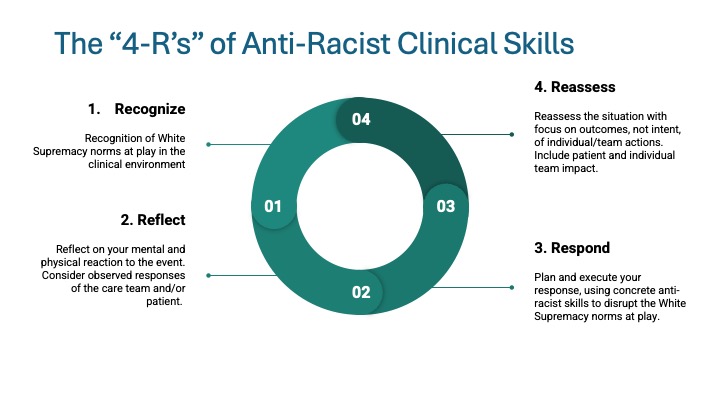
Methods: The Internal Medicine clerkship directors, after targeted coaching, implemented the curriculum using the “4 Rs” framework—Recognize, Reflect, Respond, and Reassess (Figure 1).The framework was introduced during a 15-minute orientation, which guided students to document observations of systemic racism on a secure anonymous electronic Padlet board throughout the six-week clerkship. At midpoint, the clerkship directors reminded students by email to post on the Padlet. The reflections culminated in a one-hour debriefing session including all students on the rotation. The clerkship directors invited students to share and reflect on their experiences. Student posts were discussed and strategies for antiracist practice reinforced. One author (HH) used a constructivist approach to identify themes from the Padlet posts. Authors EM and RH edited the proposed themes and grouped them according to major (occurring in many posts) or minor themes. The clerkship directors kept a reflective journal to provide context and triangulate the analysis. Students provided qualitative feedback and rated the curriculum through end-of-clerkship evaluations.
Results: Data collection encompassed three years, July 2021- June 2024. 305 Padlet posts by 294 contributors revealed issues grouped into ten major and six minor themes. Major themes included the inadequate use of language interpreters, unequal pain management for Black patients, and stigmatizing language toward marginalized populations (Figure 2). Qualitative feedback revealed that while students valued the support in addressing an important issue, many felt frustration at the lack of immediate systemic changes. Through reflective journaling, clerkship directors highlighted the challenge in moving the conversation from reflection to action. The curriculum received overall ratings of 4.4/5 on a 5-point Likert scale.
Conclusions: Using the online Padlet board enabled students to reflect in real-time and enhanced engagement on the manifestations of systemic racism that impact hospitalized patients. The cumulative student posts paint a vivid picture of systemic racism and provide opportunity for future quality improvement initiatives. The curriculum’s success relied on a local reservoir of expertise in antiracist practice, which may challenge scalability. This Padlet-based curriculum is both feasible and adaptable, offering a model for integrating antiracist education into clinical training.