Background: The scope of Point-of-Care Ultrasound (POCUS) use in hospital medicine continues to expand. Despite the noted benefits in diagnostic accuracy, the use of POCUS in hospital medicine is varied. A prospective study of hospitalists in 2022 showed that diagnostic POCUS use has increased nationally for cardiac, pulmonary, and abdominal applications. The most common barrier to POCUS use was lack of training.1 Our hospital medicine group lacked formal ultrasound training. We implemented a training program focused on workshop-based hands-on learning to train hospitalists to use POCUS routinely in their clinical care.
Purpose: Our goal was to design and evaluate a comprehensive POCUS program focused on workshop-based hands-on learning to train hospitalists at our institution to use POCUS routinely. The workshops focus on cardiac, pulmonary, abdominal, and vascular ultrasound with the use of standardized patients for real-time evaluation. Running over 3 hours our simulation center, providers rotated through 3 rooms with 1 standardized patient and ultrasound per room. 15 providers participated in the workshops at one time, with small groups of 5 providers in each room. Participation in the workshops was voluntary. Prior to the workshops, participants were surveyed to evaluate their ability to identify structures using POCUS and their level of comfort with POCUS as a diagnostic modality. After the workshop, we asked our providers to complete similar surveys to assess if their diagnostic knowledge and level of comfort had improved after participation in these workshops.
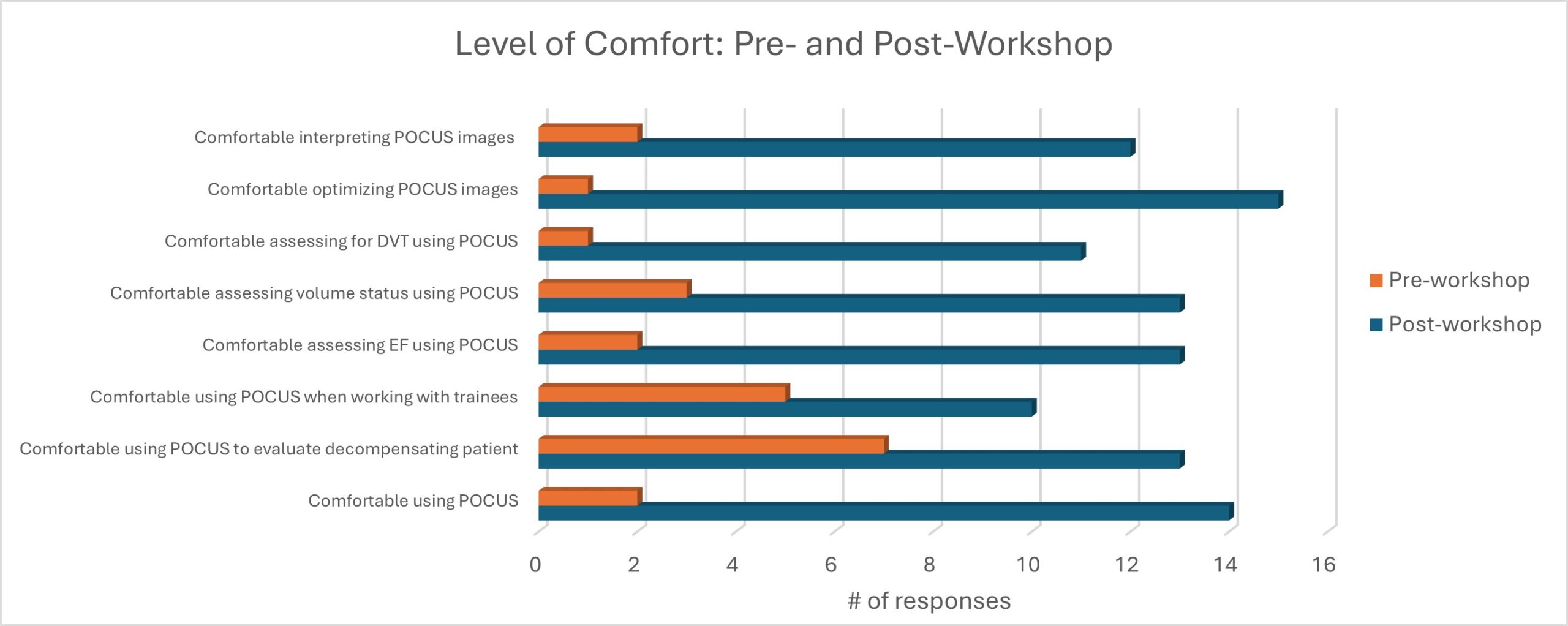
Description: 26 providers participated in 2 workshops from May to October 2024. 19 providers responded to our pre- and post-workshop surveys (73% response rate). 17% of our participants were 0-3 years out of residency, 33% of our participants were 3-5 years out of residency, and 50% of our participants were over 5 years out of residency. Our pre-test average for our knowledge-based assessment was 70% whereas our post-test average was 86%. We assessed our participants’ ability to identify key physiology, including volume status and cardiac function. Ability to correctly identify vascular congestion on POCUS images increased from 50% to 100% pre- to post-workshop. Ability to identify lung point indicating a pneumothorax increased from 27% to 60% pre- to post-workshop. We also assessed participants’ level of comfort using POCUS before and after our workshop. Comfort using POCUS increased from 10% to 77% pre- to post-workshop. Comfort using POCUS to evaluate a decompensating patient increased from 37% to 72% pre- to post-workshop. Comfort using POCUS to assess ejection fraction increased from 10% to 68% pre- to post-workshop. Comfort with image optimization increased from 5% to 78% pre- to post-workshop.
Conclusions: Implementing a POCUS training program improved provider confidence and diagnostic knowledge. We have designed a program that includes didactic teaching, simulation center training workshops, and recurring monthly teaching points distributed electronically to create a multimodal training program for hospitalists at our institution. While our providers felt more comfortable using and interpreting POCUS images, we have not yet measured impact of workshop training on hospitalist real-time clinical utilization during their daily work. Next steps include evaluating if the providers who participated in our training program are more likely to use ultrasound in real time by tracking utilization through standardized documentation.