Background: Lipoprotein(a) [Lp(a)] has recently gained recognition as an important genetically inherited biomarker for predicting coronary artery disease (CAD) risk. With targeted Lp(a)-lowering therapies on the horizon, understanding the prevalence and clinical impact of high Lp(a) levels (≥125 nmol/L) has become increasingly relevant for hospital-based clinicians. The distribution of high Lp(a) varies considerably among different populations, and elucidating these variations could help refine risk assessment and enhance primary prevention strategies.
Methods: A descriptive cross-sectional study was conducted from January 2022 to December 2024, including consecutive adult patients who underwent Lp(a) testing at a community-based hospital. Patients were categorized into high Lp(a) (≥125 nmol/L) and normal Lp(a) groups. Baseline comorbidities were comparable between groups, minimizing confounding effects. Associations between elevated Lp(a) and demographic characteristics (sex, race) as well as clinical outcomes, including CAD prevalence and need for percutaneous coronary intervention (PCI) or coronary artery bypass grafting (CABG), were analyzed using chi-square testing.
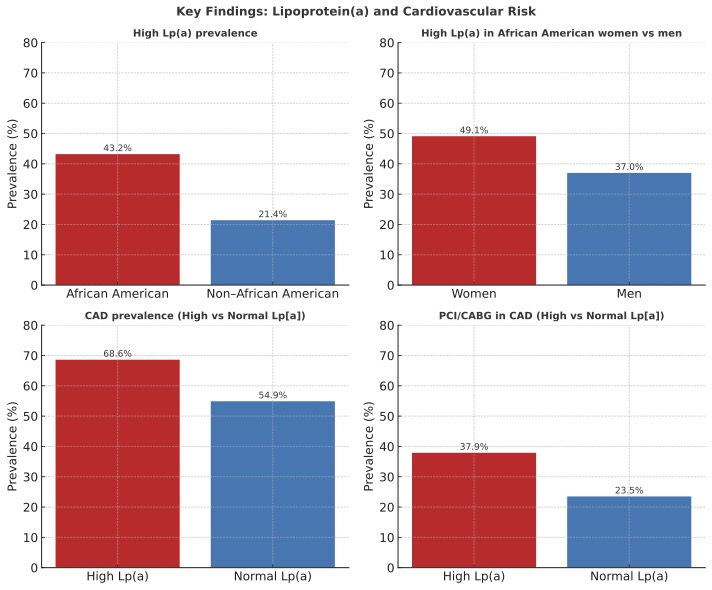
Results: Among 833 patients (mean age 63 ± 14 years; 53% male), 27% (n=223) had elevated Lp(a). High Lp(a) was more prevalent in African American patients compared with non–African American patients (43.2% vs. 21.4%, p< 0.001). Within the African American cohort, women were more likely than men to have elevated Lp(a) (49.1% vs. 37.0%, p< 0.001). CAD prevalence was significantly higher among patients with elevated Lp(a) versus those with normal Lp(a) (68.6% vs. 54.9%, p=0.0004). Among CAD patients, those with high Lp(a) were more likely to undergo PCI or CABG (37.9% vs. 23.5%, p=0.0001). (Figure 1)
Conclusions: Elevated Lp(a) is significantly more prevalent among African American women and is strongly associated with higher rates of CAD and coronary interventions (PCI/CABG). These findings emphasize the importance of Lp(a) screening in hospitalized and high-risk patients to identify those with increased cardiovascular risk. Integrating Lp(a) assessment into routine care could improve prevention efforts, guide timely Cardiology referral, and advance health equity through targeted, population-specific risk stratification.