Background: Advance care planning (ACP) has been shown to improve patient quality of life, ensure end of life wishes are known, increase earlier hospice referrals, and decrease aggressive medical interventions at end of life. It has also been shown to decrease caregiver stress, anxiety, and depression. The Surprise Question, “Would you be surprised if this patient died within the next year?”, is a tool that was developed to prompt providers to think about whether their patient would benefit from ACP. For every patient admitted to NYULH, the admitting provider must answer the Mandatory Surprise Question (MSQ): “Would you be surprised if this patient died within the next 6 months? Yes/No”. The time frame of 6 months is used as this is the required prognosis for hospice referral. If the MSQ response is “No”, EPIC asks the provider to document an ACP note and/or consult geriatrics/palliative care. The intent of the MSQ is to prompt providers to identify patients who would benefit from ACP activities early in the admission. There is limited research on whether the response to the MSQ at the time of hospital admission influences the quality of care and clinical outcomes in the inpatient setting. In this study, we aim to evaluate the impact of the admission MSQ response on the presence and timing of ACP activities during hospitalization.
Methods: This was a retrospective, propensity score matched cohort study assessing the association between the MSQ response and the presence and timing of ACP documentation and palliative care consultation. The study included patients admitted to the Hospital Medicine service across three sites over a five-year period (June 2020- May 2025) with a discharge disposition of “expired” or discharged to hospice care (inpatient or outpatient). The primary exposure was MSQ response at time of admission. The primary outcomes were presence of ACP documentation or palliative care consultation. The secondary outcomes were time to ACP documentation or palliative care consultation from time of admission.
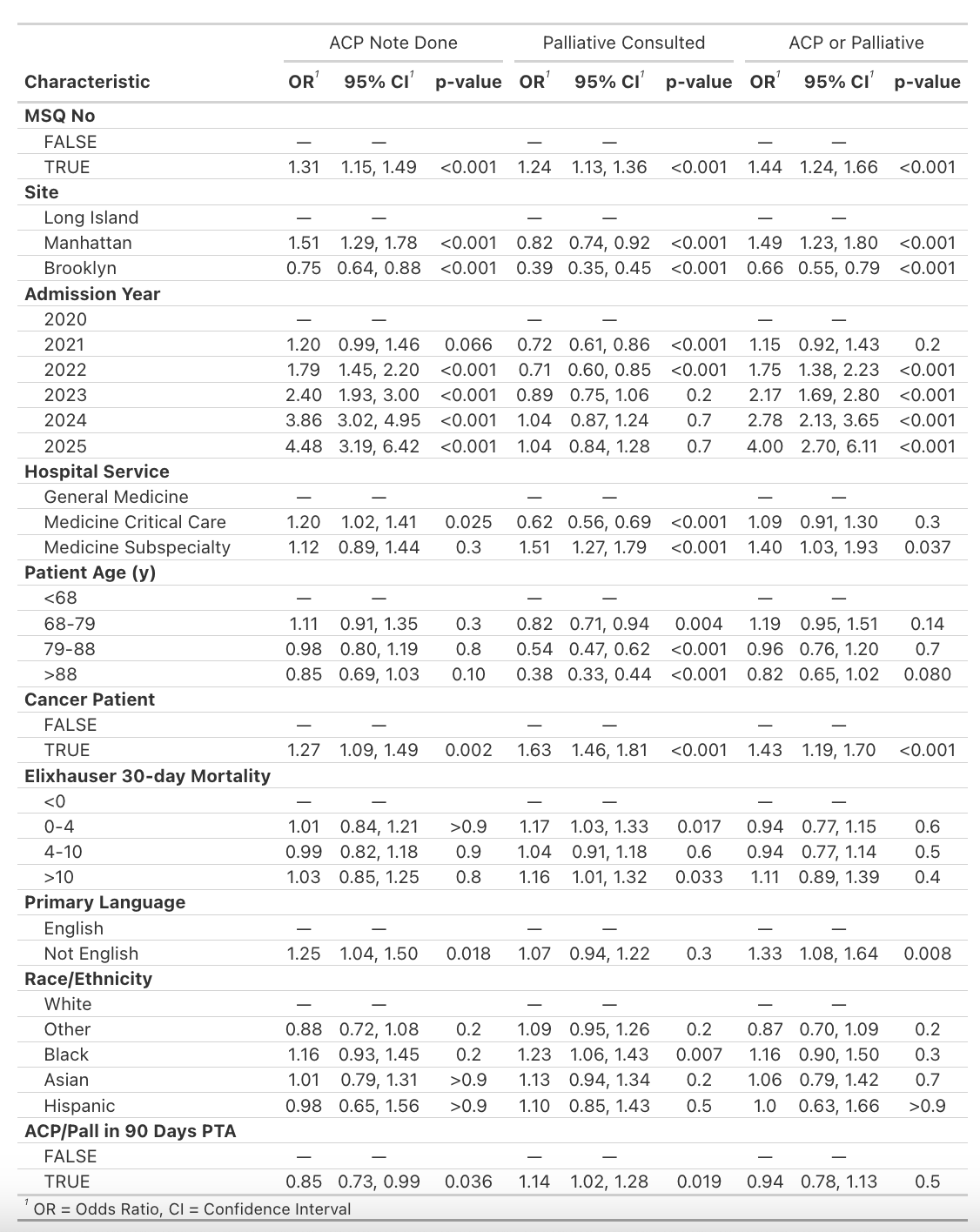
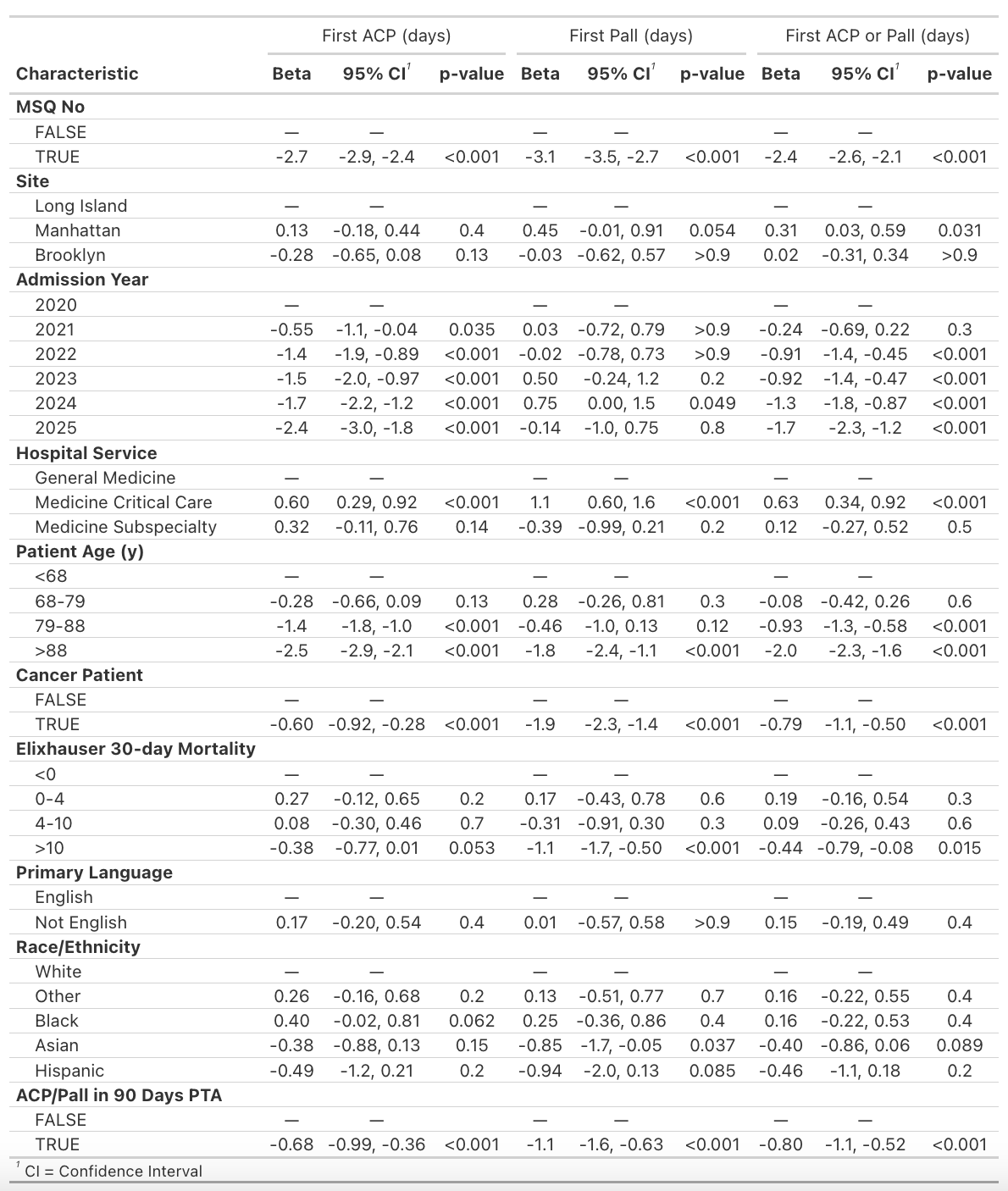
Results: After propensity matching, 9,136 encounters were analyzed. Patients with an MSQ response “No” on admission had 44% higher odds of having ACP documentation or palliative care consultation compared to those with a response “Yes” (CI 1.24 – 1.66, p < 0.001) (Table 1). Patients with an MSQ response “No” received ACP documentation or palliative consultation 2.4 days earlier than those with a response “Yes” (CI -2.6 - -2.1, p < 0.001) (Table 2).
Conclusions: An MSQ response “No” at time of admission was associated with an increased presence of ACP activities, and earlier timing of ACP activities. Several studies have examined MSQ response accuracy, and findings suggest that provider accuracy in answering the MSQ has significant variability. Our study suggests hospital systems should invest in tools and interventions that support providers in identification of patients with high risk of mortality at time of admission, in an effort to encourage ACP activities for patients that would benefit most. Further studies may explore if these interventions lead to sooner and increased ACP documentation, palliative and geriatrics consultations, and hospice referrals.