Background: Functional status plays a major role in determining discharge disposition in hospitalized adults such as need for nursing care facility vs home. (1-4) No specific diagnosis codes exist to capture functional status, limiting our ability to study its impact further. Some clinicians document functional status components in their clinical notes. Large language models (LLMs) can identify an individual’s overall functional status by capturing different functional concepts from clinical notes. We studied the correlation between LLM mobility functional status identification and discharge disposition in hospitalized adults.
Methods: Following institutional review board approval,198 hospitalized encounters among patients aged ≥65 years including both medical and surgical admissions were included. Clinical notes from 1 week before hospital admission and all notes during the hospitalization were analyzed using functional status LLM. Function was classified into five mobility functional status classes adapted from the International Classification of Functioning, Disability, and Health (ICF): Changing and maintaining body position; Carrying, moving and handling objects; Walking and moving; Moving around using transportation; and Mobility, unspecified. Functional ability in each class was categorized as impaired, possible impairment, unimpaired, and no information. Frequencies were summarized using descriptive statistics, and functional ability was compared between discharge disposition categories using chi-square tests in SAS v9.4.
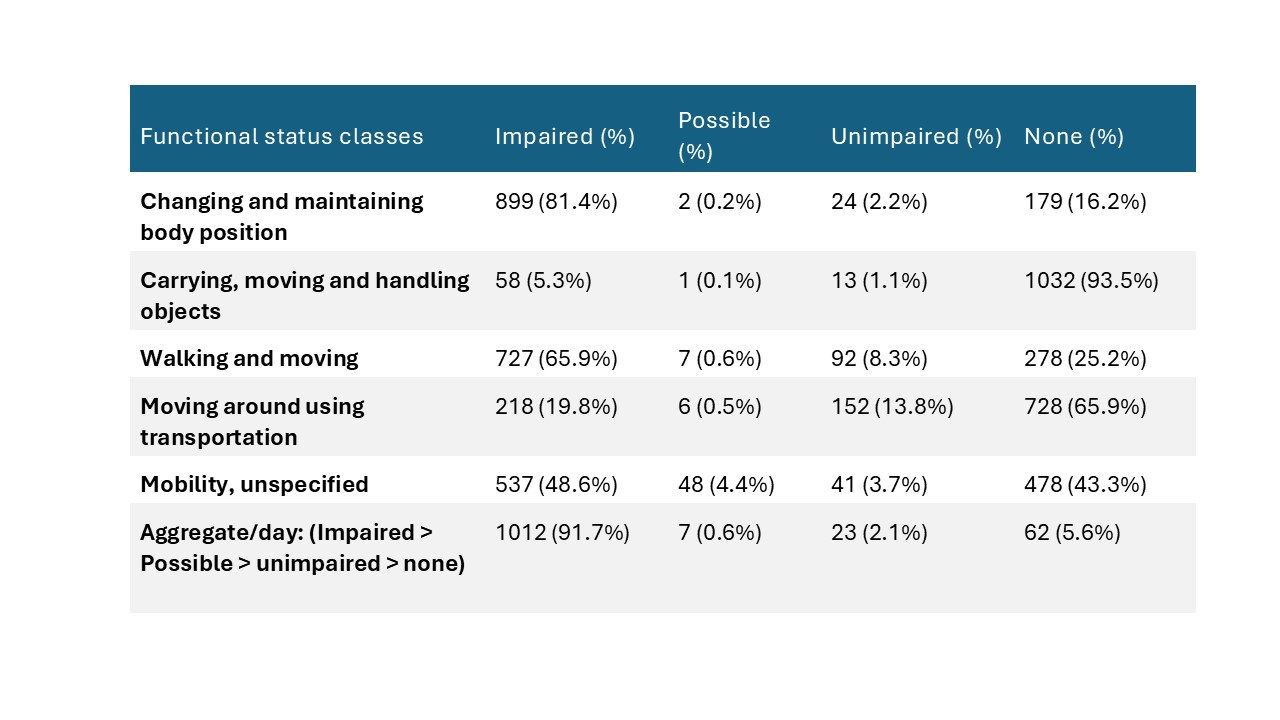
Results: 1104 clinical notes were analyzed, which included 152 unique hospitalized patients. Most clinical notes had some mention about mobility functionality (94 (Table 1). More information was documented for “Changing and maintaining body position” (83.8%) and “Walking and moving” (74.8%), while information about “carrying, moving and handling objects” was least documented (6.5%). A statistically significant association (p< 0.0001) existed between the discharge disposition location and the functional impairment categorization by the LLM model. 76.5% of patients discharged to skilled nursing facility had 2 or more functional impairments as noted by the LLMs. Of the 91 patients who discharged home, a majority (n=53, 58.2%) had one or less impairments.
Conclusions: Functional status LLM was useful for identifying mobility functional status from clinical notes and was significantly associated with discharge disposition. LLM should be further leveraged in advancing healthcare delivery based on functional status.