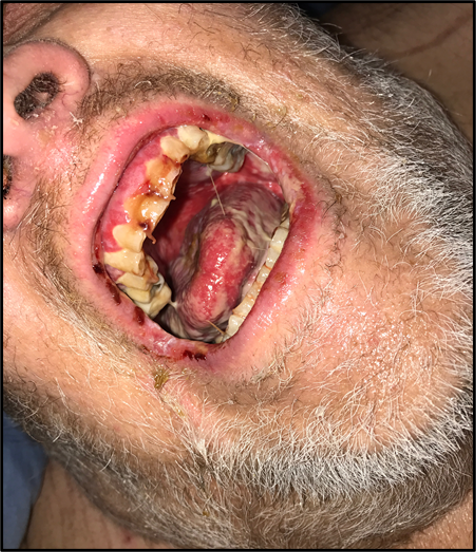
Case Presentation: A 64-year-old male presented to the Emergency Department with fevers, anorexia, flank pain and two months of progressive oral sores diagnosed as refractory oral candidiasis by his outpatient provider. Comorbidities included hypertension and obesity (body-mass-index 70). Labs revealed an elevated white blood cell count (14,000/L). Bilateral pyelonephritis was diagnosed on computed tomography. Broad spectrum antibiotics were initiated and he was admitted to the hospital for management of pyelonephritis. While his fever and flank pain resolved with treatment of the pyelonephritis, he continued to have poor PO intake due to severe odynophagia from extensive gingival disease and oral ulcerations. These oral manifestations were a presumed consequence of oral candidiasis refractory to multiple outpatient antifungal therapies prior to admission. Notably, he was not immunocompromised and reported good oral hygiene at home. Additional history was obtained, revealing he had a mild case of COVID-19 eight weeks prior for which he did not seek medical attention. While his respiratory symptoms and generalized malaise resolved after several days, thereafter he developed progressive xerostomia, mouth sores and reduced PO intake, leading to a 40lb weight loss over 6 weeks. The oral lesions were treate as oral candidiasis, but progressed despite several weeks of outpatient antifungal therapy.Considering his significant weight loss, a nutritional evaluation was pursued. Ascorbic acid (Vitamin C) returned severely low at < 0.1mg/dL (normal reference range 0.5 – 2.0 mg/dL), consistent with a diagnosis of Scurvy. Dermatology was consulted and agreed that his orocutaneous lesions were a manifestation of untreated Scurvy and unlikely to have been oral candidiasis. Considering this, a closer skin examination was conducted and revealed perifollicular hemorrhages in the sparsely distributed hair follicles of the lower legs (sparse hair distribution was likely due to undiagnosed peripheral arterial disease). Unfortunately, before high-dose Vitamin C was administered, the patient aspirated and developed acute hypoxemic respiratory failure requiring intubation. Due to progressive respiratory decline, his family elected to pursue comfort measures. He died several days later.
Discussion: Scurvy is a disease characterized by severe vitamin C deficiency. It has classically affected those with low body weight and poor access to food. While previously rare in the developed world, cases of scurvy have been rising in an unexpected population since the 1970s: patients with obesity. Obese individuals have lower bodily stores of vitamin C compared to those of normal weight. An acute illness, such as COVID-19 in this patient, can rapidly deplete already low Vitamin C levels, placing them at a high risk for scurvy and severe health consequences.
Conclusions: Individuals with obesity are at higher risk of malnutrition compared to normal weight individuals because of diets that are comparatively higher in calories, but lower in nutritionally dense foods such as fresh fruits and vegetables. However, individuals with obesity are rarely screened for malnutrition as they are classically considered “well-fed” due to their body habitus and excess weight. As such, nutritional deficiencies are often undiagnosed, leading to significant morbidity and mortality as evidenced in this case.