Background: We see high rates of Emergency department (ED) use in urban settings, and pregnant women are no exception. There are numerous valid concerns a woman may have that lead her to seek care in the ED during pregnancy, accompanied by potential underlying factors that explain increased ED use during this time. We examined a broad set of social, health, and health care factors to determine whether they were associated with use of the ED in pregnancy.
Methods: We used data from the June 2009-December 2011 LIFE birth cohort study of preterm birth to perform a secondary analysis. The study recruited 1411 African American (AA) women immediately postpartum in a Detroit suburban hospital. Data collection involved an interview 2 days postpartum, and medical abstraction. Our primary research question looked at ED visits during pregnancy in AA women across a wide range of socioeconomic status, examining prenatal exposures and experiences associated with ED visits. We computed Odds Ratios to compare proportions with chi square tests of statistical significance using health history x ED visit and prenatal counseling x ED visit.
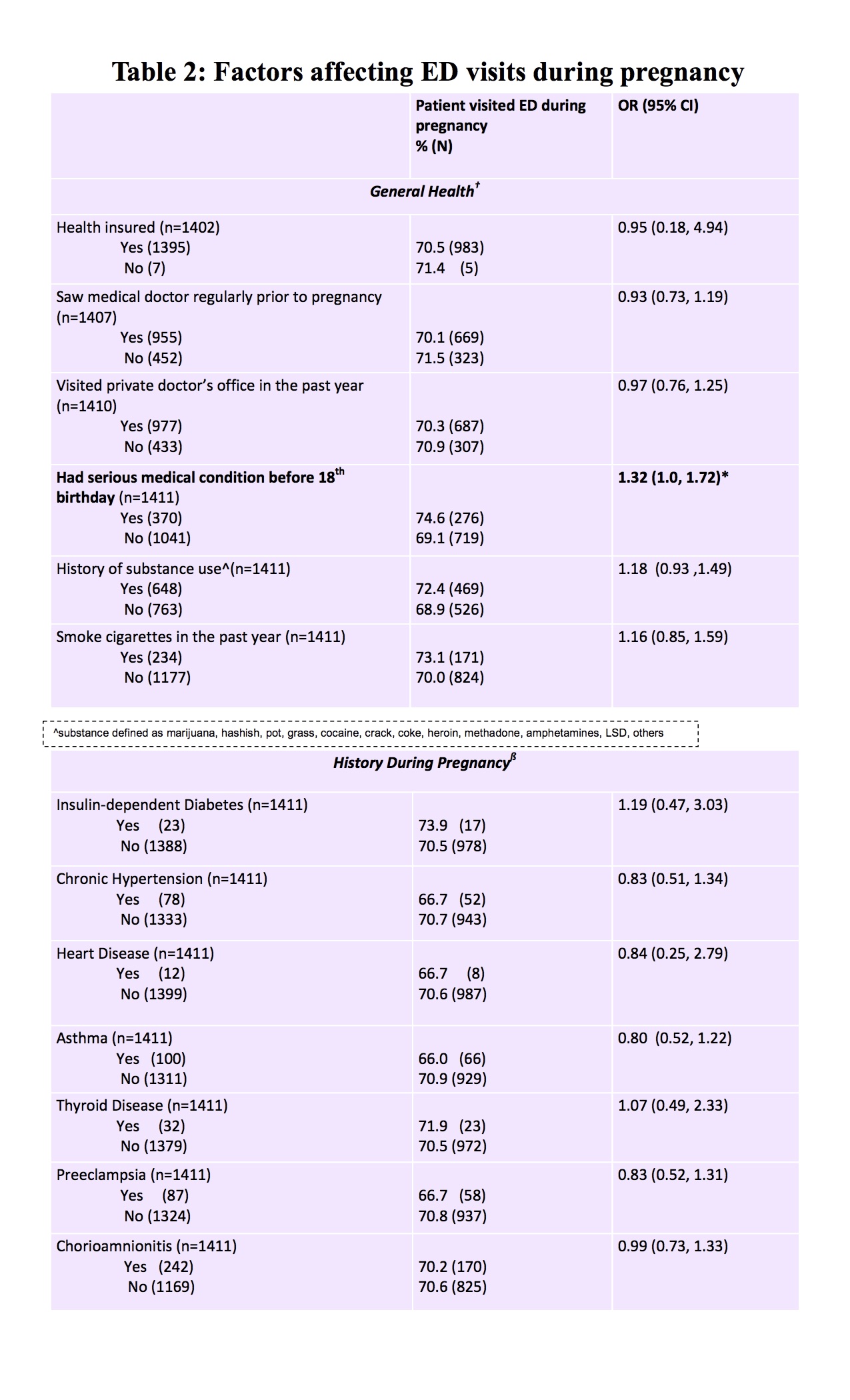
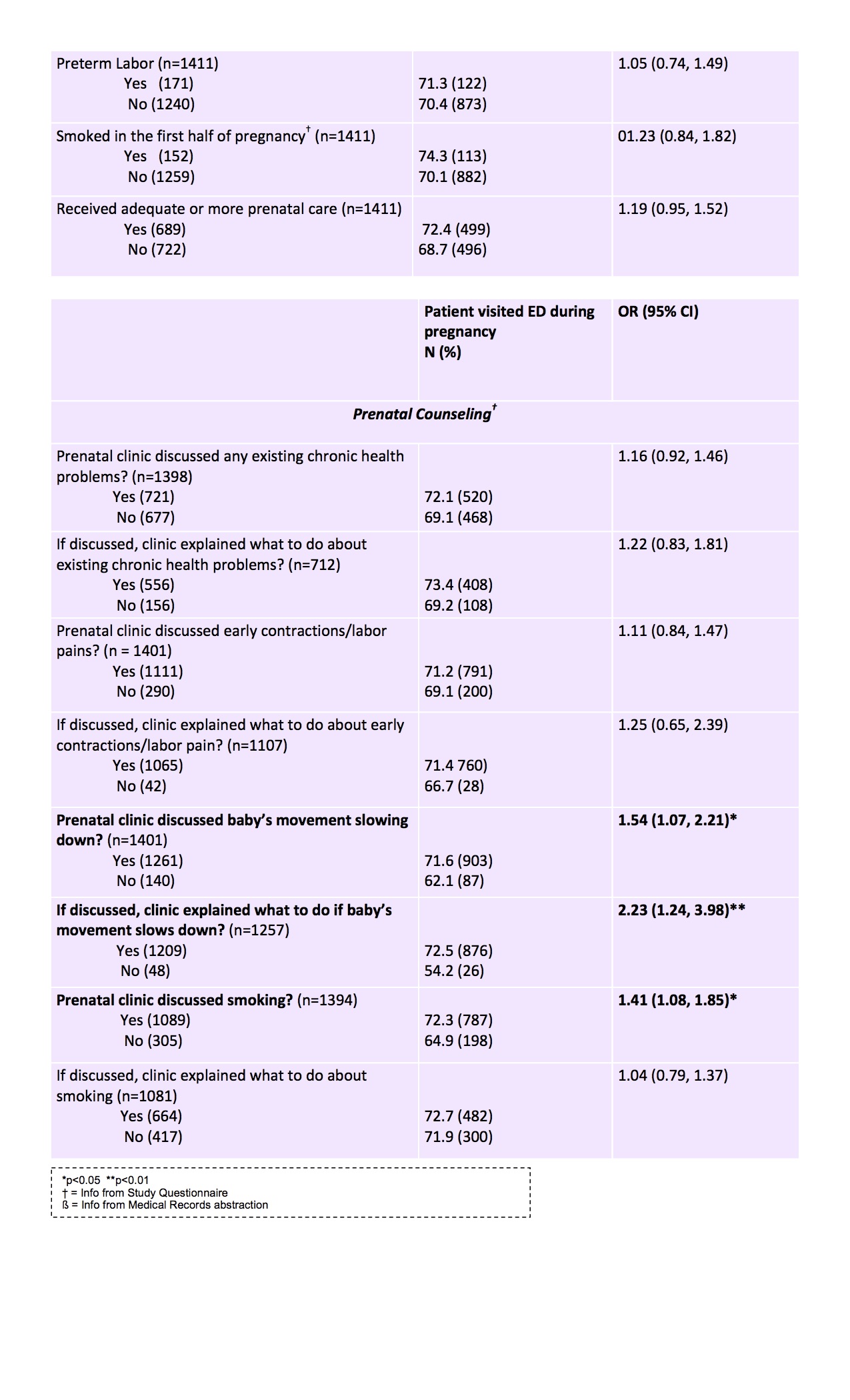
Results: 70.5% (n=995) had ≥1 visit to the ED during pregnancy. A history of chronic conditions prior to pregnancy, such as asthma (Odds Ratio (OR), 0.89, confidence interval (CI): 0.64-1.25), hypertension (OR, 0.90, CI: 0.55-1.46), or diabetes (OR, 3.38, CI: 0.77-14.78), was not a significant predictor of ED use in pregnancy. Receiving adequate (or more) prenatal care (OR, 0.84, CI: 0.66-1.05) was also not a significant predictor of ED use in pregnancy. There were few factors associated with a statistically significant increased likelihood of ED use during pregnancy in the LIFE cohort of AA women. Women with a serious medical condition before their 18th birthday were about 30% more likely to go to the ED. Women whose prenatal counseling discussed baby’s movement slowing down, whether or not they were told what to do, were about 50% more likely to have an ED visit during pregnancy. Among these women, women who were told by the prenatal clinic WHAT TO DO about baby’s movement slowing down were more than 2 times more likely to go to the ED during pregnancy. Finally, women whose prenatal counseling included the topic of smoking were about 40% more likely to go to the ED during pregnancy
Conclusions: It should not be assumed that ED use in pregnancy is wrong. What is appropriate use of the ED during pregnancy, and how to educate women to determine that, must be established. Women with prior health concerns may be going to the ED for concerns outside of pregnancy, but those may affect the pregnancy. Whether prior health concerns warrant ED use during pregnancy, or if ED use is a product of lack of primary care prior to pregnancy, needs to be established. For the latter, routine care for women must be provided and maintained prior to pregnancy to decrease ED usage during pregnancy. Our results showed prenatal counseling increased ED usage. This may be an important area of focus to address appropriate ED use in pregnancy. Further work must be done to determine if the content of prenatal care intends to increase ED use during pregnancy, or if it is an unexpected outcome. We ask clinicians and researchers to question what is causing high rates of ED use in pregnancy, and what is the role for prenatal care providers. Potential areas of intervention include updating and standardizing prenatal counseling for all pregnant women, directly counseling women about ED usage, and improving resources for pregnant women after-clinic hours, outside of the ED.