Background: Inherent biases of healthcare professionals can result in interactions with colleagues that lead to workplace tension and hostile environments, due to a practice called othering. Othering is a frame that captures the many forms of prejudice and persistent marginality such as race, gender, sexuality, religion, income, and disability. In opposition to othering, belonging is defined as inclusion and opportunity to impact decision-making; having the power to create the structures that shape a community. Targeted Universalism (TU) is a methodology for creating belonging with a novel step-by-step approach. Building belonging requires universal goals for all and targeted approaches to reach those goals. TU has been applied across wide contexts – classrooms, nonprofits, organizations, businesses, government institutions.
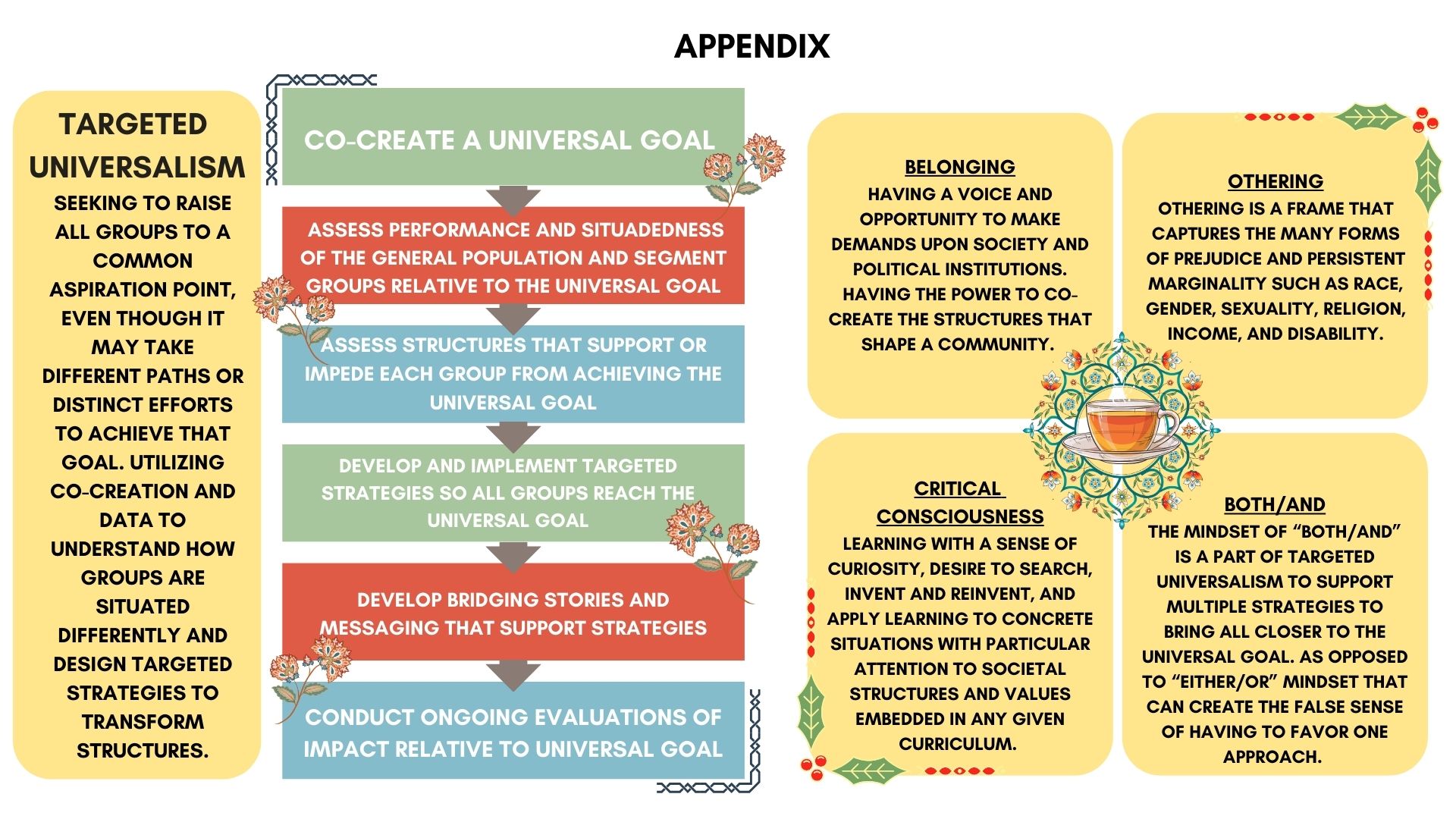
Purpose: To cultivate a stronger sense of community within healthcare teams, it is important to create space for dialogue to learn and to practice skills, attitudes, and behaviors that promote belonging. To promote belonging amongst a diverse group of healthcare professionals in a single institution, we sought to teach and practice TU. We chose to teach the steps of TU, and practice applying the first step: co-creation of a universal goal. Due to the novel methodology of TU, participants were unfamiliar with the concept and the learning objectives centered on describing and defining terminology (figure 1), followed by practicing to apply the first step of TU.
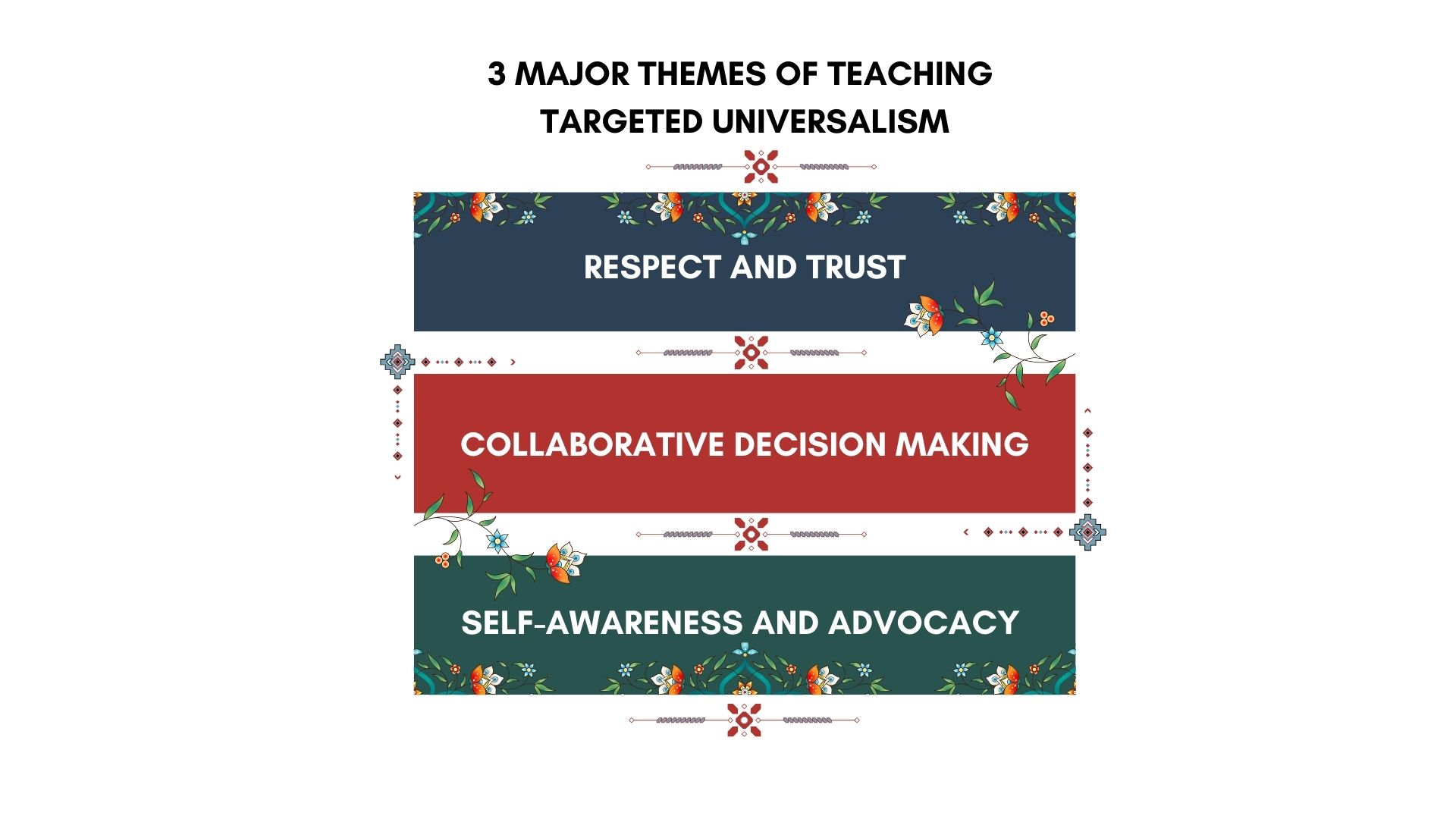
Description: In a single half-day of an in person faculty and staff development education session, participants including hospital staff, faculty, leadership, and clinicians, came together to learn and apply TU. The dialogue prompts were designed intentionally to create a welcoming space for participants who may not all be familiar with each other by starting with an invitation to share the “origin story” – why pursue a career in healthcare? After learning the steps of TU in the didactic portion, participants responded to the prompt to co-create a universal goal to promote belonging. With permission, the participants co-created universal goals were recorded and transcribed and analyzed for themes. Participants were administered post-session opt-in surveys that included free text responses and thematic qualitative analysis was completed using survey responses. There were 18 participants and 11 completed the opt-in post-session survey. On a 4-point (not at all-slightly-moderately-completely) Likert scale to measure learning objectives, on average participants were moderately able to define terminology (figure 1) and apply the first step of TU to co-create a universal goal by the end of the session. Teaching TU elicited three major themes 1) creating belonging and strengthening relationships through an inherent sense of respect and trust, 2) valuing differences and empowering others to share opinions in group-decision making, and 3) urging action through self-education, advocacy and self awareness of positionality in social issues (figure 2).
Conclusions: Teaching TU impacted the sense of community and belonging in a group of healthcare professionals in a single institution. By applying the methodology of TU, there is a step-by-step approach for co-creating universal goals and building belonging. Targeted universalism can facilitate community conversation, address sources of oppression, and prioritize the benefit of marginalized populations while co-creating a goal that the community as a whole will benefit from.