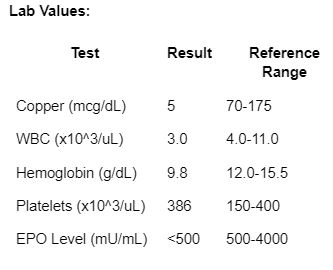
Case Presentation: A female patient was referred to hematology/oncology with severe neutropenia and leukopenia. Bone marrow biopsy revealed ringed sideroblasts with multilineage dysplasia consistent with MDS. Further diagnostic workups did not reveal common genetic mutations, and she was scheduled to start treatment with either erythropoietin or luspatercept. Copper deficiency was later found in follow-up, which might have been a contributing factor. Copper supplementation was initiated and, in the course of therapy, the abnormal hematological findings of the patient had near complete resolution with repletion of copper levels.
Discussion: Copper deficiency is a rare nutritional deficiency that can cause pancytopenia and can easily be misdiagnosed as myelodysplastic syndrome (MDS). The World Health Organization defines ringed sideroblasts as a key feature of MDS, a feature that can be shared with copper deficiency, which can complicate the diagnostic landscape. Similarities in bone marrow findings and peripheral blood counts can often be difficult to distinguish between the two conditions. In cases where patients present with pancytopenia and initial bone marrow biopsy suggests MDS, a negative SF3B1 mutation should prompt a thorough evaluation of copper levels. Differentiating between a true MDS diagnosis and a metal deficiency that mimics MDS is essential for appropriate treatment. Additionally, while SF3B1 mutations and other genetic markers are vital in the assessment of MDS, clinicians should also consider evaluating for mineral deficiencies, such as copper and, less commonly, zinc, which can produce similar bone marrow findings. This case report highlights the importance of careful diagnosis and the potential for copper supplementation to resolve dysplastic features in the bone marrow.
Conclusions: This case identifies the need to include copper levels when cytopenias and ringed sideroblasts are identified. It also emphasizes the broader relevance to hematologists and physicians in general internal medicine for the awareness of nutritional deficiencies in the presentation of possible myelodypslastic syndrome, especially in the context of mutation negative patients. This patient’s disease had near complete resolution with the institution of copper replacement therapy, thereby underlining a probably underappreciated cause of dysplasia and emphasizing the importance of an extensive diagnostic workup.