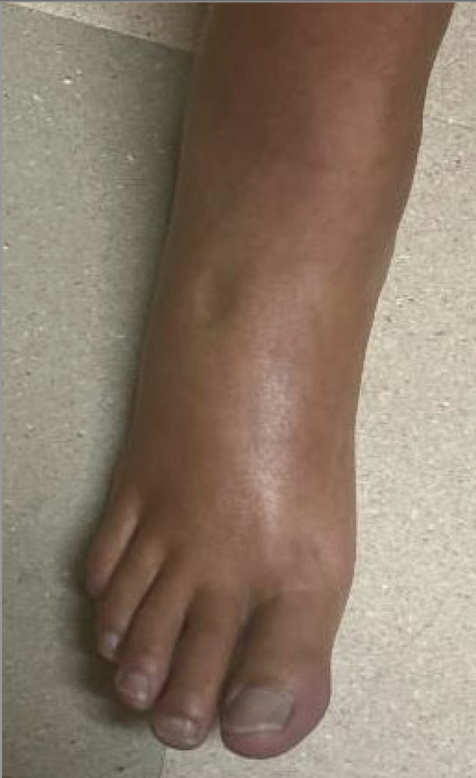
Case Presentation: A 66-year-old male presents as an urgent new patient evaluation to rheumatology with new complaints of abrupt bilateral hand and foot swelling for six weeks with difficulty flexing fingers and toes. The swelling remained constant throughout the day, not improving with activity or rest. The patient was recently seen by his primary doctor who was initially concerned for new onset gout and started him on colchicine with no improvements. After switching to prednisone, the patient had a complete resolution of the swelling in a few days. Unfortunately, shortly after the prednisone was completed, the hand and foot swelling re-occurred. During this time, the patient, who had a history of prostate cancer with resection, recently started radiation due to recurrence of his cancer. Physical exam revealed bilateral pitting edema of the hands and feet with swelling to the wrists and ankles. No rashes, joint tenderness or other deformities were noted. Outpatient labs were obtained showing a normal uric acid and negative ANA, CCP, and RF. Given the history of a robust response to prednisone and seronegative rheumatological work-up thus far, it was concluded that remitting seronegative symmetrical synovitis with pitting edema (RS3PE syndrome) was the likely diagnosis and the patient was started on a long tapering course of prednisone over the next three months with reported resolution of his symptoms. The patient also continued to receive treatment for his prostate cancer. However, after having missed a single day of his prednisone therapy, the patient had recurrence of his symptoms, and it was ultimately decided to add hydroxychloroquine 400 mg daily to act as a steroid sparing agent in addition to continuing prednisone 2.5 mg daily.
Discussion: This case illustrates the importance of correct diagnosis and treatment of a rare syndrome that could easily be missed in a primary care or hospital setting for other rheumatological conditions–gout in this case. The diagnosis of RS3PE is clinical and requires a good history and physical exam, as common rheumatological markers will be negative. In most cases, a prednisone taper is sufficient for treatment and remission of RS3PE. However, as in this case, patients who have ongoing cancer and RS3PE, may require the addition of hydroxychloroquine for disease management. It is also possible that the earlier diagnosis of RS3PE, which has a known association with cancer, could have led to the patient’s earlier referral for the treatment of his recurring prostate cancer.
Conclusions: Remitting seronegative symmetrical synovitis with pitting edema (RS3PE syndrome) is a rare rheumatological condition involving abrupt onset small joint inflammation with a characteristic subcutaneous pitting edema of both hands and feet. The symptoms usually quickly resolve with small doses of prednisone. The syndrome has been more associated in patients older than 50 and has some correlation with cancer diagnosis, but the true etiology of this syndrome remains uncertain. The best estimated prevalence of RS3PE is 0.09%. Although rare, RS3PE should be included in the differential for any polyarthritis in order to avoid misdiagnoses and ensure patients are treated appropriately.