
Background:
Elevated platelet count is frequently reported to be associated with iron deficiency. However, the causes underlying iron deficiency vary with age and may have differential effect on platelet count. Therefore, we hypothesized that the effect of body iron stores (BIS) on platelet count varies between younger and older individuals.
Methods:
Participants (N = 14,440) in the Third National Health and Nutrition Examination Survey (1988‐94) older than 20 years were divided into younger (≤ 35 years, n = 5085) and older (>35 years, n = 9355) cohorts. As there is no single perfect measure of BIS, we ran 3 sets of analyses, each using 1 of the 3 measures of BIS [serum iron (SI), transferrin saturation (TS), and serum ferritin (SF)]. In addition, to examine a differential role of lower versus higher BIS on platelet count, we used a spline separating low from high BIS measures (spline knots at 50 μg/dL for SI, 25 ng/mL for SF, and 20% for TS). Multivariable analyses adjusting for BIS, age cohort, smoking status, C‐reactive protein (CRP), white blood cell count (WBC), glomerular filtration rate, race, sex, and serum folate were performed with and without an interaction between age cohort and a measure of BIS. WBC, CRP, serum folate, and SF were log‐transformed to meet the assumption of normality.
Results:
Of the study participants, 54% were women, 27% were African Americans, and 26% were smokers. Mean (SD) platelet count was 274,000 (71,000)/μL, hemoglobin 13.9 (2.3) g/dL, SI 87 (37) μg/dL, TS 25% (11%), and SF 133 (148) ng/ mL. Consistent with the previously reported findings, without an interaction term, all measures of BIS in the lower range were inversely and significantly associated with platelet count, but this association was not present at higher ranges of BIS. On the other hand, when the interaction term was include in the model, the inverse association between lower‐range BIS and platelet count was present only in the older cohort and was absent in the younger cohort. There was a positive association between BIS in the higher range and platelet count in the younger cohort, although it reached statistical significance for SI only. In contrast, there was an inverse association between BIS in the higher range and platelet count in the older cohort, although it was significant for only ST (Table 1).
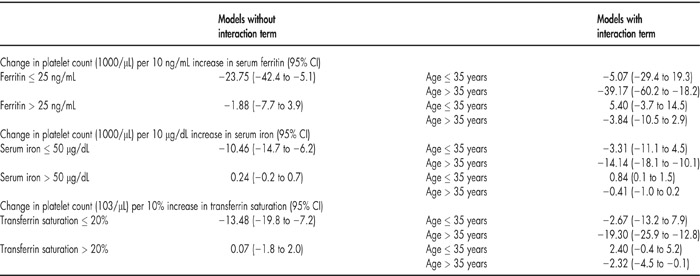
TABLE 1 Relationship Between Platelet Count and Body Iron Stores with Effect Modification by Age
Conclusions:
Low iron levels are inversely associated with platelet counts only in individuals >35 years, not in individuals ≤ 35 years. This differential inverse association between low iron levels\ and platelet count could be a result of different causes of iron deficiency in the 2 age groups. Hospitalists should be aware of the differential effect of age while evaluating the cause of thrombocytosis in the presence of iron deficiency.
Disclosures:
R. Qayyum ‐ none; J. Adomaityte ‐ none; M. Khawaja ‐ none; A. Rehman ‐ none; S. Shakeel ‐ none; M. Amer ‐ none