Background: Peer-to-peer discussions between hospitalists can support clinician decision-making and diagnostic reasoning. However, there is no standard approach to training hospitalists to facilitate effective and collegial conversations with peers about diagnostic excellence. As a part of the Achieving Diagnostic Excellence through Prevention and Teamwork (ADEPT) study we created and piloted a novel standardized teaching model to develop hospitalists’ skills in facilitating structured discussions with peer hospitalists whose patients experienced a rapid response. We recruited 52 hospitalists from the 13-hospital ADEPT Collaborative to participate in the training.
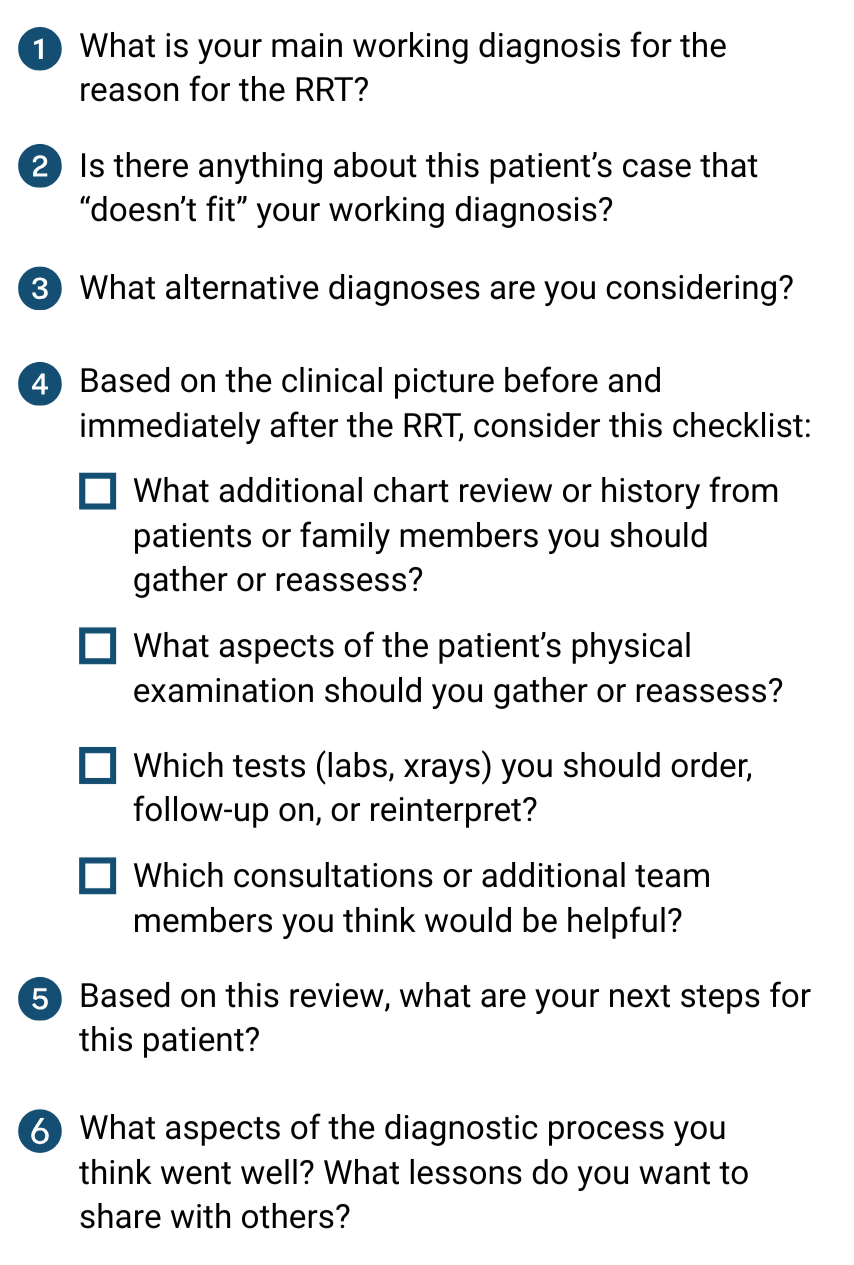
Purpose: Effective feedback about the diagnostic process requires clinical expertise and communication skills that promote reflection, curiosity, and trust. As a result, our training session emphasized reflective dialogue, humble inquiry, and aimed to maintain diagnostic rigor while supporting psychological safety, fostering collaboration, and nurturing a growth mindset. We also trained facilitators to use the novel Diagnostic Cross-Check Tool (Table 1) to incorporate a component of structure to the diagnostic reflection.
Description: Training sessions lasted between 60 and 90 minutes and were held in-person or via video conference. It began with didactics on appreciative inquiry and motivational interviewing principles, followed by a guided review of the novel Diagnostic Cross-Check Tool. We then worked through six role play scenarios during which participants applied the concepts. Our scenarios included: one involving a clinician who was not engaged in the cross-check process; another where the clinician was a divisional leader with potential authority over the cross-checker; and a case where the clinician perceives the cross-check as a threat to their autonomy. Each role-play included a cross-checker, a primary clinician, and an observer. After each case, participants received feedback on the observed interaction. The session concluded with a structured debrief to reflect on verbiage, strategies for managing difficult interactions, and consolidate lessons learned.During a pilot of the cross-check program, trained hospitalists carried out 125 cross-checks across all sites. 98.8% of the primary clinicians stated they would participate again, and 91.8% were satisfied or very satisfied with the process. Many cited the collaborative nature and constructive feedback as key strengths.
Conclusions: We developed and iteratively refined a role-play–based training program for diagnostic cross-checkers that emphasizes reflective listening, humble inquiry, and psychologically safe dialogue. The curriculum pairs unstructured conversation with structured, checklist-guided reflection to support diagnostic reasoning. Implementation across sites was feasible, and provides a scalable model for embedding reflective, peer-facilitated diagnostic support into hospital medicine practices. This approach may also inform broader initiatives to advance diagnostic excellence and patient safety.