Background: More frequently, clinicians encounter patients with mild-to-moderate COVID-19 (defined as patients whose oxygen saturation remains above 94% on room air)1 in the hospital setting.2 These patients may have acquired COVID-19 in the hospital or have tested positive for COVID-19 while presenting to the hospital for another condition.3 Many of these patients are high risk for disease progression based on their age and comorbidities4, and guidelines recommend clinicians treat these patients with antivirals if they are within 5-7 days of when symptoms started. 5,6 This study assessed how many hospitalized patients with mild-to-moderate COVID-19 received antiviral treatments, and explored the reasons why antiviral treatments may not have been given.
Methods: We randomly reviewed 500 hospitalized patients 50 years of age or older who tested positive for SARS-CoV-2 by PCR at Charleston Area Medical Center (CAMC) between March 1, 2022 and August 27, 2023 and had symptoms of SARS-CoV-2 infection with the goal of identifying patients with mild-to-moderate COVID-19 eligible for treatment.When a patient with mild-to-moderate COVID-19 within 5 days of symptom onset did not receive antiviral treatment, a member of the study team conducted a detailed chart review to determine the reasons why and classified each patient using the following criteria: 1) antiviral therapy was offered, and the patient or consenting representative declined treatment; 2) antiviral medications were not offered because concern about drug interactions was expressed by the provider; 3) antiviral medication was not offered due to concerns about the patient’s liver or kidney function; 4) antiviral medication was not offered due to determination of mild disease or because the patient did not require supplemental oxygen; or 5) no reason was mentioned as to why antiviral medication was not prescribed.
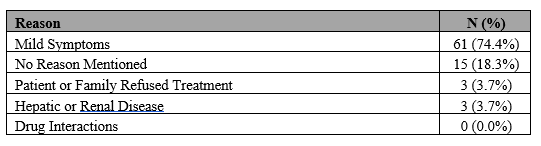
Results: Of 500 hospitalized patients with symptomatic COVID-19, 123 patients (24.6%) met the inclusion/exclusion criteria and were identified as having mild-to-moderate COVID-19 and being eligible for antiviral treatment. Of these patients (40 of 123 patients; 32.5%) received antiviral treatment; 36 were treated with remdesivir, and 4 were treated with nirmatrelvir/ritonavir. The majority of eligible patients (83 patients, 67.5%) did not receive antiviral treatment. The most common reason documented as to why antiviral medication was not prescribed was that the patient had mild symptoms (61 patients, 74.4%).
Conclusions: Our study suggests that inpatient providers are not treating most hospitalized patients with mild-to-moderate COVID-19 eligible for antiviral treatment, with the most common reason being the patient had mild symptoms or was not hypoxic. This suggests a need to increase the utilization of antiviral medications in preventing disease progression in high-risk hospitalized patients with mild-to-moderate COVID-19.