Background: The opiate epidemic remains a major national public health crisis with approximately 50,000 overdose deaths reported annually [1]. This epidemic stems in part from the over prescription of opiates and is therefore inexorably linked to physician prescribing habits. In recent years, non-physician providers such as physician assistants and nurse practitioners have become increasingly vital in the provision of primary care, supplying up to 25% of primary care in certain areas [2]. In this study, we used the Medicare Provider Utilization and Payment Data: Part D Prescriber Public Use File (PDPPUF) to evaluate changes in opioid prescribing habits of major physician specialties and non-physician providers.
Methods: We searched the Medicare PDPPUF for opiate prescriptions reimbursed from 2013 to 2017, which are the years available in the dataset. Opiate medications queried included codeine, fentanyl, methadone, morphine, oxycodone, and tramadol. Prescribing trends evaluated included Medicare claims by specialty and total number of Medicare claims. Chi-squared goodness-of-fit tests were used to calculate differences in prescribing trends between years.
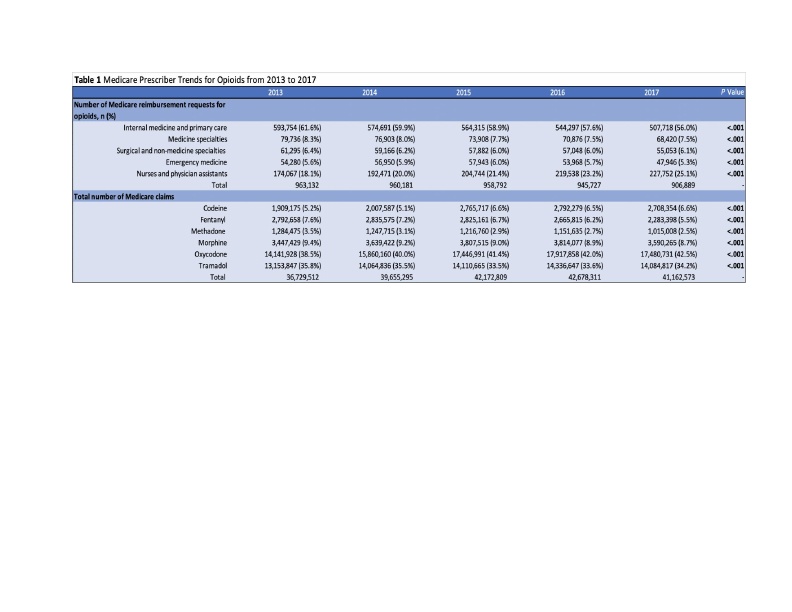
Results: The majority of Medicare reimbursement requests for opiate prescriptions were filed by internal medicine/primary care providers, accounting for 61.6% of all prescriptions in 2013, followed by non-internal medicine physicians at 20.3% and non-physician providers at 18.1%. From 2013 to 2017, the number of opiates prescribed by internal medicine/primary care physicians decreased by 14.5% (P < .001). Non-internal medicine physicians similarly decreased prescriptions by 12.2% (P < .001). However, non-physician providers increased prescriptions by 30.8% (P < .001). By 2017, non-physician providers grew to account for 25.1% of all Medicare opiate prescriptions. Overall number of opiate prescriptions decreased 6% (P < .001), with significant increases noted between 2013 and 2015 for codeine, fentanyl, morphine, oxycodone, and tramadol (P < .001).
Conclusions: The number and proportion of prescription reimbursement requests by internal medicine/primary care and non-internal medicine physicians significantly decreased between 2013 and 2017 while the overall number of opiate prescriptions decreased only slightly. This disconnect appears to be driven by increasing opiate prescription by non-physician providers. Recent data has shown that targeting specific providers with education-based interventions can decrease opiate prescription by greater than 50% [3]. Non-physician providers are vital for expanding the provision of primary care; however, the observed trends suggest that interventions targeting the prescribing habits of these providers may be effective in decreasing total opiate prescriptions and overdose deaths.