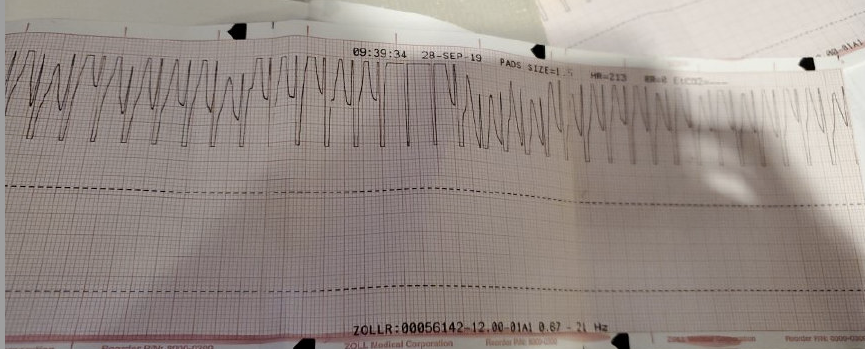
Case Presentation: A previously healthy 17 year old man presented to the emergency room with complaints of progressively worsening palpitations, associated dyspnea and chest pain. He had presented two years earlier with a similar complaint and was found to have a heart rate (HR) 200 beats/min, with K 2.8 mmol/L and Cr 0.8 mg/dL with concern for sinus tachycardia vs supraventricular tachycardia (SVT). He was discharged on no medications and was subsequently lost to follow up. On arrival, patient’s HR was 210-220 beats/min with a narrow complex tachycardia with no visible P waves on the telemetry strip (Figure 1). BP was 121/74. HR was non-responsive to Valsalva maneuvers, but responded to 6 mg adenosine. Post-adenosine 12-lead EKG showed sinus tachycardia of 110-120 beats/min (Figure 2). Labs revealed K 3.0 mmol/L, Cl 106 mmol/L, Mg 1.7 mmol/L, P 1.5 mmol/L, CO2 21 mmol/L, Cr 0.98 mg/dL, with anion gap 13. Urine showed pH 7, urine anion gap 13.1, urinary Na 112 mmol/L and urinary calcium/creatinine ratio 0.29 and no evidence of infection. Echocardiogram revealed normal anatomy and function. Patient was discharged on atenolol after consultation with cardiology and given recommendations to follow up with primary care and cardiology as an outpatient.
Discussion: We present a case of an adolescent with a recurrent episode of SVT, found to have hypokalemia on both occasions. Other more common causes of hypokalemia, such as GI losses or significantly decreased PO intake were not present. His kidney injury, borderline hyperchloremia and borderline low bicarbonate suggestive of a hyperchloremic metabolic acidosis with normal anion gap, a urinary pH > 5.3, urinary sodium >25 mmol/L, positive urinary anion gap 13.1 mmol/L and elevated urinary calcium/creatinine > 0.28, increased our suspicion for renal tubular acidosis (RTA), especially distal RTA. Hypokalemia can induce arrhythmias, through its effects on cardiac contractility and action potentials, though more commonly is associated with ventricular tachyarrhythmias (1). Retrospective studies have shown a large percentage of patients in SVT with normal electrolytes (1). Case reports of distal RTA, however, have shown cardiac abnormalities such as secondary AV block, atrial flutter, and symptoms mimicking coronary ischemia in the setting of hypokalemia (2, 3). We suggest that our patient’s recurrent SVT may have been caused by hypokalemia in the setting of an underlying RTA through an unknown mechanism, resulting in multiple hospital visits.We also highlight the importance of pursuing more thorough diagnostic efforts while in the hospital rather than relying on repeat laboratory work-up in the outpatient setting in cases of adolescents nearing transition to adult care with known poor follow-up. As in our 17 year old teenager, a blood gas while in the hospital could have solidified the diagnosis of a RTA, thus potentially preventing future visits to the hospital, as he has to date not followed up with primary care nor cardiology on discharge.
Conclusions: Providers should pursue more thorough work-ups in patients with recurrent SVT, especially when electrolyte abnormality such as hypokalemia with no other known cause is present. Renal tubular acidosis, though rare, should be kept on the differential. Focused and thorough diagnostic efforts may help prevent future episodes of SVT and hospital revisits.