Background: Patient-centered communication, defined as delivering information simply and accurately, is a critical component of health literacy. However, curricula to teach patient-centered communication are not standardized in medical school or residency. The objective of this study was to evaluate whether a brief educational session can improve the use of patient-centered communication among medical students and residents.
Methods: This IRB-exempt study used an anonymous pre-post survey design across five Graduate Medical Education sites (internal medicine/family medicine residents and medical students) within a large health system. A pre-session survey evaluated resident perceptions of the importance of patient-centered communication (5-point Likert scale) and a free-text evaluation of patient-centered language using a case vignette of a patient with heart failure (graded by 2 independent Hospitalists using a 3-point Likert scale) based on the use of layman terms, simplifying complex information into manageable chunks, and avoiding medical jargon. A post-session survey assessed free text answers and satisfaction with the training session. T-tests were used to evaluate pre/post free text responses.
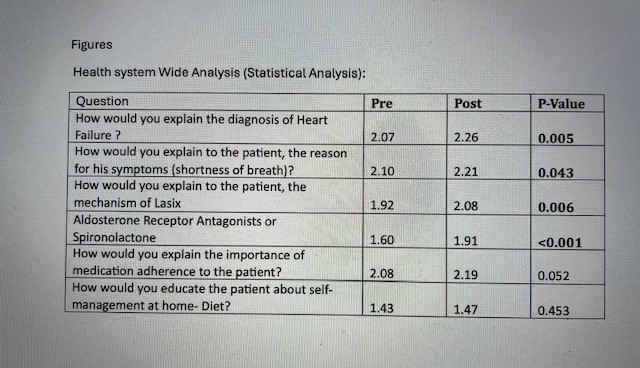
Results: A total of 122 learners participated in the training session, of which 53% (n=65) were residents, 50% (n=61) were between 25-29 years old, 40% were male (n=49), 32% were Asian (n=39), and 24% (n=29) were white. Incomplete surveys were excluded n(28).With regard to learner perspective on the importance of health literacy and person-centered language, 40% (n=50) rated health literacy as a significant (Likert scale 4-Often and 5-Always) barrier to patient’s health, Overall, there was significant improvement on 4 out of 6 free text questions explaining: diagnosis of heart failure (2.07 vs. 2.26, p=0.005); symptoms of heart failure (2.10 vs. 2.21, p=0.043); mechanism of furosemide (1.92 vs. 2.08, p=0.006); and mechanism of aldosterone receptor antagonists (1.60 vs. 1.91, p=< 0.001). There was no difference in explaining: medication adherence (2.08 vs. 2.19, p=0.052) and diet self-management (1.43 vs. 1.47, p=0.453). In the post-education satisfaction survey (Likert scale 4-Often and 5-Always), 71% (n=87) reported that this session would change their communication practices and 32% (n=38) wanted additional education in patient-centered communication.
Conclusions: This study highlights the need for targeted education to help residents and medical students improve patient-centered communication using simple, layman-friendly language. Structured training can enhance their ability to present medical information clearly, leading to better patient understanding and outcomes.