Background: In the ever-evolving field of healthcare, the need for physicians to understand cost considerations is paramount. Cultivating cost awareness among residents is critical as residents play a pivotal role in shaping the future of medicine. However, the incorporation of cost-consciousness into medical education remains a challenge, often overshadowed by clinical priorities. By examining current practices and understanding of cost awareness in residency training programs, the necessity of integrating cost-consciousness into the core curriculum of medical residency programs can be determined. Embracing a holistic approach to medical education that encompasses both clinical excellence and fiscal responsibility is essential for ensuring the delivery of high-quality, value-based care.
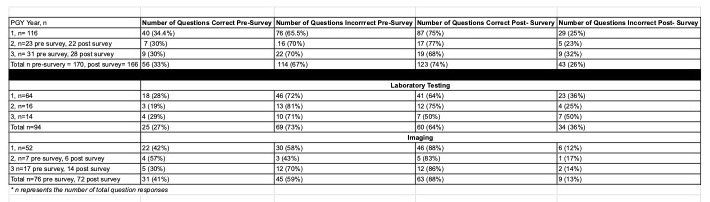
Methods: A cross-sectional survey was conducted among internal medicine residents using a questionnaire. The survey assessed knowledge of the costs of common inpatient lab tests and imaging, perceptions of cost awareness, and attitudes towards evaluating cost when ordering tests. The cost of common labs and imaging were incorporated into 4 interactive didactic sessions, where a clinical case was discussed among internal medicine residents. Residents were divided into breakout groups and encouraged to order the minimum tests needed to reach a diagnosis. The group ordering the least expensive tests while still reaching the diagnosis won. The prices were obtained from the hospital’s standardized Medicare cost list and the hospital’s online cost-estimator calculator. A post-intervention survey was then conducted at the end of the session. When comparing the total number of question responses in both the pre-survey (n=170) and post-survey (n=166), there was a 41% increase in number of questions with correct responses.
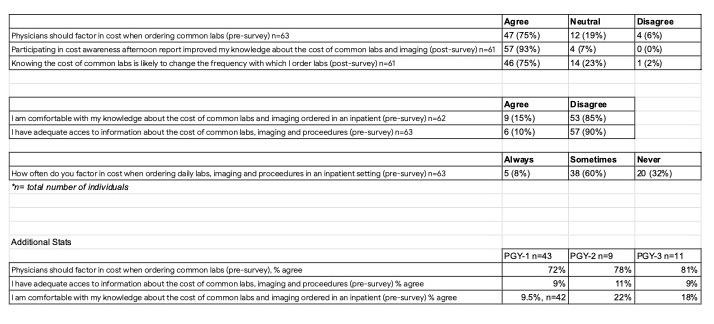
Results: Based on our data, 85% of the total residents who participated in the pre-survey question (n=62) stated that they are not comfortable with their knowledge about the cost of common labs and imaging ordered. 90% of the total residents who participated in the pre-study question (n=63) stated that they do not have adequate access to information about the cost of common labs, imaging and procedures. However, 75% of total residents who participated in the pre-study question (n=63) stated that they agree that physicians should factor in cost when ordering labs. After the session, 93% of the residents who participated in the post survey question (n=61) agreed that participating in the cost awareness afternoon report improved their knowledge about the cost of common labs and imaging. Among the questions answered by the PGY-1 class (n=119), 34.4% of questions were answered correctly on the pre-survey which increased to 75% of questions answered correctly after the sessions.
Conclusions: The incorporation of cost-consciousness into medical education has profound implications for patient care and healthcare system sustainability. Although some residents received prior education on cost containment, there were gaps in their knowledge of the costs of common medical tests. By providing residents with skills to navigate healthcare costs, we empower them to advocate for value-based care. Integrating cost awareness into medical residency will help bridge the gap between clinical expertise and fiscal responsibility. Teaching high-value care interactively and repetitively ensures both the health and financial well-being of patients.