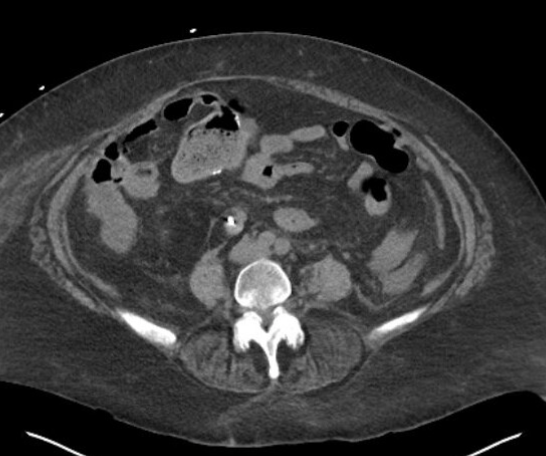
Case Presentation: A 74 year old lady with past medical history of urothelial cancer on pembrolizumab, atrial fibrillation on warfarin, systemic hypertension, diabetes mellitus and stroke presented from an outside hospital to the urology service with complaints of abdominal pain, fever and altered mental status. Her vitals on presentation were within normal limits with physical examination positive for confusion and no abdominal findings. Laboratory evaluation showed urinalysis concerning for infection, hemoglobin of 9 gm/dl and creatinine at her baseline of 1.9 mg/dl. She had a CT scan at the outside hospital that reported right-sided hydronephrosis. She was transferred to the medicine service and underwent a stent placement with urology on day 2. She was also started on broad spectrum intravenous antibiotics and her anticoagulation was held for forty eight hours per urology. She was febrile post procedure with improved abdominal pain. Her antibiotics were subsequently narrowed to cefepime alone with cultures remaining negative. Repeat CT scan on day 3 showed residual hydronephrosis and urology planned a cystogram on day 6. She had intermittent tachycardia with heart rate in the 130s related to her atrial fibrillation and dose of metoprolol was increased with intermittent low blood pressures down to 80s systolic. She was also restarted on heparin drip. She complained of crampy abdominal pain, poor appetite and constipation on day 4. Bowel regimen and ambulation was encouraged. She continued to complain of abdominal pain, and an abdominal Xray was done on day 5 which reported a normal gas pattern. On day 6, she continued to have abdominal pain, her hemoglobin dropped overnight from 8.6 to 7.2 gm/dl, exam revealed abdominal tenderness with peritoneal signs and she had intermittent hypotension. CT scan revealed a 9cm * 6 cm rectus sheath hematoma and 12cm * 9 cm extraperitoneal hematoma.
Discussion: Spontaneous rectus sheath hematoma is a serious complication while on anticoagulation. One study found that 36.4% of patients with non-traumatic retroperitoneal or rectus sheath hematomas were on intravenous heparin. Female sex and older age were found to be risk factors for an increased risk of bleeding while on heparin. Some of the additional risk factors included diabetes mellitus, hypertension, malignancy, alcohol use, liver disease, severe chronic kidney disease, peptic ulcer disease, anemia, prior stroke or intracerebral hemorrhage, bleeding disorder and concomitant use of other medications that increased risk of bleeding. Patients can present with abdominal pain, which can be sudden in onset and persistent, abdominal mass or swelling on exam, hypotension, tachycardia, drop in hemoglobin. Treatment consists of conservative management, holding or reversing anticoagulation and support with blood products. Some patients may require surgical consultation or interventional radiology consultation for selective embolization. A high index of suspicion must be maintained for patients on anticoagulation who have post operative pain which is persistent, and must necessitate further evaluation.
Conclusions: Patients on heparin are at risk of spontaneous bleeding which requires careful monitoring. Our patient improved with conservative management by holding heparin drip, blood transfusions and hemodynamic monitoring. Subsequently heparin was restarted and she was bridged to warfarin with no further issues with bleeding.