Background: Patient handoffs are known to be high-risk times for patient safety events. Standardized high-quality handoff processes help to reduce this risk and improve quality of care. The handoffs between the emergency department (ED) and hospital medicine (HM) at the time of hospital admission are especially complex as they involve a transition in specialty care teams, as well as a change in a patient’s physical location and unit staff (Smith, 2015). This project was undertaken in a community academic health system lacking a standardized handoff process between the ED and HM. Prior to the intervention, inpatient admission handoffs required paging and return phone calls for verbal handoffs. Both ED and HM physicians felt that the current process was inefficient, inconsistent, and often resulted in delays in care and miscommunications. Additionally, results from the American College of Graduate Medical Education (ACGME) Survey showed that only 66% of internal medicine (IM) residents felt that “Information is not lost during shift changes, patient transfers, or the hand-off process”.
Methods: A template was created within the electronic medical record (EMR) based secure messaging platform to standardize communication and provide a written handoff between ED and HM at time of admission in place of paging and call-back. ED and HM physicians were surveyed to evaluate efficiency and quality of communication, safety, and overall satisfaction with the new process. Outcomes monitored were length of stay (LOS) in the ED for admitted patients (median time from ED provider “decision to admit” to patients leaving the ED), and median time from “decision to admit” to admission order placement. Balancing measures included a change in level of care within 12 hours of admission, and the rate of admissions lasting 24 hours or less.
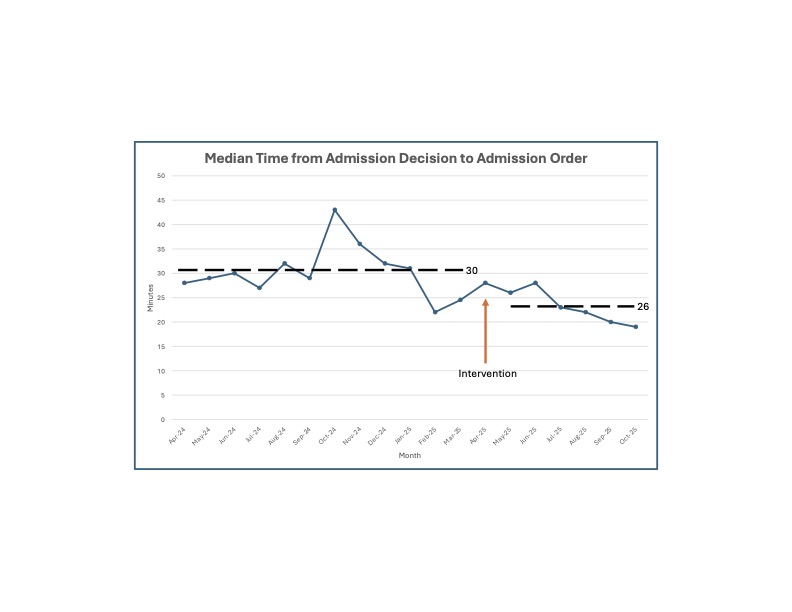
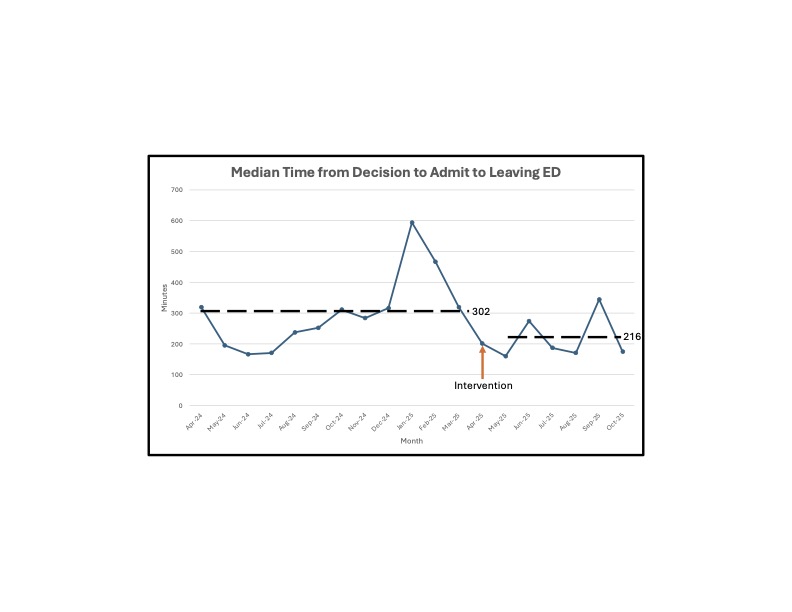
Results: 100% of ED and HM physicians responding to the survey adopted the new EMR based handoff process, and all reported they rarely or never required additional verbal communication for clarification. Time to placement of the admission order fell from 30 minutes to 24 minutes (Figure 1). ED LOS for admitted patients fell from 302 minutes to 216 minutes (Figure 2). The majority of ED and HM felt the new process enhanced the quality of the handoff they gave/received, and significantly improved efficiency and quality of inter-specialty communication and collaboration. ED physicians were more likely to report that the process positively impacted patient safety, and a majority of the ED and HM physicians did not observe any negative impacts on patient safety. Additionally, IM resident satisfaction with the handoff process improved from 66% to 77% on the ACGME survey. Data on balancing measures is forthcoming.
Conclusions: A standardized EMR based handoff process at the time of inpatient admission improved the efficiency and quality of communication and collaboration between ED and HM physicians without negatively impacting patient safety. The process reduced the time to admission orders being placed and ED LOS, improving throughput in the ED. These results also have significant implications for improving patient experience with better collaboration between care teams and decreased ED boarding time.