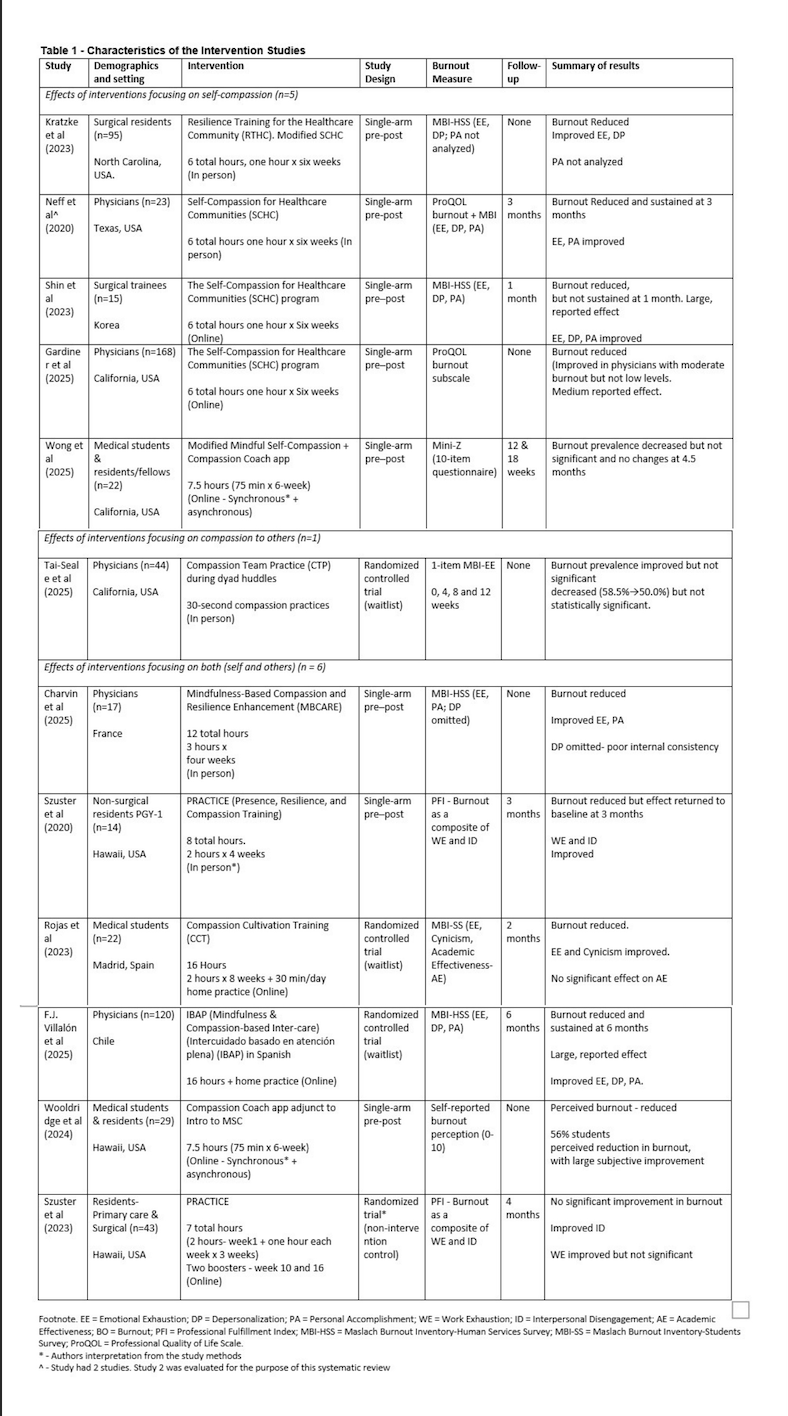
Background: Compassion interventions are emerging as a promising approach to reduce burnout among healthcare professionals [1-3]. While numerous studies have reported significant correlations between self-reported compassion and burnout[4, 5], it is not well understood whether compassion interventions are effective and for whom. To our knowledge, this is the first systematic review examining the effectiveness of compassion interventions on burnout in physicians (practicing physicians, resident physicians) and medical students.
Methods: We systematically searched PubMed and EBSCO in accordance with PRISMA guidelines [6] between September12th and18th, 2025. Articles were included if they evaluated the effects of compassion interventions on burnout among physicians or medical students. Of the 1,048 records screened by title and abstract, 66 met criteria for full-text review, and 12 ultimately met the eligibility criteria. Authors extracted data using a standardized form capturing population, intervention type, delivery format, burnout measures, and effect sizes, with all entries independently verified. Owing to methodological heterogeneity, we conducted a narrative synthesis following SWiM (Synthesis Without Meta-analysis) guidelines and grouped interventions into self-compassion, compassion to others, or both (self and others).
Results: Twelve studies involving 612 participants across six countries met inclusion criteria. Interventions focused on self-compassion in five studies, compassion to others in one study and both (self and others) in six studies. Overall, nine studies (75%) reported significant reductions in burnout, with five reporting effect sizes ranging from moderate to large. Only one study assessed longer-term outcomes, and demonstrated sustained benefits at six months. One study showed partial effect, with improvement in a single burnout subscale (8.3%), while two reported no effect (16.7%). Notably, the only study that investigated compassion to others as the primary intervention and found no impact on burnout. Effects were broadly consistent across diverse settings, sample sizes, populations (physicians, medical students, or mixed clinical groups), intervention duration, delivery mode (in-person or virtual) and study designs ( randomized and pre–post). However, the small number of studies limits the ability to draw subgroup comparisons.
Conclusions: Compassion interventions significantly reduce burnout among physicians and medical students, with many studies reporting moderate to large and few demonstrating sustained benefit. Future research is needed to explore the impact of compassion directed to others and assess long-term outcomes.
.jpg)