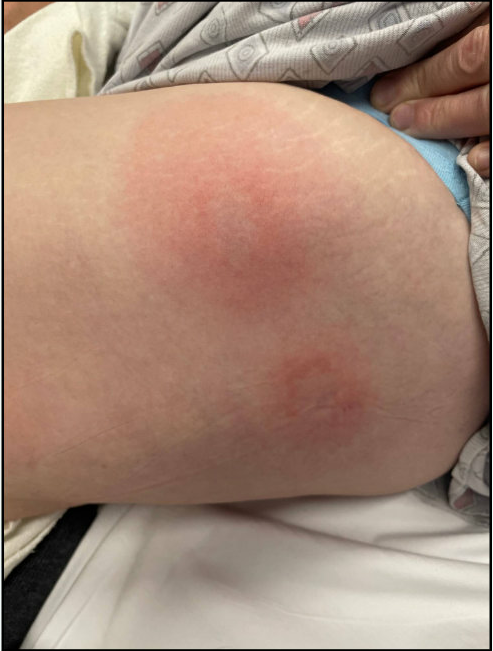
Case Presentation: 38-year-old healthy female presented with left sided facial droop, dyspnea on exertion and rash. Weeks before, she had myalgias, subjective fevers and fatigue. Days prior to presentation, she developed bilateral lower extremity edema, a mildly pruritic leg rash, and exertional dyspnea. The day of admission, she developed left sided facial droop. Exam revealed bradycardia, erythema migrans on her left thigh and left lower facial droop with asymmetric forehead wrinkling. Her stroke work-up was negative but she was bradycardic with first and second-degree type II heart block on ECG. She had negative troponins, elevated pro-BNP, elevated CRP/ESR. Her other laboratory work-up, including CSF studies, were unremarkable. Her rhythm evolved into complete heart block with ongoing bradycardia without hypotension. Given her new onset Bell’s Palsy, erythema migrans, and heart block, she was empirically treated for disseminated Lyme Disease with IV ceftriaxone. Relevant social history included that patient lived on a farm in northern Kentucky with regular exposure to ticks but no known bites or travel to an endemic Lyme region. Her two-tier testing for Lyme Disease was positive. After 4 days of IV ceftriaxone, her bradycardia resolved and she transitioned from complete to first degree heart block. She was discharged home with a Holter monitor and with a PICC line to complete 21 days of IV ceftriaxone.
Discussion: Lyme Disease is spreading in distribution(1). In 2017, a CDC report indicated that states considered to have endemic Lyme Disease had stable to slightly decreasing numbers of cases from 2008 to 2015(2). In contrast, the surrounding non-endemic states (such as Kentucky, Tennessee, Ohio, West Virginia, Iowa, Indiana, Illinois, North Dakota and South Dakota) had increased incidences of Lyme. For Kentucky in particular, there have been increasing rates of Borrelia burgdorferi in ticks(3). Our case emphasizes the relevance of this trend for non-endemic hospitalists. Providers in historically non-endemic regions must be equipped to properly diagnose Lyme–something that can prove challenging. PCR testing is frequently negative, and diagnosis often involves two-tier antibody testing (initial screening for total Lyme antibodies followed by either Western blotting or ELISA testing, specified as either IgM or IgG). If both tiers are positive, as in our case, specificity is over 95%(4). Early in the disease process, antibodies may be negative and diagnosis can be made with a high degree of suspicion and presence of erythema migrans. Our case also exemplifies the nuances of Lyme cranial nerve palsy, as the patient had partial–not full–weakness of the forehead muscles. This made the distinction between central and peripheral cranial nerve VII palsy more difficult. Thorough examination is critical. Finally, our case emphasizes the role of antibiotic therapy alone to treat Lyme Carditis with complete heart block. Unless a patient becomes hemodynamically unstable, pacemaker placement is not required as Lyme Carditis typically resolves within several weeks of antibiotic therapy(5).
Conclusions: Our case of disseminated Lyme Disease in a Kentuckian is unique but may become more common as the distribution of Lyme Disease spreads. Physicians practicing in areas bordering endemic states should be aware of the changing epidemiology of Lyme Disease, comfortable with interpreting diagnostic testing, and prepared to treat patients with significant complications such as complete heart block.