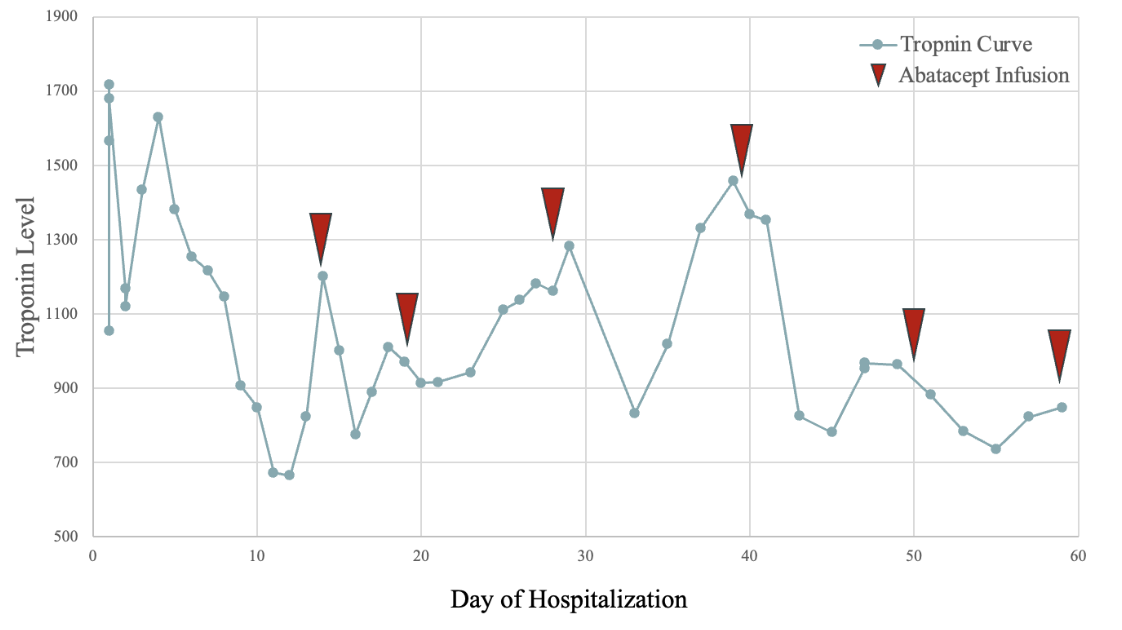
Case Presentation: A 79 year old man with a history of hypothyroidism and stage IIIb melanoma on pembrolizumab presented with worsening bulbar symptoms following the second dose of pembrolizumab. He had noticed mild left ptosis after the initial dose a month earlier. Physical exam was notable for dyspnea, bilateral complete ophthalmoplegia, and weakness in the lower extremities. Neurology was consulted and diagnosed the patient with myasthenia gravis associated with Triple M syndrome. On admission, labs were notable for a creatinine kinase of 5380 U/L and troponin elevated to 1718 ng/L (upper limit of normal 19 ng/L) with a normal EKG and echocardiogram. The patient was started on methylprednisone, followed by pyridostigmine. He was intubated on day 3 due to progressive diaphragmatic weakness. In addition to neurology, oncology, cardiology, and rheumatology were consulted, enabling coordinated, rapid escalation of immunosuppression. Second line therapy was implemented on day 3, with five sessions of plasmapheresis followed by five infusions of intravenous immunoglobulin (IVIG). On day 14, therapy was further escalated to ruxolitinib and abatacept. He has thus far received five additional abatacept infusions. Notably, each dose of abatacept was given after his troponin level was noted to be rising, followed by an abrupt downtrend. The patient remains hospitalized with continued improvements in strength, ocular movements, downtrending troponin, and gradual progress on long-term vent weaning protocol, with plan for discharge to inpatient rehabilitation.
Discussion: Triple M syndrome is a rare sequela of immune checkpoint inhibitor (ICI) use, characterized by a triad of myositis, myocarditis and myasthenia gravis, thought to be precipitated by T cell over-activation. Current studies estimate a < 1% incidence with a high in-hospital mortality rate of 40% [1]. However, incidence is likely underreported as this newly emerging condition may be misdiagnosed or unknown to healthcare professionals. A timely diagnosis and appropriate, multidisciplinary intervention is crucial, and can better address potential complications [2, 3]. Management of triple M is similarly understudied. A majority of cases are refractory to steroids and require prompt escalation to second-line interventions, often followed by immunosuppressants [1, 4, 5, 6]. Treatment of Triple M syndrome with ruxolitinib and abatacept is an off-label indication, often resulting in difficulty and delays with authorization. However, our patient had notable decreases to his troponin level immediately after each dose of abatacept, in addition to gradual recovery of his strength. In this case, timely initiation of therapy may have resulted in a more favorable outcome.
Conclusions: As the use of ICIs expands, the incidence of Triple M and other immune related adverse events will likely rise. Clinicians must maintain a high index of suspicion in patients presenting with overlapping neuromuscular and cardiac symptoms after ICI exposure. Early recognition, coupled with prompt coordination of multidisciplinary management, remains essential for optimizing outcomes in this high-mortality condition. Further work is needed to define optimal therapy and ensure timely escalation of treatment. Additional investigation into possible predisposing factors, such as underlying autoimmune disorders, as well as the feasibility of screening prior to ICI administration, may help identify patients at increased risk.