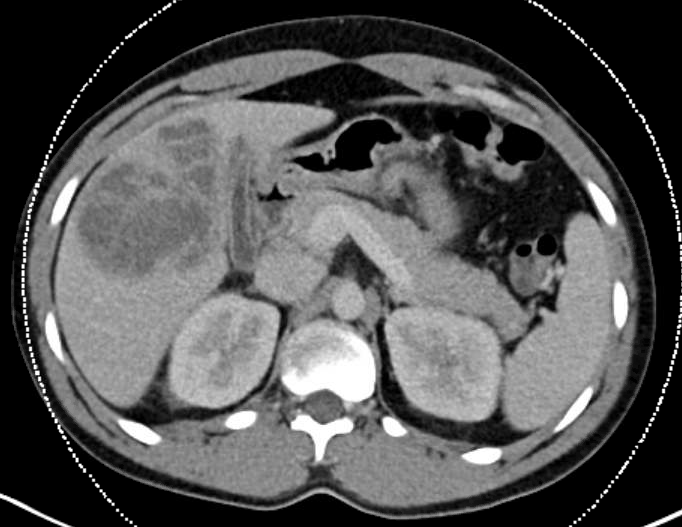
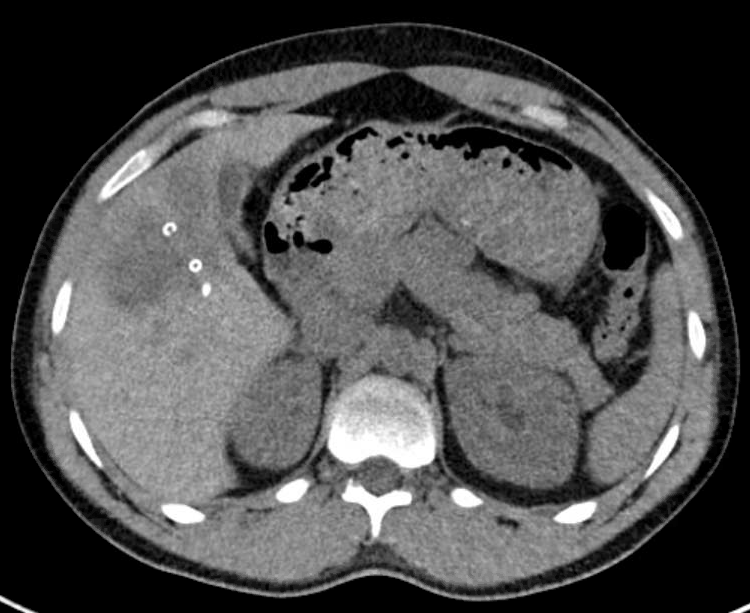
Case Presentation: A 24-year-old previously healthy male presented with 4 days of right upper quadrant pain and intermittent fever one month after arriving from Liberia. On admission, he was febrile to 99.9°F, mildly tachycardic to 109. Pertinent lab studies showed leukocytosis of 22.3K and thrombocytosis of 665. He was also found to have cholestatic abnormal liver function test. CT abdomen revealed multiple multiloculated right hepatic lobe lesions consistent with abscesses. He was empirically started on piperacillin-tazobactam and interventional radiology performed drainage with placement of two catheters. PCR from abscess fluid was positive for Entamoeba histolytica, prompting de-escalation to ceftriaxone and metronidazole. On day 7, platelet count peaked at 1,219 K/μL. Hematologist recommended JAK2 mutation testing which resulted as negative, hence, confirmed reactive thrombocytosis. No antiplatelet or anticoagulation therapy was initiated. Following clinical improvement and near-resolution of abscesses, one drain was removed by day 12, and platelets declined to 752 K/μL. The patient was discharged on a 4-week course of metronidazole and levofloxacin with complete recovery.
Discussion: Amebic liver abscess (ALA) typically presents with fever, right upper quadrant pain, and elevated liver enzymes — but marked reactive thrombocytosis (>1,000 K/μL) is rarely described. The degree of thrombocytosis can initially raise concern for myeloproliferative neoplasm (MPN) such as essential thrombocythemia, which was ruled out with negative JAK2 mutation testing. Infection and inflammation lead to elevated IL-6 and thrombopoietin, stimulating megakaryopoiesis. In ALA specifically, marked inflammatory response due to hepatic necrosis and systemic cytokine release may explain the unusually high platelet count. Platelet levels paralleled infection activity—peaking with inflammation and normalizing with resolution of abscess. Platelet trends serve as a marker of response to treatment. Importantly, reactive thrombocytosis rarely confers significant thrombotic risk. Recognizing this mechanism can prevent unnecessary marrow evaluation or anticoagulant therapy.
Conclusions: Amebic liver abscess may present with profound systemic and hematologic manifestations, including extreme reactive thrombocytosis. Contextual interpretation of laboratory abnormalities within the infectious picture prevents overtreatment and guides appropriate, targeted management.