Background: Patient-directed discharge – defined as leaving the hospital prior to completing recommended medical treatment – is associated with increased morbidity and mortality and occurs in 10-20% of hospitalizations for patients with opioid use disorder (OUD). Patients with OUD often cite untreated pain and withdrawal as contributing to their decision to leave the hospital by patient-directed discharge. Hospitalizations are a reachable moment when patients can be initiated on life-saving medications for opioid use disorder (MOUD), methadone and buprenorphine, which have also been shown to be associated with decreased odds of patient-directed discharge. Despite this, only 15- 20% of patients with OUD receive MOUD during hospitalization. Likely related to this infrequent use of MOUD, the rate of patient-directed discharge is approximately ten times higher for patients with OUD compared to patients without OUD. Understanding the risk factors for patient-directed discharge is essential to improving outcomes for this population. We hypothesized that, among patients with OUD who receive methadone treatment while hospitalized, early and higher doses of methadone would be associated with decreased risk of patient-directed discharge.
Methods: We conducted a retrospective observational cohort study in a single academic health center in the Northeastern United States from July 1, 2019 – June 30, 2022. Participants were hospitalized adults with OUD, with methadone not listed in their medication history, who received methadone during the first 72 hours of admission. Exposure was cumulative dose of methadone received 24, 48, and 72 hours after initial evaluation in the emergency department. Primary outcome was patient-directed discharge by 48, 72, 96 hours, or ever, as indicated by discharge disposition in the patient’s electronic medical record.
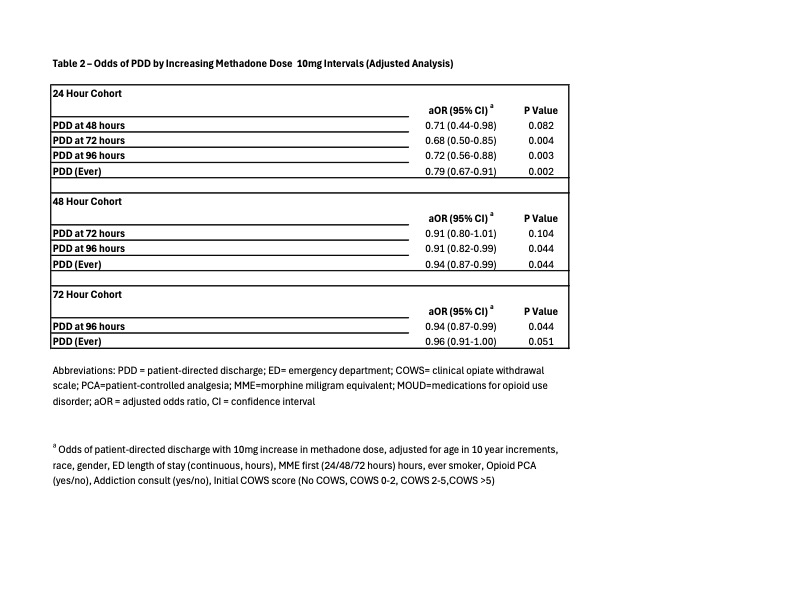
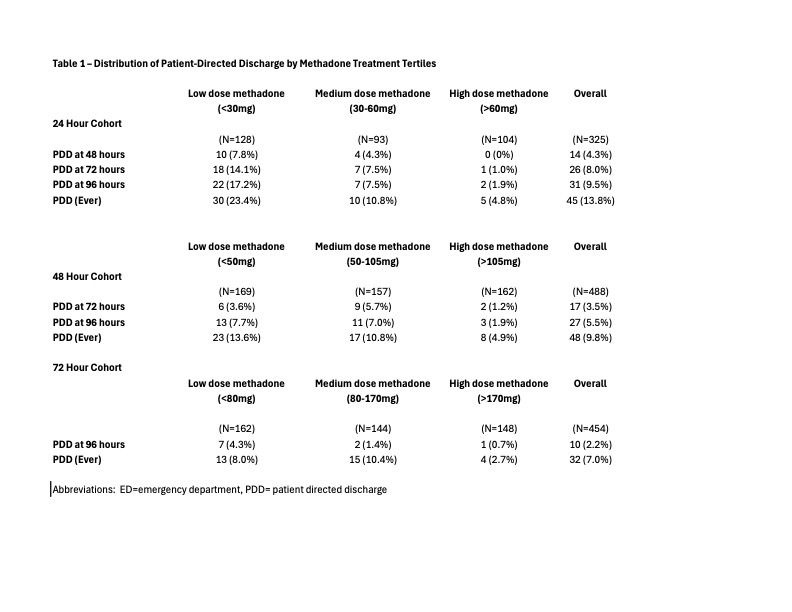
Results: Among 325 patients (56.6% male, median age 49 years) receiving methadone within 24 hours of presentation to the emergency department, the incidence of patient-directed discharge was 13.8%. In an adjusted logistic regression model, each additional 10mg of methadone in the first 24 hours was associated with 29% lower odds of patient-directed discharge (OR 0.71, 95% CI 0.44 to 0.98) at 48 hours. Results were similar for patient-directed discharge at 72 hours, 96 hours, or ever, and weaker but qualitatively similar for cumulative methadone dose at 48 and 72 hours. The results for the 24-hour, 48-hour, and 72-hour analytic groups are presented in Table 1. The results of the adjusted logistic regression are presented in table 2.
Conclusions: Previous studies have shown a general association of MOUD initiation with decreased odds of patient directed discharge. However, this is the first study to examine the impact of dose and timing of methadone on odds of patient-directed discharge. For every 10 mg increase in methadone received in first 24 hours of hospitalization, odds of patient-directed discharge decreased by nearly 29%. We therefore conclude that early, higher doses of methadone during the early phase of hospitalization may reduce patient-directed discharge in hospitalized patients with OUD.