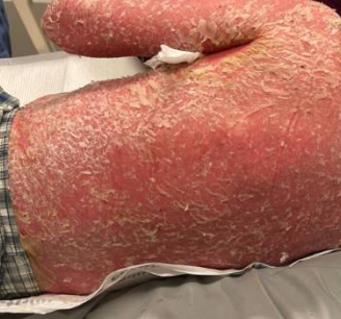
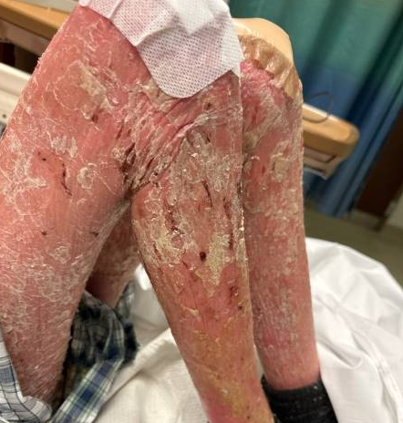
Case Presentation: Psoriasis is an inflammatory skin condition characterized by erythematous plaques often over extensor surfaces. There are multiple subtypes including the most severe form, erythrodermic psoriasis (EP), which usually presents with systemic pruritis, and pain accompanied by reddened exfoliation of the skin covering 90% or more of the body’s total surface area[1]. Complications can be life-threatening including disruption of thermoregulation and metabolic dysfunction[1,2]. There are numerous documented triggers including abrupt changes to steroid regimen or overuse of topical steroids, recent stressors or illnesses, and certain medications[3]. Here we present a case of suspected Bactrim-triggered EP.Patient is a 35-year-old male with pertinent past medical history of juvenile rheumatoid arthritis with contractures and psoriasis on oral prednisone. He was diagnosed with MRSA/MSSA bacteremia and was treated with Bactrim. A couple of days later, he presented with neck and axillary pain associated with globally erythematous skin with a positive Nikolsky sign. Infectious Disease (ID) was consulted for concern of staphylococcal scalded skin syndrome. The differential included possible staphylococcal infection with drainage vs recent use of Bactrim which triggered a severe episode of EP. Bactrim was promptly discontinued. The patient was started on intravenous antibiotics and IV steroids with marked improvement of his erythema and pain. A diagnosis of EP was confirmed by Dermatology and treatment with methotrexate and folate was initiated. The patient was transitioned to a slow taper of oral steroids with outpatient Dermatology follow up.
Discussion: Psoriasis is uncommon with an estimated prevalence of up to 5% worldwide and EP is among the rarest subtypes, accounting for less than 3% of these cases[4]. Broadly, the etiology of EP is the result of interactions between the environment, skin, and genetic and immunological data igniting a hyperproliferation of keratinocytes stimulated by T cell activation infiltrated into the skin[1,5]. Here, Bactrim was the environmental trigger in a high-risk patient with known rheumatologic and dermatologic history. There is at least one other documented case of Bactrim-induced EP[6].First-line EP treatments vary between facilities, mostly due to availability of agents and limited data but often include cyclosporin, infliximab, or methotrexate and progress to biologics as in our patient’s case[1,5,7]. Systemic steroids as treatment are generally not recommended and use in flares remains controversial[8]. However, there is anecdotal evidence which aligns with our patient’s clinical trajectory that short courses can be beneficial, particularly when used as combination therapy with immunosuppressants when cyclosporin and biologics cannot be used[8].
Conclusions: EP is a rare dermatologic emergency and medication regimens should be scrutinized for possible inciting agents, including Bactrim, in tandem with initiation of treatment.