Background: Ineffective communication between team members negatively impacts healthcare worker (HCW) well-being and contributes to approximately 25% of patient safety incidents. Despite its acknowledged importance within healthcare teams, interprofessional communication training is rarely part of academic clinical training or practice. We aimed to study the impact of an interprofessional communication training program on a high functioning team at a single academic medical center.
Methods: A hospitalist and palliative care led communication workshop included these communication tools: agenda setting, establishing rapport quickly, responding to emotions, delivering serious news, managing conflict, and identifying cultural frames of reference. The workshop was held in person with the medical center’s interprofessional Advanced Heart Failure team. Facilitation focused on positive feedback to foster a safe environment and allow shared vulnerability.The training included four instructional methods: interactive didactic sessions, partnered learning activities, high-fidelity skills practice, and deliberate feedback. This program evaluation utilized a mixed-methods approach to evaluate the impact of the training intervention. Quantitative data were collected through pre- and post-training surveys to assess changes in participants’ confidence in communication skills, self-reported skill use, safety climate, and psychological safety. Semi-structured qualitative interviews were conducted to explore participants’ experiences with the training and its perceived impact on their work environment.
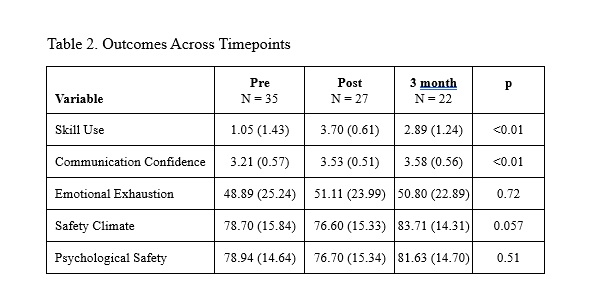
Results: Of the 80 team members who were invited to participate in the training, 40 attended. Of those, 40 (100%) completed at least one survey of the three survey timepoints (pre, post, and 3-month follow-up). Demographic data is listed in Table 1. Registered nurses (12/40, 30.0%) and other non-clinical roles (10/40, 25.0%) made up the largest groups by role. Only 2/13 (15.4%) of the physicians invited attended. There were nine qualitative interview participants which included: nurses (2/9, 22.2%), program coordinators (2/9, 22.2%), social work (1/9, 11.1%), medical assistants (2/9, 22.2%), and finance (2/9, 22.2%). Significant improvements were observed in all participants’ skill use (p< 0.01) and communication confidence (p< 0.01) across the measured timepoints (Table 2). No significant changes were observed in emotional exhaustion (p = .72), psychological safety (p = .51), or safety climate (p = .057), although the latter showed a trend toward improvement on the 3-month postsurvey (Table 2).Four themes emerged from the qualitative interview data: (1) Strong desire for interprofessional training (including presence of physician leaders), (2) Confidence and empowerment in team settings, (3) Limited impact on team dynamics, and (4) Feedback on training design and delivery.
Conclusions: This evaluation highlights the potential of targeted communication training to improve individual confidence and skill use among members of an interprofessional team in an academic medical center. Broader changes in team dynamics and psychological safety may require structural and cultural changes. Future training efforts should consider integrating follow-up sessions, ensuring presence of physician leaders, role-specific content, and strategies to address team-level communication challenges.
.jpg)