
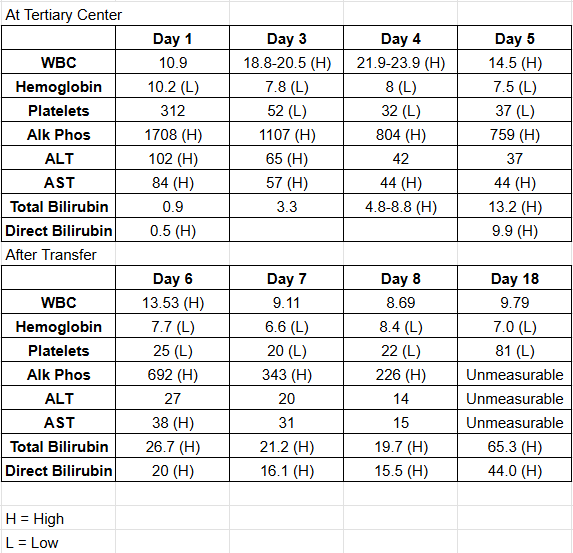
Case Presentation: 67 year-old female with coronary artery disease, hypertension, peripheral neuropathy, initially presented to a tertiary care center for initiation of treatment, and hematology/oncology evaluation; with newly confirmed adenocarcinoma of the duodenum and pancreatic head with metastasis. Stent placement was initially attempted prior to chemotherapy but was cancelled in the setting of severe and refractory thrombocytopenia. She received 3 units of platelets prior to transfer. Due to the rapid drop of platelets from >50 x109/L to 22 x109/L over 6 days, total bilirubin of 19.3 mg/dL with signs of hemolytic anemia on lab work, concerns for thrombotic thrombocytopenic purpura (TTP) was raised. Therapeutic plasma exchange (TPE) was emergently initiated. Peripheral smear showed schistocytes, but lab tests found normal ADAMTS13 levels. TPE was then stopped. Fibrinogen was 350 mg/dL, the D dimer unmeasurable due to icteric sample , HIT antibody negative, ruling out DIC or HIT. Her cytopenias persisted despite further blood products and workup was consistent with malignancy-induced Thrombotic Microangiopathy (TMA). Additionally, her bilirubin rose to a max of 65 mg/dL but her mental status remained intact without deficits. Due to indefinite transfusion dependence, hospice care was initiated per patient request; as she was not a candidate for chemotherapy.
Discussion: TMA is a term for a group of distinct disorders defined by microangiopathic hemolytic anemia (MAHA), thrombocytopenia, and microvascular thrombosis. TTP specifically is a rare hematologic emergency needing hematology evaluation and consideration for TPE, as mortality approaches 90% without treatment. Complement-mediated TTP is also a time sensitive diagnosis, as anti-complement therapy can mitigate risk of renal failure and neurocognitive impairment.TTP involves impairment of ADAMTS13 enzyme activity; which cleaves von willebrand factor (VWF). Without this cleavage, VWF accumulates in microvasculature, causing platelet activation and thrombus formation. This results in ischemia and shearing of red blood cells causing hemolytic anemia and thrombocytopenia due to the consumption of platelets. TPE is first line treatment for acute TTP to reduce circulating VWF. This generally requires 5-10 days of consecutive treatment while considering immunosuppressive or monoclonal antibody therapy. Therapy can be stopped once thrombocytopenia and ADAMTS13 activity have improved.Our patient’s ADAMTS13 activity level was normal and her TMA was likely due to her underlying untreated malignancy. Cancer-associated TMA is most commonly associated with metastatic solid tumors; adenocarcinomas often being implicated. The proposed mechanism involves microvascular metastases activating the clotting cascade and producing shearing independent of ADAMTS13 deficiency. For those with neurologic symptoms, rapid reversal is usually seen with a rise in platelet count over 3-4 days. This condition has high mortality; with a relapse rate of 30-60% over months to years and overall mortality of 15-20%.
Conclusions: Rapid drop in platelet count along with evidence of a hemolytic anemia warrants hematology evaluation for consideration of empiric treatment for TTP. These disease states can rapidly progress to multi-organ failure and death without treatment. If lab work and clinical evaluation ultimately rule out these conditions, TPE can be stopped. Our case highlights the clinically challenging presentation of cancer-associated TMA.
.png)