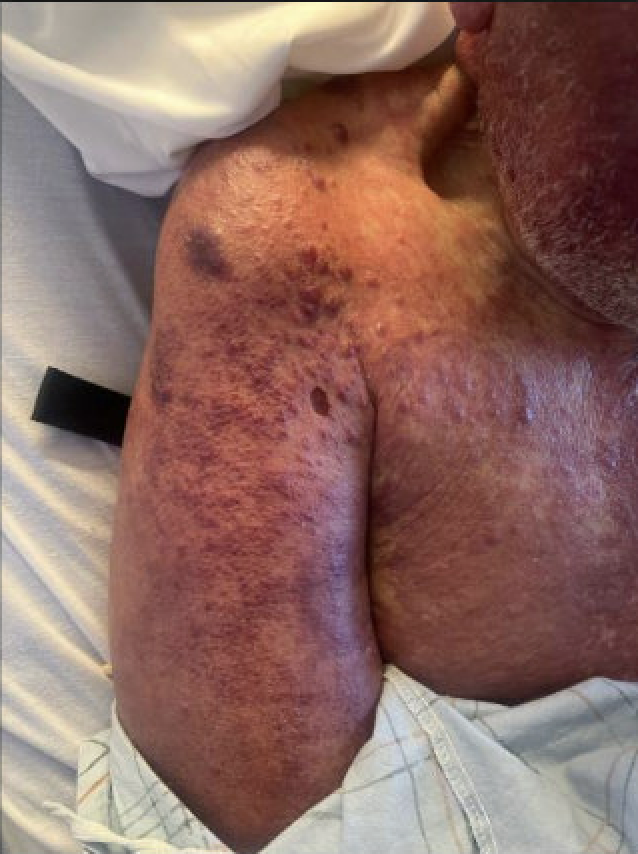
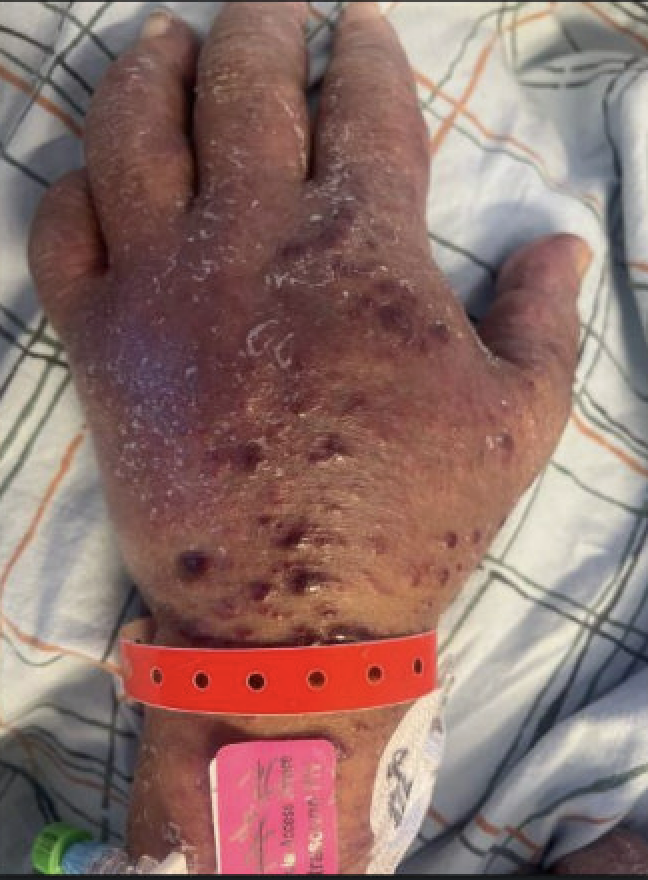
Case Presentation: An 83-year-old man with cerebrovascular disease, chronic kidney disease, and type 2 diabetes mellitus presented with altered mental status, characterized by three days of increasing somnolence. Five days earlier, he was started on levofloxacin for a cough and subsequently developed a diffuse maculopapular rash involving the trunk and extremities. A similar but milder rash had occurred after prior levofloxacin exposure one month earlier, raising concern for a drug reaction.On admission, he was febrile, hypotensive, and had no focal neurologic deficits. Initial labs showed hemoglobin of 7.9 g/dL, thrombocytopenia, creatinine of 4.82 mg/dL, and calcium of 15.7 mg/dL. These findings raised concern for multiple myeloma, while the rash was attributed to possible antibiotic hypersensitivity. Hypercalcemia was refractory to IV fluids and calcitonin, prompting initiation of denosumab. Anemia worsened, requiring two transfusions.A bone marrow biopsy was performed but showed no evidence of plasma cell dyscrasia. As the patient’s condition declined, manual differential review revealed abnormal lymphocytes with cerebriform nuclei. HTLV-1 PCR returned positive, and flow cytometry identified a clonal T-cell population. Dermatology re-evaluated the rash in the setting of new facial swelling, recommended systemic steroids, and obtained skin biopsies. The final diagnosis was adult T-cell leukemia/lymphoma (ATLL) with cutaneous involvement.
Discussion: This case highlights how cutaneous T-cell neoplasms may initially be misdiagnosed as drug reactions or infections. The patient’s presentation initiated a dual diagnostic pathway: the diffuse rash in the setting of recent levofloxacin exposure raised concern for a hypersensitivity reaction, while concurrent hypercalcemia, renal dysfunction, and anemia suggested multiple myeloma. These two working diagnoses, antibiotic-induced rash and plasma cell dyscrasia, each provided a plausible explanation, reinforcing anchoring bias and delaying recognition of the underlying malignancy.Adult T-cell leukemia/lymphoma (ATLL) is a rare T-cell malignancy caused by HTLV-1, a retrovirus endemic to parts of the Caribbean, Japan, and West Africa. Although most infected individuals remain asymptomatic, a small percentage develop ATLL after decades of latency. Hypercalcemia in ATLL results from RANKL-mediated osteoclast activation, closely mimicking the pathophysiology of myeloma.In this case, the turning point was the identification of atypical cerebriform lymphocytes on manual differential, prompting a shift in diagnostic focus. Peripheral smear interpretation remains a vital, underused tool in hospital medicine. A hypothesis-driven approach, input from consulting services, and flexibility in diagnostic thinking enabled the team to identify a rare malignancy masked by a common presentation. Hospitalists are often the first to encounter undifferentiated syndromes like this, and must remain vigilant for atypical features when classic illness scripts fail.
Conclusions: ATLL can present with overlapping features of both infectious syndromes and drug hypersensitivity reactions, leading to diagnostic delay. Hospitalists should consider cutaneous T-cell neoplasms in the differential when patients present with rash and systemic abnormalities unresponsive to conventional therapies. Broadening diagnostic thinking beyond common illness scripts remains critical for accurate and timely diagnosis.