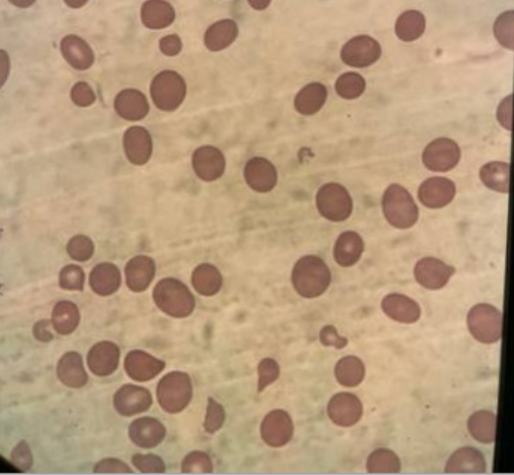
Case Presentation: A 40-year-old woman reported six weeks of progressive fatigue and dyspnea. She had a history of severe anemia of unclear etiology despite an extensive workup ten years earlier. She was referred to the emergency department after outpatient labs found a hemoglobin of 5.5 g/dL (hemoglobin 10 g/dL two months earlier). On arrival, she was tachypneic and tachycardic without neurologic deficits, gait abnormalities, or signs of bleeding. Blood work revealed macrocytic anemia with hemoglobin 5.5 g/dL and MCV 121 fL, thrombocytopenia with platelets 79 ×10³/µL, and inadequate bone marrow response (reticulocyte count 5.3%, reticulocyte index 1.1). Hemolysis markers were notable for LDH 6,483 U/L, haptoglobin < 8, and mildly elevated indirect bilirubin, while coagulation studies showed elevated D-dimer of 11.31 µg/mL with normal fibrinogen level. Peripheral smear showed macrocytosis, slight schistocytes and moderate tear drop cells. The combination of hemolysis, thrombocytopenia, and schistocytes raised concern for a type of thrombotic microangiopathy known as thrombotic thrombocytopenic purpura (TTP), prompting urgent hematology consultation. The PLASMIC score was 5 (intermediate risk for TTP); however, several features were atypical for TTP, notably the undetectable B12 level, markedly elevated LDH disproportionate to the degree of thrombocytopenia, and inadequate marrow response. These findings pointed toward pseudo-thrombotic microangiopathy (pseudo-TMA), an uncommon manifestation of severe B12 deficiency. Further evaluation confirmed B12 deficiency with elevated homocysteine and methylmalonic acid, and positive intrinsic factor and anti–parietal cell antibodies, consistent with pernicious anemia.Her hemoglobin appropriately responded to transfusion; her tachypnea and tachycardia resolved, and intramuscular vitamin B12 was given. By day three, laboratory values improved with vitamin B12 replacement: platelets increased to 115 × 10³/µL, LDH decreased to 3,696 U/L, and the reticulocyte index rose to 4.4. She was discharged with follow up for routine intramuscular B12 supplementation. After discharge, ADAMTS13 activity resulted normal, definitively excluding TTP.
Discussion: Pseudo-TMA is an uncommon but important manifestation of severe vitamin B12 deficiency, occurring in approximately 2.5% of patients with B12 deficiency [1]. It closely mimics TTP due to the presence of hemolytic anemia, thrombocytopenia, and slight schistocytes. However, several laboratory features help differentiate pseudo-TMA from true TTP. Ineffective erythropoiesis and intramedullary hemolysis in B12 deficiency result in markedly elevated LDH levels and reticulocytopenia, findings that are typically absent or less prominent in TTP. In this case, the combination of undetectable B12, very high LDH, and inadequate reticulocyte response supported pseudo-TMA, leading to appropriate deferral of plasma exchange and initiation of vitamin B12 therapy.
Conclusions: Pseudo-TMA should be considered in patients presenting with macrocytic anemia, thrombocytopenia, and evidence of hemolysis, particularly when LDH is significantly elevated and the reticulocyte response is low. Early recognition allows for prompt and effective treatment with vitamin B12 while preventing unnecessary, invasive, and potentially harmful plasma exchange therapy. This case highlights the importance of distinguishing pseudo-TMA from true TTP to reduce healthcare utilization and improve patient outcomes.