Background: Point of Care Ultrasound (POCUS) is a growing field with an evidence-base across most clinical specialties. National surveys have shown student, resident, and fellowship training opportunities are increasing, but report lack of experience faculty as the primary barrier to POCUS use. The most effective faculty training programs include longitudinal training and mentorship. Unfortunately, few such opportunities exist, and most are sponsored by specialty societies which can limit their accessibility. Despite the siloing of POCUS education by specialty, basic POCUS training is similar across a wide range of clinical practice.
Purpose: We aimed to assess the need for POCUS faculty training across the School of Medicine (SOM) and to utilize local POCUS expertise to develop a novel multidisciplinary training program.
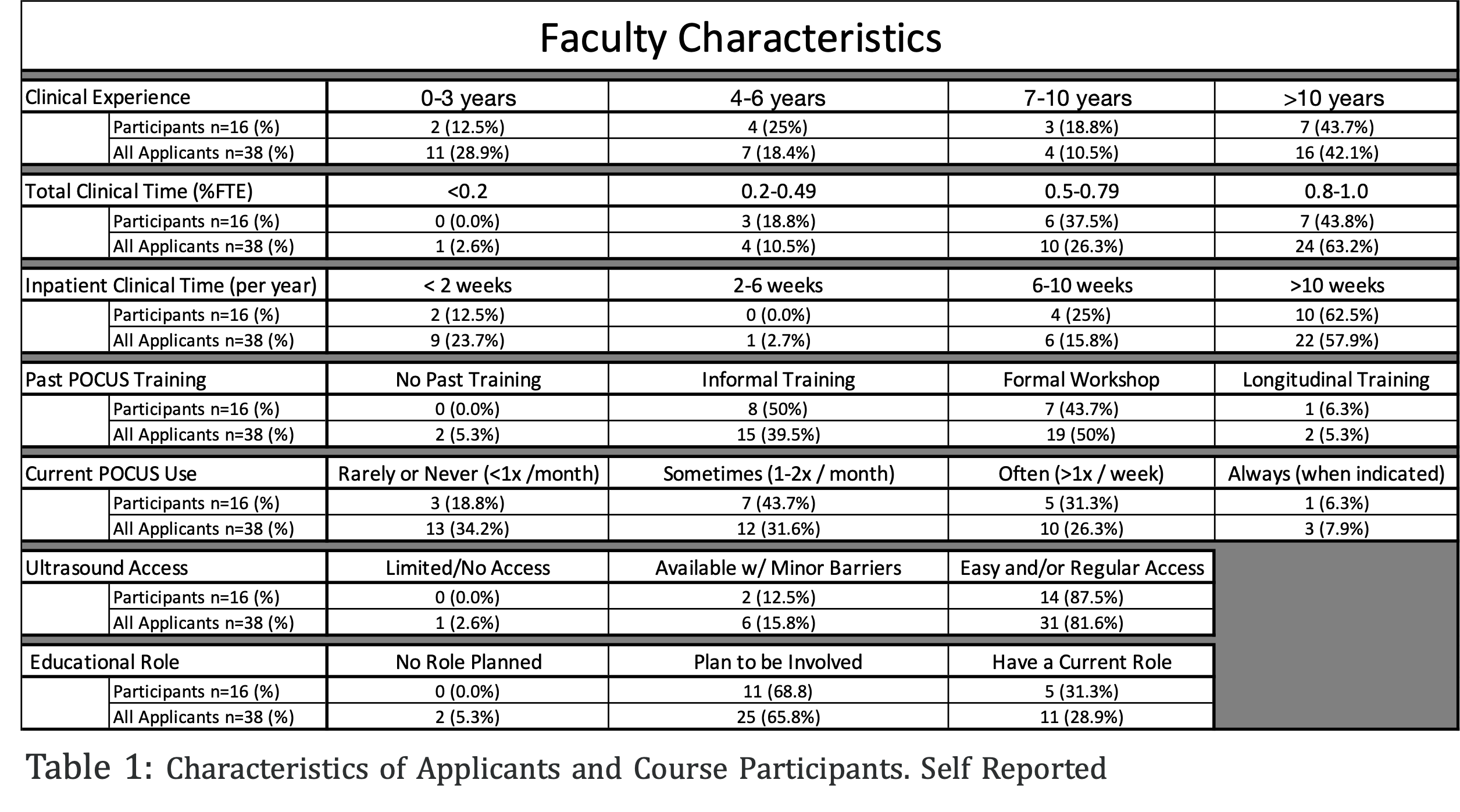
Description: We surveyed 188 faculty across 14 subspecialties for interest in longitudinal POCUS training with 167 (88.8%) faculty reporting being likely/highly likely to enroll. With this robust interest, we developed a curriculum and engaged the SOM, Office of Faculty Development, and our Simulation Center, to support this endeavor.We proposed our curriculum to the Faculty Development Office, who supported a 0.2 Clinical FTE (0.15 Director, 0.05 Assistant Director) funding request to the SOM. Additionally, Faculty Development supplies administrative support, and the Simulation Center supports the course with space and standardized patients. With their support we launched the first POCUS Champions Course. Interested faculty were required to apply with a letter of support from their Chair indicating their effort would be protected.Over the 10-month course, learners meet for weekly, 2-hour sessions. The curriculum is a mix of virtual didactics, hands-on workshops, supervised clinical scanning, and image review (Figure 1). The didactics transition from image acquisition/interpretation to clinical integration with time. The learners are required to 1) attend 75% of sessions 2) pass a knowledge and hands on skills assessment and 3) complete an image portfolio. A certificate, CME/MOC credit, and POCUS privileges are awarded at completion. To deliver the curriculum, core faculty include two directors (Hospital Medicine and Anesthesia/Critical Care) and contributing faculty in Hospital Medicine (4), Family Medicine, Anesthesia (1), and Emergency Medicine (1). We are monitoring completion of certification, POCUS privileges, ongoing POCUS use, revenue, and educational contribution of faculty as measures of success.We received 38 applications with 16 faculty included in the initial cohort spanning Emergency Medicine, General Internal Medicine, Hospital Medicine, Family Medicine, Nephrology, Critical Care, Anesthesia, Pediatrics, and Surgery. There was wide agreement in which POCUS indications applicants wanted to learn with Cardiac, Lung, Assessment of Free Fluid, and Vascular being the most common, in that order. TABLE 1 shows additional faculty characteristics.
Conclusions: Our multidisciplinary approach with institution wide support allowed us to navigate many common hurdles in faculty training. First, we engaged stakeholders across the SOM to leverage institutional resources. With this broader support, we also received investment from the Simulation Center, and ability protect faculty effort. We hope this program can be an innovative model to address a key bottleneck that has hindered POCUS adoption, especially for specialties where local champions may not exist.