Background: Teaching complex topics, such as hyponatremia, requires simultaneous processing of multiple interconnected concepts. Traditional teaching methods like small and large group lectures may overwhelm learners, making innovative tools necessary to manage cognitive load. Serious games, designed with a primary purpose beyond entertainment—to teach, train, or assess students in a structured, engaging way designed for educational purposes, provide a promising approach to enhance learning through interactive and engaging methods (1). A serious card game, Hyponatremia-Uno, was developed to explore its potential as a teaching tool.
Purpose: This study aimed to evaluate the effectiveness of a serious game for simplifying complex medical topics, using hyponatremia as a case study. The intervention applied chunking and randomization principles to enhance schema development while fostering active learning through structured gameplay leading to formation of robust mental schemas (2).
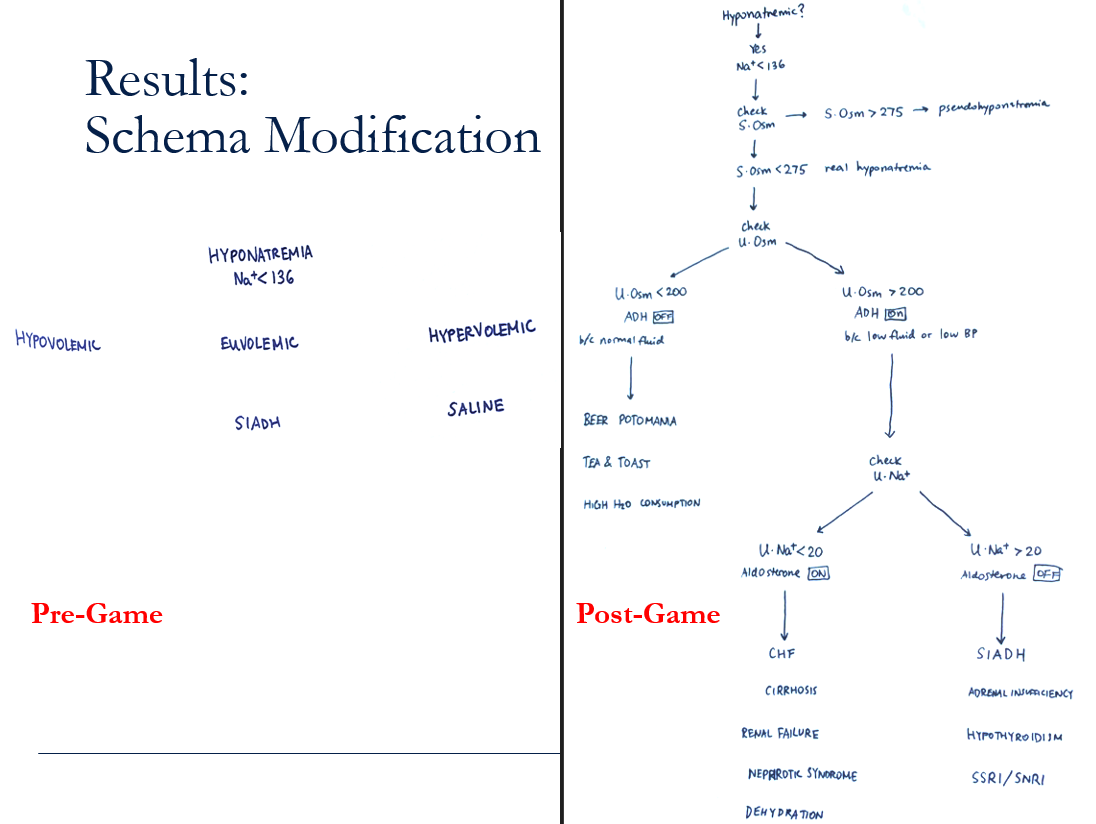
Description: Description The development of Hyponatremia-Uno began with a literature review of US and European guidelines for managing hyponatremia to identify its critical components. These components were chunked into cards representing lab values, diagnoses, and treatments, with accompanying instructions for facilitators and learners. The game used the familiar UNO format to introduce controlled randomization. The game was piloted by attendings on the medical wards team with learners with mixed expertise (residents, interns, and students) after rounds or during afternoon didactics if the team had patients with hyponatremia. Learners first created pre-game schemas to activate prior knowledge. A ten-minute chalk-talk on hormonal sodium regulation followed, to address proactive interference. The game was then played in two rounds: the first collaborative round promoted clarification and cognitive congruence, while the second competitive round encouraged self-directed learning through trial and error. Post-game, participants created concept maps to consolidate and reflect on their learning (3). Across three pilot sessions with 10 participants, learners demonstrated robust schema development. All participant’s reported game was fun and helped clarify concepts.
Conclusions: Hyponatremia-Uno proved to be an effective teaching tool rooted in social constructivism, as advocated by Piaget, promoting discovery learning and schema construction. Additionally, the game incorporated Vygotsky’s principles of scaffolding and social interaction, enabling learners to collaboratively navigate complex concepts. While promising, the study was limited by a small sample size, unclear contributions of chalk-talk, and the absence of long-term retention data. As next steps, future research should replicate this intervention with a larger cohort to evaluate its generalizability and impact on retention. The framework can also be adapted for teaching other complex medical topics, providing a versatile tool for medical educators.